Your State's Grid
Backup Power for Pacific Northwest Windstorms and Ice
Seattle and Portland outages are November windstorms and January ice — under a sky that makes solar nearly useless for four months. Here is what that means for what you buy.
We earn a commission on purchases made through links on this page, at no extra cost to you. How this works.

What's in this article
Mid-January 2024. An ice storm coated Portland and the Gorge, trees came down across the metro, and PGE customers were dark for days in single-digit temperatures. verify Two months earlier the usual November windstorms had done the same thing across Puget Sound.
The Northwest problem is the calendar. The outage season and the dark season are the same season.
Why the Northwest is its own problem
Trees. The region's distribution grid runs through Douglas fir and cedar, and saturated winter ground lets whole trees uproot in wind. Puget Sound Energy, Seattle City Light, PGE and Pacific Power all fight the same enemy every winter.
Grey sky for four months. Seattle and Portland see very little useful sun between November and February. A solar panel that refills a battery beautifully in July produces a trickle in December — and December is when the power goes out.
Heat pumps. The Northwest converted to heat pumps early and widely. A heat pump is the heat, and it draws far more than any portable battery can supply. Households that assume "backup power" means "warm house" find out otherwise.
Two regions, two problems. West of the Cascades is wind and rain. East of them — Spokane, Bend, the Gorge — is ice, real cold, and increasingly wildfire shutoffs in late summer.
Recharging is the whole question
Ask what refills the battery in a week of grey weather with the grid down. The honest answers, in order:
1. The car. A 12V adapter refills a mid-size unit slowly and reliably in any weather. This is the Northwest winter recharge. Engine running, always.
2. A neighbour or a relative with power. Outages here are patchy. Someone three streets over often has power, and an hour on their wall outlet is a full charge.
3. Panels, in summer only. Buy them for the wildfire season east of the mountains, or for camping. Do not plan a January around them.
| Appliance | EcoFlow DELTA 21,024 Wh | Anker SOLIX C10001,056 Wh | Bluetti AC200L2,048 Wh |
|---|---|---|---|
| Full-size refrigerator~150W running, cycles ~35% of the time | 17 hr | 17 hr | 33 hr |
| Gas furnace blower~400W running, cycles ~40% of the time | 5.4 hr | 5.6 hr | 11 hr |
| Wi-Fi router + modem~20W running | 44 hr | 45 hr | 87 hr |
| LED lights (whole room)~40W running | 22 hr | 22 hr | 44 hr |
Heat, honestly
Gas furnace: power the blower. A few hundred watts cycling heats the whole house, and a 1,000Wh unit carries it for a long time. Needs a transfer switch and an electrician. The details.
Heat pump only: a battery will not heat the house. One closed room, layers, an electric blanket — which genuinely works on a battery — and a warm place to go if it runs long.
Wood stove: the Northwest answer that needs no electricity at all. If you have one, keep it serviced and stocked. The battery covers everything else.
What we'd buy, by situation
Seattle, Tacoma, Portland metro
A 1,000Wh unit, left plugged in. The EcoFlow DELTA 2 or Anker SOLIX C1000. Metro outages are usually a day; this covers fridge, internet, phones and lights, and refills from the car if it runs long.
Kitsap, the Peninsula, the Gorge, the foothills
2,000Wh class and a car adapter. The Bluetti AC200L. Multi-day outages are normal once you are off the dense grid, and the extra capacity means a grey week does not empty you.
East of the Cascades
Same as above, plus real cold-weather storage discipline — the battery lives indoors, not in the shop. And if you are in a wildfire shutoff zone, panels earn their keep in August.
What not to buy in the Northwest
Panels as a winter plan. They will sit under grey sky exactly when you need them.
A battery for the heat pump. It will not run it. Buy for the fridge and the internet, and plan heat separately.
A unit stored in the garage. Northwest garages are cold and damp. Lithium does not charge below freezing, and it may not respond when you need it.
The free things, which matter most
Trim the trees you own. Most Northwest outages start with a branch. Your own trees over your own service line are the ones you can do something about.
Know which side of the Cascades your plan is for. Wind and rain west, ice and fire east. Prepare for yours.
Keep the car above half a tank all winter. It is your generator.
The picks, in detail
Specs come from data/products.json, so they're the same everywhere on this site.
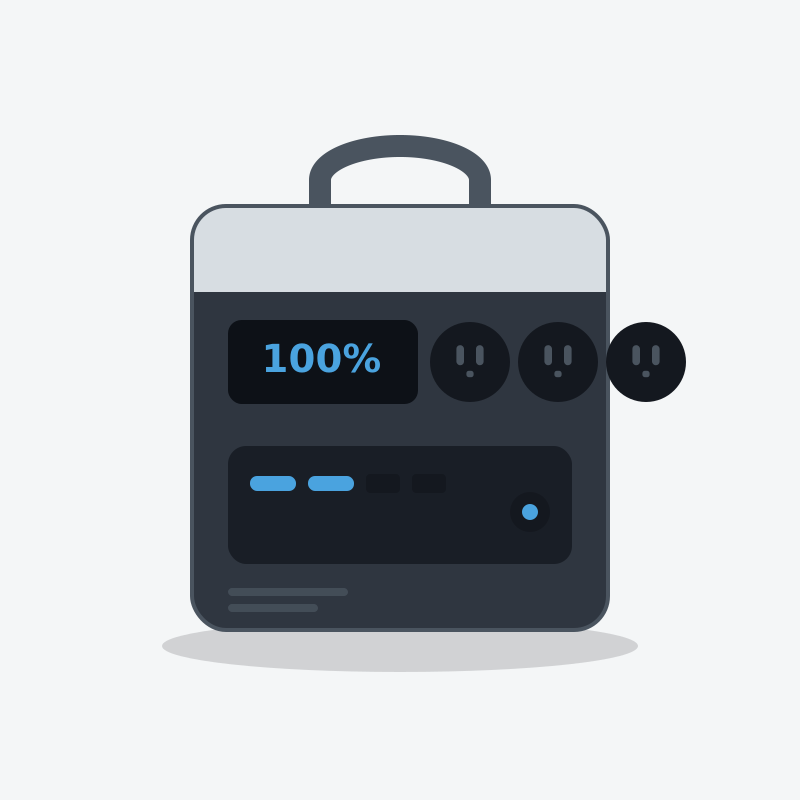
EcoFlow
EcoFlow DELTA 2
The one most people should buy. It refills fast enough that a short sunny break between storm bands actually matters.
- Capacity
- 1,024 Wh
- AC output
- 1,800W
- Weight
- 27 lb
What's good
- Wall recharge is genuinely quick — useful when power flickers back for an hour
- LiFePO4 cells, so it tolerates being left plugged in for years
- Six AC outlets means no daisy-chained power strips on the kitchen counter
- Add an extra battery later instead of buying a whole second unit
What's annoying
- The fan is audible in a quiet bedroom at night
- 1800W ceiling rules out most space heaters and hair dryers
- Expansion batteries cost nearly as much as the unit itself
Who this is wrong for
Anyone who needs to power a well pump, an electric water heater or a central AC. It will not start them, and it is not a whole-home unit.
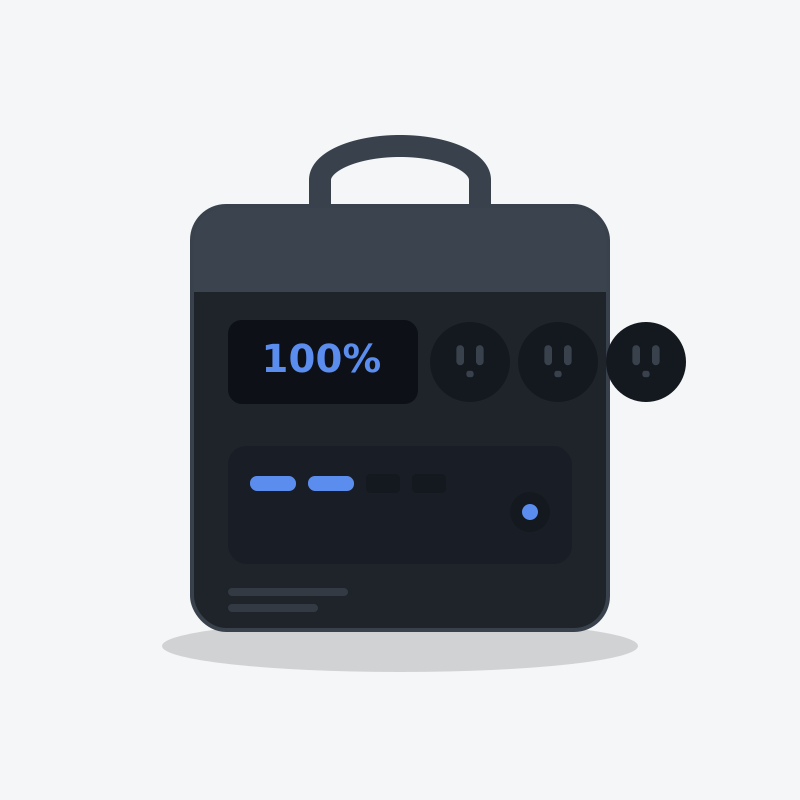
Anker
Anker SOLIX C1000
The best-built 1kWh unit on the market, and the one that fits an RV bay without a shoehorn.
- Capacity
- 1,056 Wh
- AC output
- 1,800W
- Weight
- 28.44 lb
What's good
- The most compact 1kWh box here — it genuinely fits where others don't
- Anker's warranty service is the least painful in this category
- Full wall recharge in under an hour
- Quiet fan behaviour under moderate load
What's annoying
- Expansion battery caps you at about 2,112Wh and is expensive
- Fewer solar input options than EcoFlow
- Anker discounts less often, so you rarely catch a deep sale
Who this is wrong for
People who need to run more than 1800W. And it won't grow with you — expansion is limited.

Bluetti
Bluetti AC200L
Specs unverifiedA lot of battery for the money, with the port selection of a small workshop.
- Capacity
- 2,048 Wh
- AC output
- 2,400W
- Weight
- 61.9 lb
What's good
- Expandable, unlike most Bluetti units at this size
- A genuinely useful spread of ports including a 30A RV outlet
- Fast recharge for a 2kWh unit
What's annoying
- Shorter warranty than EcoFlow and Jackery offer
- Big and awkward to store
- Bluetti's US service turnaround has been inconsistent
Who this is wrong for
Small apartments. It's physically large and you will trip over it.
Questions people actually ask
What causes most power outages in Washington and Oregon?
Are solar panels useful for backup in the Pacific Northwest?
Do heat pumps work during an outage?
How long do PSE and PGE outages last?
Why does the Pacific Northwest lose power in winter more than summer?
Who wrote this
Dhruvil Domadiya
Founder and editor, GreenCommuteGuide
I started GreenCommuteGuide because backup power is sold with numbers that sound impressive and mean very little — watt-hours on the box, surge ratings that turn out to be a boost mode, charge times quoted to 80% and printed as though they were full. I set the rules this site runs on: every spec is checked against the manufacturer's own documentation, anything we have not verified is marked as unverified on the page rather than quietly published, prices are never shown because they go stale, and every review names at least one product not to buy and who it is wrong for. Where I have not tested something myself, the page says so.
- · Sets and enforces the editorial standards on this site — unverified claims are flagged on the page, and the build fails if they are not
- · Specs are taken from manufacturers' own published documentation, never from retailer listings, and the source and date are recorded for each product
- · No payment is accepted for a rating, a ranking, or a positive verdict
Read this next
- Battery & Tech BasicsHow Long Does It Take to Charge a Power Station from a Car?Slow, unglamorous, and it has rescued more outages than solar has. Real times, what it costs in fuel, and the mistake that leaves you with two dead batteries.
- Run This ApplianceCan a Solar Generator Run a Gas Furnace?Yes, and it is the single best trade in backup power. Your gas furnace already makes the heat — the battery only has to spin the fan.
- Run This ApplianceCan a Power Station Run Starlink? (And For How Long)Yes, easily — and unlike cable internet, Starlink keeps working when your whole town is dark. That is the part worth understanding.
- Battery & Tech BasicsHow to Store a Power Station Over Winter (Without Wrecking It)Store it at about half charge, indoors, and never charge it while it is below freezing. That last one destroys batteries permanently and almost nobody knows it.