Your State's Grid
Backup Power for New England Nor'easters: The Oil Heat Problem
Half of New England heats with oil or propane, and both need electricity to run. That one fact should decide what you buy — and it is the fact most national advice misses.
We earn a commission on purchases made through links on this page, at no extra cost to you. How this works.

What's in this article
The October 2011 snowstorm dropped heavy wet snow on trees that still had their leaves. Limbs came down across the whole region, and parts of Connecticut and Massachusetts were dark for more than a week. verify
New England outages are winter outages, and winter in New England means the question is not food. It is heat.
Why New England is its own problem
A very large share of the region heats with oil or propane. This is unusual — most of the country is gas or electric. And it changes everything, because an oil or propane furnace makes its own heat but cannot run without electricity. The burner, the fuel pump, the circulator, the blower and the controls all need power. verify
Lose the grid in January and a house full of heating oil goes cold. That is the failure mode, and it is entirely fixable with a modest battery.
Long rural lines through forest. Northern New England has some of the longest, most tree-lined distribution lines in the country. Every heavy snow and every ice storm brings something down on them, and Eversource, National Grid and CMP restore the dense areas first.
Wet snow on leafed trees. The autumn nor'easter that arrives before the leaves drop is the classic New England outage. The weight is enormous and the damage is everywhere at once.
The one thing to get right
If you heat with oil or propane, power the furnace.
The load is small. A typical oil burner, pump and blower together draw somewhere in the low hundreds of watts, cycling rather than continuous. verify A boiler with a circulator pump often draws even less. A 1,000Wh unit carries that for hours and heats the whole house — not one room, the whole thing.
This is the best return on backup power available anywhere in the country, and it is specific to how this region heats. The full arithmetic and the wiring reality.
| Appliance | EcoFlow DELTA 21,024 Wh | Anker SOLIX C10001,056 Wh | Bluetti AC200L2,048 Wh |
|---|---|---|---|
| Gas furnace blower~400W running, cycles ~40% of the time | 5.4 hr | 5.6 hr | 11 hr |
| Full-size refrigerator~150W running, cycles ~35% of the time | 17 hr | 17 hr | 33 hr |
| Wi-Fi router + modem~20W running | 44 hr | 45 hr | 87 hr |
| LED lights (whole room)~40W running | 22 hr | 22 hr | 44 hr |
The furnace blower row is the one that matters. Everything else on that list is cheap by comparison.
If you have a heat pump
Be honest early. A heat pump is the heat — electricity in, warmth out, thousands of watts. No portable battery runs one for a night.
If you have converted and want outage heat, the choices are keeping the old oil system as backup, a wood or pellet stove, or one room and an electric blanket. The blanket is the one that runs on a battery, and it works far better than people expect.
Cold, and what it does to the battery
Lithium packs will not charge below freezing and give less capacity in the cold. A unit stored in an unheated garage or mudroom can be dead weight on the morning you need it.
Keep it indoors, plugged in. That is the whole rule, and it matters more in Maine than in Florida. How to store it properly through a New England winter.
What we'd buy, by situation
Suburban Boston, Hartford, Providence — oil or gas heat
A 1,000Wh unit and a transfer switch. The EcoFlow DELTA 2 or Anker SOLIX C1000 wired to the furnace keeps the house warm, the fridge cold and the phones charged through a two-day outage.
Rural New Hampshire, Vermont, Maine — long lines, week-long restorations
2,000Wh class. The Bluetti AC200L gives margin for the week that rural restoration can take. Pair it with a car charging adapter, because December sky does nothing for a solar panel.
A camp or second home closed for winter
Nothing installed. Drain the pipes and leave it. A battery in an unheated building through a Vermont winter is a battery you will replace.
What not to buy in New England
Solar panels as your winter recharge. Short days, low sun, snow on the glass. A car adapter is the honest answer from November to March.
Electric space heaters. A 1,500W heater empties a 1,000Wh unit in under an hour. Power the furnace instead — it heats the whole house on a fraction of the draw.
A unit that lives in the garage. See above. Indoors or it is not a plan.
The free things, which matter most
Get the furnace wired before the first storm. The electrician is booked solid the week after.
Fill the oil tank in autumn. A furnace on battery power still needs fuel, and delivery trucks do not run on impassable roads.
Know your utility's outage map. Eversource, National Grid, CMP and Green Mountain Power all publish restoration estimates, and they tell you whether to stay or go to a relative.
Keep a wood stove serviced if you have one. It is the only heat that needs nothing at all.
The picks, in detail
Specs come from data/products.json, so they're the same everywhere on this site.
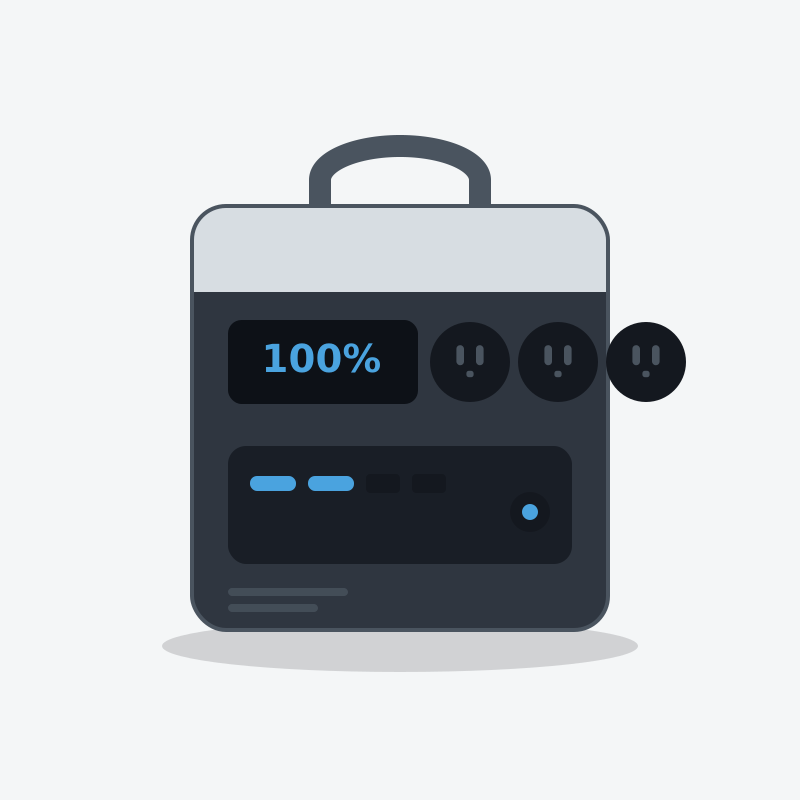
EcoFlow
EcoFlow DELTA 2
The one most people should buy. It refills fast enough that a short sunny break between storm bands actually matters.
- Capacity
- 1,024 Wh
- AC output
- 1,800W
- Weight
- 27 lb
What's good
- Wall recharge is genuinely quick — useful when power flickers back for an hour
- LiFePO4 cells, so it tolerates being left plugged in for years
- Six AC outlets means no daisy-chained power strips on the kitchen counter
- Add an extra battery later instead of buying a whole second unit
What's annoying
- The fan is audible in a quiet bedroom at night
- 1800W ceiling rules out most space heaters and hair dryers
- Expansion batteries cost nearly as much as the unit itself
Who this is wrong for
Anyone who needs to power a well pump, an electric water heater or a central AC. It will not start them, and it is not a whole-home unit.
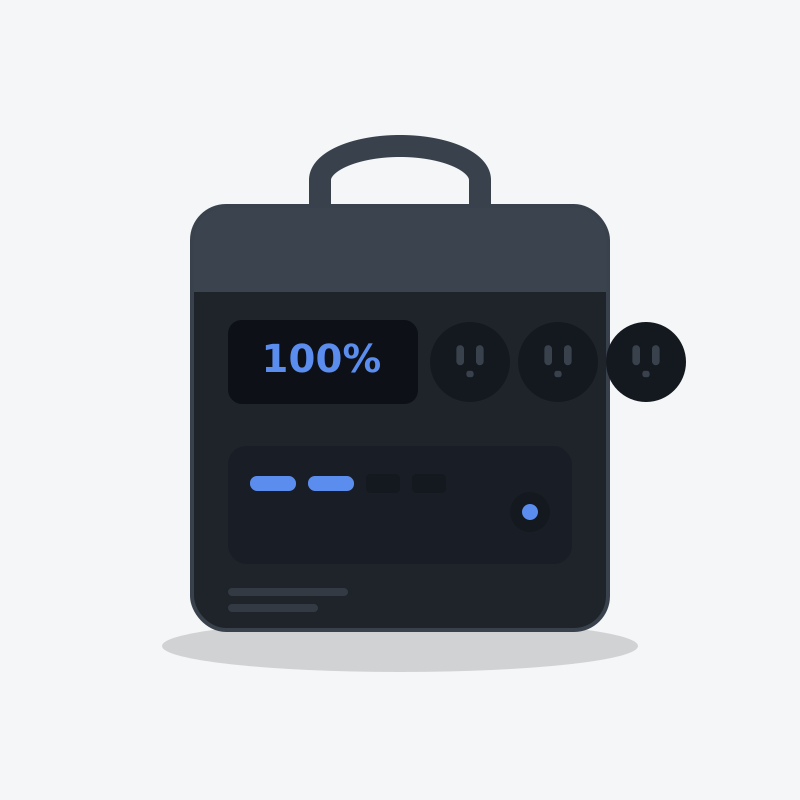
Anker
Anker SOLIX C1000
The best-built 1kWh unit on the market, and the one that fits an RV bay without a shoehorn.
- Capacity
- 1,056 Wh
- AC output
- 1,800W
- Weight
- 28.44 lb
What's good
- The most compact 1kWh box here — it genuinely fits where others don't
- Anker's warranty service is the least painful in this category
- Full wall recharge in under an hour
- Quiet fan behaviour under moderate load
What's annoying
- Expansion battery caps you at about 2,112Wh and is expensive
- Fewer solar input options than EcoFlow
- Anker discounts less often, so you rarely catch a deep sale
Who this is wrong for
People who need to run more than 1800W. And it won't grow with you — expansion is limited.

Bluetti
Bluetti AC200L
Specs unverifiedA lot of battery for the money, with the port selection of a small workshop.
- Capacity
- 2,048 Wh
- AC output
- 2,400W
- Weight
- 61.9 lb
What's good
- Expandable, unlike most Bluetti units at this size
- A genuinely useful spread of ports including a 30A RV outlet
- Fast recharge for a 2kWh unit
What's annoying
- Shorter warranty than EcoFlow and Jackery offer
- Big and awkward to store
- Bluetti's US service turnaround has been inconsistent
Who this is wrong for
Small apartments. It's physically large and you will trip over it.
Questions people actually ask
How long do nor'easter outages last in New England?
Will a power station run my oil furnace?
What about a boiler with baseboard radiators?
Do heat pumps work on a battery in New England?
Should I keep the battery in the garage over winter?
Who wrote this
Dhruvil Domadiya
Founder and editor, GreenCommuteGuide
I started GreenCommuteGuide because backup power is sold with numbers that sound impressive and mean very little — watt-hours on the box, surge ratings that turn out to be a boost mode, charge times quoted to 80% and printed as though they were full. I set the rules this site runs on: every spec is checked against the manufacturer's own documentation, anything we have not verified is marked as unverified on the page rather than quietly published, prices are never shown because they go stale, and every review names at least one product not to buy and who it is wrong for. Where I have not tested something myself, the page says so.
- · Sets and enforces the editorial standards on this site — unverified claims are flagged on the page, and the build fails if they are not
- · Specs are taken from manufacturers' own published documentation, never from retailer listings, and the source and date are recorded for each product
- · No payment is accepted for a rating, a ranking, or a positive verdict
Read this next
- Run This ApplianceCan a Solar Generator Run a Gas Furnace?Yes, and it is the single best trade in backup power. Your gas furnace already makes the heat — the battery only has to spin the fan.
- Your State's GridMidwest Ice Storm Backup Power: Staying Warm When the Lines Come DownIf you have gas heat, one 400-watt load keeps your whole house warm. That single fact is worth more than any battery comparison.
- Run This ApplianceCan a Power Station Run an Electric Blanket?Yes, easily — and it is the one heating trick that actually works on a battery. Why 60 watts beats a 1,500W space heater when the power is out in winter.
- Battery & Tech BasicsHow to Store a Power Station Over Winter (Without Wrecking It)Store it at about half charge, indoors, and never charge it while it is below freezing. That last one destroys batteries permanently and almost nobody knows it.