Home Outage & Backup
Is Backfeeding Your House Illegal?
Yes, in every US jurisdiction — and the reason is not bureaucratic. It is the lineman working on the pole outside your house. Here is what to do instead.
We earn a commission on purchases made through links on this page, at no extra cost to you. How this works.
What's in this article
What backfeeding actually is
Someone runs a cord from a generator to a dryer or range outlet, flips the main breaker off, and the house has power. It works. That is the problem — it works well enough that people keep doing it.
The cord involved has male plugs on both ends. While one end is in the running generator, the other end's prongs are live and exposed. Electricians call it a suicide cord and the name is not hyperbole.
Why it kills people who are not you
This is the part that changes minds, so it is worth being concrete.
Your home's service runs through a transformer on a pole or a pad outside. Its job is to step utility voltage down to the 240V that enters your house.
Transformers work in both directions. Push 240V backwards into it and it steps that up — to several thousand volts on the distribution line outside.
It also endangers your neighbours — everyone on the same transformer gets a partial, unregulated feed — and it can start a fire in your own panel when the grid comes back out of phase with your generator.
"But I turn the main breaker off"
The most common defence, and it fails for two reasons.
It depends on you being right every time. Under stress, in the dark, at 3am, in an emergency you have never rehearsed. One forgotten step and the consequence lands on someone else.
It depends on the breaker. A main breaker is a switch, not a lockout. Breakers fail, weld, get bumped, or get flipped back by another member of the household who does not know what you did outside.
A transfer switch or interlock removes the human entirely. It is physically impossible for both sources to be connected — not procedurally discouraged, mechanically prevented. That is the whole difference.
What it costs you beyond the danger
Homeowner insurance. A fire traced to an unpermitted generator connection is a straightforward denial. You will have paid premiums for years and get nothing.
Liability. If a lineman is injured, you are not looking at a code violation. You are looking at criminal charges and a civil suit that insurance will not cover.
Selling the house. Any competent inspector spots a backfeed outlet, and it becomes a condition of sale.
Utility action. Many utilities may disconnect service, and some pursue costs.
The legal ways, cheapest first
| Option | What it does | Roughly |
|---|---|---|
| Extension cords to appliances | No panel connection at all. Completely legal, no electrician. | Free |
| Interlock kit | A metal plate that makes it mechanically impossible to have the main breaker and the generator breaker on together. Powers your existing circuits. | Cheapest permanent option verify |
| Manual transfer switch | A separate sub-panel with selected circuits. Cleanest to operate. | More than an interlock verify |
| Automatic transfer switch | Switches itself. Standard with standby generators. | Most expensive verify |
We compare the middle two properly in interlock kit vs transfer switch, and walk through whether you need one at all in do you need a transfer switch.
Both the interlock and the transfer switch need a licensed electrician and usually a permit. That is not gatekeeping — it is the inspection that confirms the interlock is fitted correctly, which is the thing keeping the lineman alive.
Most people do not need any of this
Worth saying clearly, because this topic makes people assume they need an electrician before they can use a battery.
If you run extension cords from a power station to a fridge, a lamp and a router, you are doing nothing illegal. There is no connection to your house wiring at all. That is how the large majority of portable power station owners use them, and it covers most of what an outage takes from you.
You only enter transfer-switch territory when you want power at your existing outlets and hardwired loads — which in practice means a well pump, a furnace blower, or 240V circuits.
If that is you, the unit matters as much as the switch: you need real 240V output, which is a small subset of this category. Our outage guide covers which units genuinely do it and what the whole installed cost looks like — because once an electrician is involved, a standby generator deserves a serious comparison.
Swipe the table sideways to see every column.
| Price | |||||||
|---|---|---|---|---|---|---|---|
| EcoFlowEcoFlow DELTA Pro UltraLiFePO4 · expandable | 6,000 Wh | 7,200W | — | — | — | 5 yr | Check price for EcoFlow DELTA Pro Ultra (opens in a new tab, affiliate link) |
| EcoFlowEcoFlow DELTA Pro 3LiFePO4 · expandable | 4,096 Wh | 4,000W | 6,000W | 113 lb | — | 5 yr | Check price for EcoFlow DELTA Pro 3 (opens in a new tab, affiliate link) |
| AnkerAnker SOLIX F3800LiFePO4 · expandable | 3,840 Wh | 6,000W | 9,000W | 132.3 lb | — | 5 yr | Check price for Anker SOLIX F3800 (opens in a new tab, affiliate link) |
Specs come from data/products.json. Capacity is the figure on the box — real usable output is roughly 85% of it once you account for inverter losses.
The short version
Illegal everywhere, and the legality is the least of it. The person most likely to be hurt by backfeeding is a utility worker who has no idea you exist.
Extension cords are legal and cover most needs. If you want your house circuits powered, an interlock kit and an electrician is the cheap, correct answer — and it is not expensive relative to what you already spent on the generator.
The picks, in detail
Specs come from data/products.json, so they're the same everywhere on this site.
EcoFlow
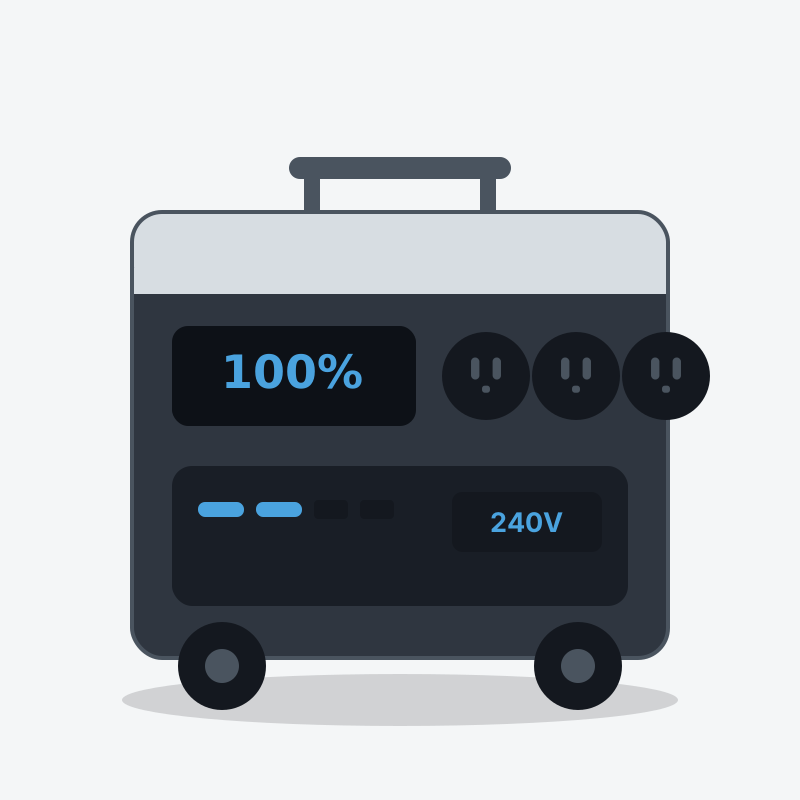
EcoFlow DELTA Pro 3
Specs unverifiedThe first portable unit that can honestly claim to back up parts of a house, including 240V circuits.
- Capacity
- 4,096 Wh
- AC output
- 4,000W
- Weight
- 113 lb
What's good
- 240V output covers well pumps and some dryers, which almost nothing else portable does
- Pairs with a transfer switch so you stop running extension cords through a window
- Chains with extra batteries into genuinely serious capacity
What's annoying
- Costs about the same as a permanently installed standby generator once you add a transfer switch
- 113 lb means it lives where you put it
- The install to make it useful is an electrician job, not a weekend project
Who this is wrong for
Anyone who wants to move it more than once. It has wheels for a reason, and stairs will beat you.

EcoFlow
EcoFlow DELTA Pro Ultra
Specs unverifiedA whole-home battery system that happens to be sold as a product. Genuinely powers a house, and priced accordingly.
- Capacity
- 6,000 Wh
- AC output
- 7,200W
- Weight
- —
What's good
- 7,200W and 240V runs genuinely heavy loads, including central air
- Scales to 90kWh, which is past any realistic household requirement
- Bundled Smart Home Panel means the switchover is designed rather than improvised
- 20ms switchover, so nothing in the house notices the grid going
What's annoying
- Needs an electrician, a subpanel and a permanent location
- At this price a whole-home standby generator deserves a serious comparison
- Several key specs are absent from EcoFlow own product page
- Nothing about this is portable, despite the category it is sold in
Who this is wrong for
Almost everyone reading a portable power station guide. This is a fixed installation with a subpanel and an electrician, not a box you carry. If you want something you can move, or you are backing up a fridge and some phones, every other unit on this site is a better fit.
Anker
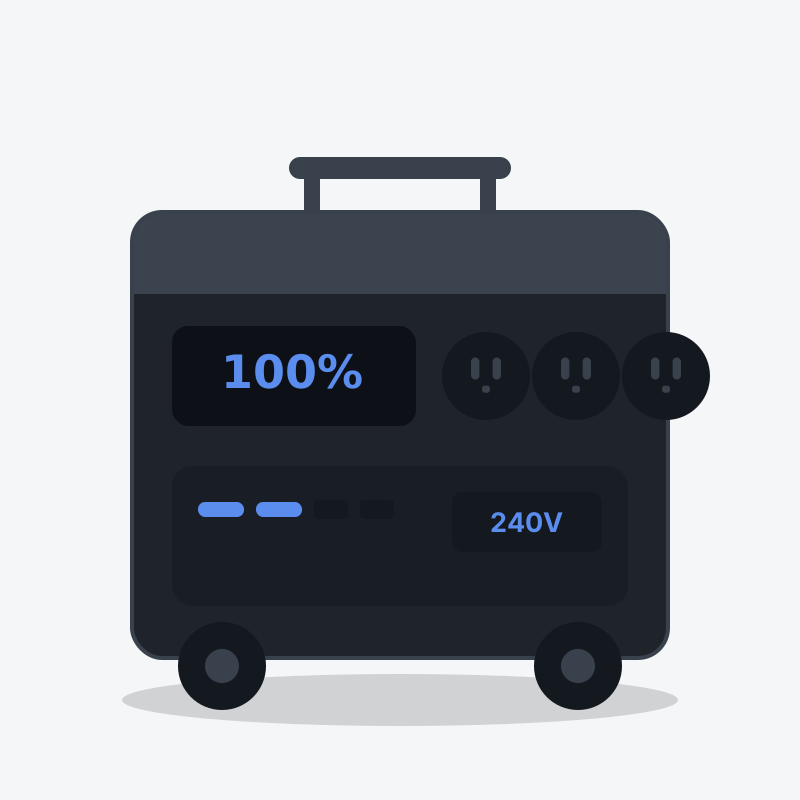
Anker SOLIX F3800
A home backup system wearing a portable power station's clothes. Treat it as an install, not a purchase.
- Capacity
- 3,840 Wh
- AC output
- 6,000W
- Weight
- 132.3 lb
What's good
- 6000W output covers nearly anything in a normal house, one at a time
- Real 240V, so the well pump and the dryer are on the table
- Stacks with expansion batteries into a very large bank
What's annoying
- 132 lb, and it needs a permanent home
- The transfer switch and electrician push the real cost well past the sticker
- At this price a standby generator deserves a serious look
Who this is wrong for
Renters. You cannot get the value out of it without wiring work you don't own.
Questions people actually ask
Is backfeeding your house illegal?
Why is backfeeding so dangerous?
What is a suicide cord?
What is the legal way to connect a generator to my house?
Do I need a transfer switch for a portable power station?
Who wrote this
Dhruvil Domadiya
Founder and editor, GreenCommuteGuide
I started GreenCommuteGuide because backup power is sold with numbers that sound impressive and mean very little — watt-hours on the box, surge ratings that turn out to be a boost mode, charge times quoted to 80% and printed as though they were full. I set the rules this site runs on: every spec is checked against the manufacturer's own documentation, anything we have not verified is marked as unverified on the page rather than quietly published, prices are never shown because they go stale, and every review names at least one product not to buy and who it is wrong for. Where I have not tested something myself, the page says so.
- · Sets and enforces the editorial standards on this site — unverified claims are flagged on the page, and the build fails if they are not
- · Specs are taken from manufacturers' own published documentation, never from retailer listings, and the source and date are recorded for each product
- · No payment is accepted for a rating, a ranking, or a positive verdict
Read this next
- Home Outage & BackupDo You Need a Transfer Switch for a Solar Generator?Extension cords work fine for most people. Here is exactly when they stop working, what a transfer switch costs, and the shortcut that kills lineworkers.
- Home Outage & BackupInterlock Kit vs Transfer Switch: Which Do You Need?Both do the same safety job. One is cheaper and gives you more circuits. Here is how to pick, and the shortcut that kills people.
- Home Outage & BackupSolar Generator vs Gas Generator: The Honest ComparisonGas wins on raw power and price. Battery wins on everything else. Here is exactly where each one falls apart, including the part that kills people.
- Home Outage & BackupBest Solar Generators for Power Outages in 2026Which battery actually gets your family through the night, which one is a waste of money, and how to tell the difference before you spend.