Your State's Grid
California PSPS Backup Power: What to Buy Before the Next Shutoff
PSPS events are scheduled, not random. That changes everything about what you should buy — and it makes solar panels far more useful here than elsewhere.
We earn a commission on purchases made through links on this page, at no extra cost to you. How this works.
What's in this article
The email arrives two days before. Winds are picking up, humidity is dropping, and your power is going off on Tuesday afternoon.
That's what makes PSPS different from every other outage in America. You get warning.
Most backup power advice is written for storms — sudden, unpredictable, dark skies. California's planned shutoffs are the opposite, and that changes what you should buy.
Three things PSPS gives you that storms don't
Warning. You know it's coming. Everything can be at 100% before it starts.
Sunshine. PSPS happens in dry, clear, windy conditions. That's excellent solar weather. During a hurricane your panels are useless for days; during a PSPS the sun is out the whole time.
Predictability. It happens in the same season, often in the same areas, most years. You can plan a system rather than panic-buy one.
The length problem
PSPS outages run longer than people expect.
The power doesn't come back the moment the wind drops. Crews have to physically inspect the de-energized lines for damage before re-energizing, and that takes time across hundreds of miles.
Plan for two to three days, not an afternoon.
What to buy
The core: 1,000–2,000Wh with real solar input
The EcoFlow DELTA 2 or Anker SOLIX C1000 at the smaller end; the Bluetti AC200L if you want two days without thinking about it.
Fridge, internet, phones, lights, fans. That's the realistic list.
The part that matters more here: panels
Two 200W panels. The Bluetti PV200 uses MC4 connectors so it works across brands rather than locking you in.
| Appliance | EcoFlow DELTA 21,024 Wh | Bluetti AC200L2,048 Wh |
|---|---|---|
| Full-size refrigerator~150W running, cycles ~35% of the time | 17 hr | 33 hr |
| Wi-Fi router + modem~20W running | 44 hr | 87 hr |
| Box fan~75W running | 12 hr | 23 hr |
| Phones and a laptop~65W running, cycles ~50% of the time | 27 hr | 54 hr |
With panels recharging during the day, a 1kWh unit covering a fridge overnight becomes a system you can run indefinitely rather than a countdown.
That's the PSPS advantage, and it's real.
The heat question
Let's be direct: a portable battery will not run your air conditioning.
A window unit empties a 2,000Wh pack in a few hours. Central air isn't a conversation.
What works is a box fan — around 75 watts, running for many hours on a modest battery. verify Close the curtains on the sun side, pick one room, and move air.
If someone in your household genuinely cannot tolerate the heat, that's not a portable-battery problem. That's a standby generator or a home battery system, and it's worth knowing that before you spend $1,500 hoping.
Medical equipment and PSPS
California utilities run Medical Baseline programs. If someone in your home depends on powered medical equipment, get registered.
It doesn't guarantee your power stays on — PSPS is a safety shutoff and it applies to everyone — but it does mean extra notification and, in some cases, additional support.
Do that alongside buying a battery, not instead of it.
What we would not buy
Anything under 500Wh as your PSPS plan. A two-to-three-day event needs real capacity. That's a phone box, not a plan.
A big battery with no panels. For a multi-day event in sunny weather, spending everything on capacity and nothing on recharging is the wrong split. A 1kWh unit plus 400W of panel beats a 2kWh unit alone.
A gas generator without thinking hard. PSPS happens during extreme fire risk. Running a combustion engine outdoors in exactly those conditions deserves real caution — and check your local rules, because some areas restrict it during red flag conditions.
The free things
Charge everything the moment the notice arrives.
Fill the freezer with jugs of water — mass holds cold, air doesn't.
Fill your car's tank. A 12V adapter makes it a slow charger, and it's already in the driveway.
Set the fridge colder the day before. You're banking cold into the food itself.
Straight answer
1,000Wh unit plus two 200W panels. That's the PSPS setup for most households, and the panels are what make it work for a three-day event rather than a one-night one.
Buy it in spring, not the week the winds arrive. Prices in this category are far better out of season, and so is availability.
The picks, in detail
Specs come from data/products.json, so they're the same everywhere on this site.
EcoFlow
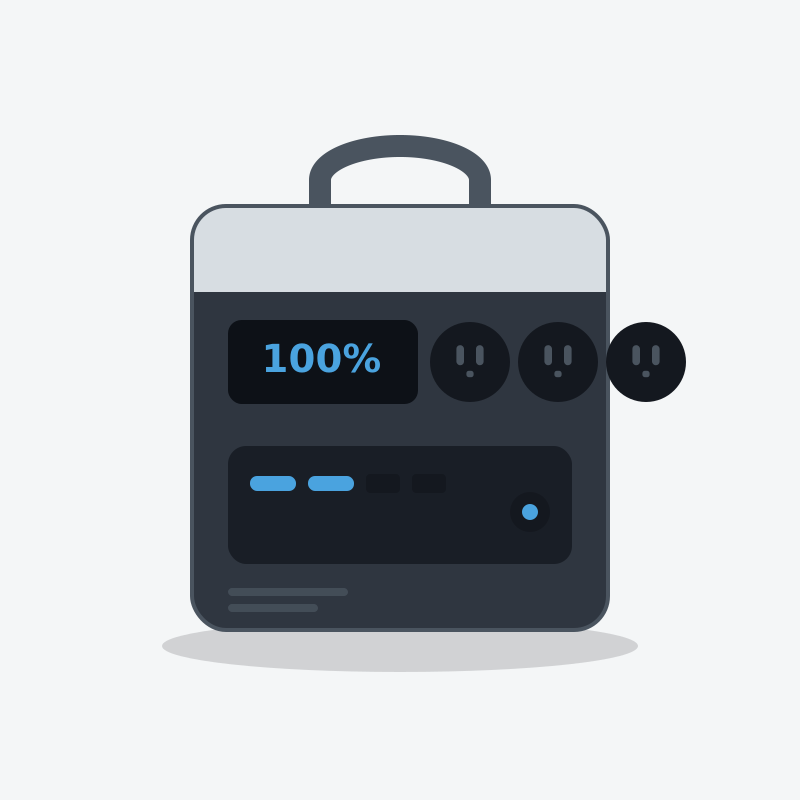
EcoFlow DELTA 2
The one most people should buy. It refills fast enough that a short sunny break between storm bands actually matters.
- Capacity
- 1,024 Wh
- AC output
- 1,800W
- Weight
- 27 lb
What's good
- Wall recharge is genuinely quick — useful when power flickers back for an hour
- LiFePO4 cells, so it tolerates being left plugged in for years
- Six AC outlets means no daisy-chained power strips on the kitchen counter
- Add an extra battery later instead of buying a whole second unit
What's annoying
- The fan is audible in a quiet bedroom at night
- 1800W ceiling rules out most space heaters and hair dryers
- Expansion batteries cost nearly as much as the unit itself
Who this is wrong for
Anyone who needs to power a well pump, an electric water heater or a central AC. It will not start them, and it is not a whole-home unit.
Bluetti
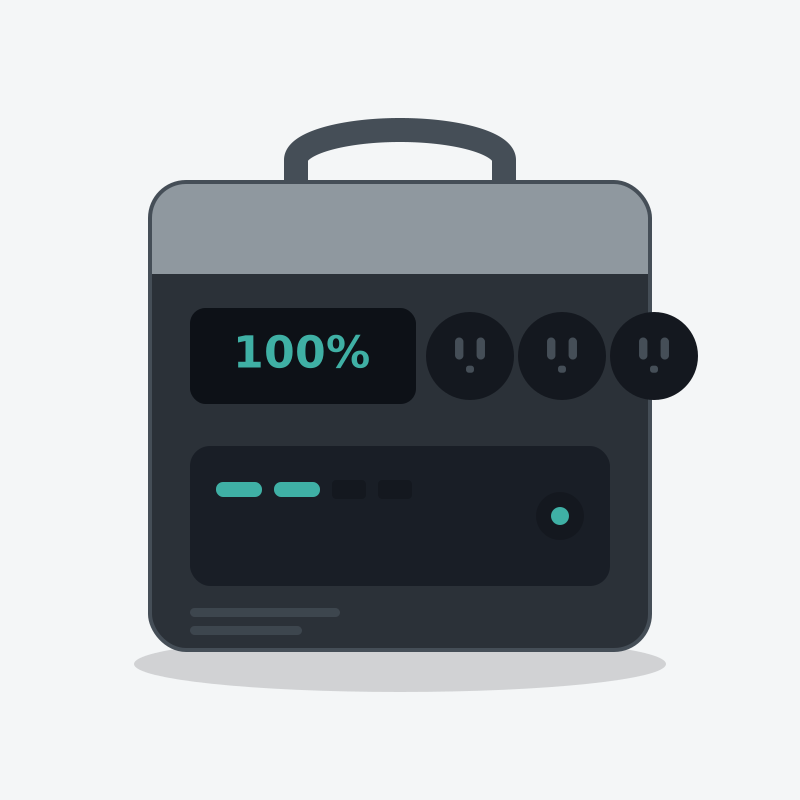
Bluetti AC200L
Specs unverifiedA lot of battery for the money, with the port selection of a small workshop.
- Capacity
- 2,048 Wh
- AC output
- 2,400W
- Weight
- 61.9 lb
What's good
- Expandable, unlike most Bluetti units at this size
- A genuinely useful spread of ports including a 30A RV outlet
- Fast recharge for a 2kWh unit
What's annoying
- Shorter warranty than EcoFlow and Jackery offer
- Big and awkward to store
- Bluetti's US service turnaround has been inconsistent
Who this is wrong for
Small apartments. It's physically large and you will trip over it.
Bluetti
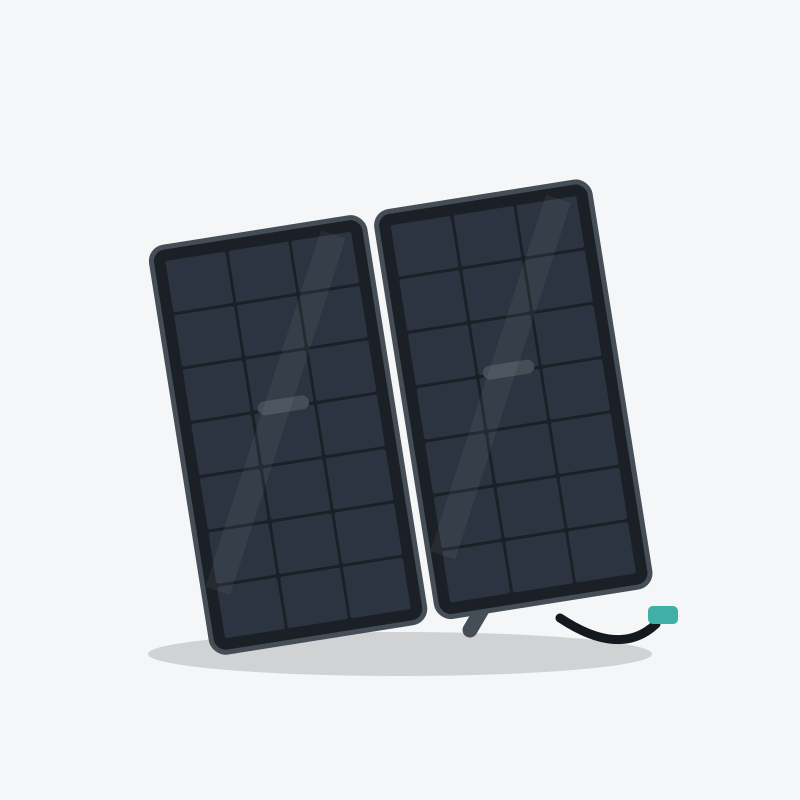
Bluetti PV200 200W Solar Panel
Specs unverifiedThe most watts per dollar in folding panels, with a case that feels like it'll outlast the warranty.
What's good
- Strong output for the money
- MC4 makes it universal across brands
- Durable long-fiber ETFE surface
What's annoying
- Four-fold design is awkward in wind
- No integrated USB output
- Kickstand angles are limited
Who this is wrong for
Quick grab-and-go trips. Unfolding four panels in wind is a two-person job.
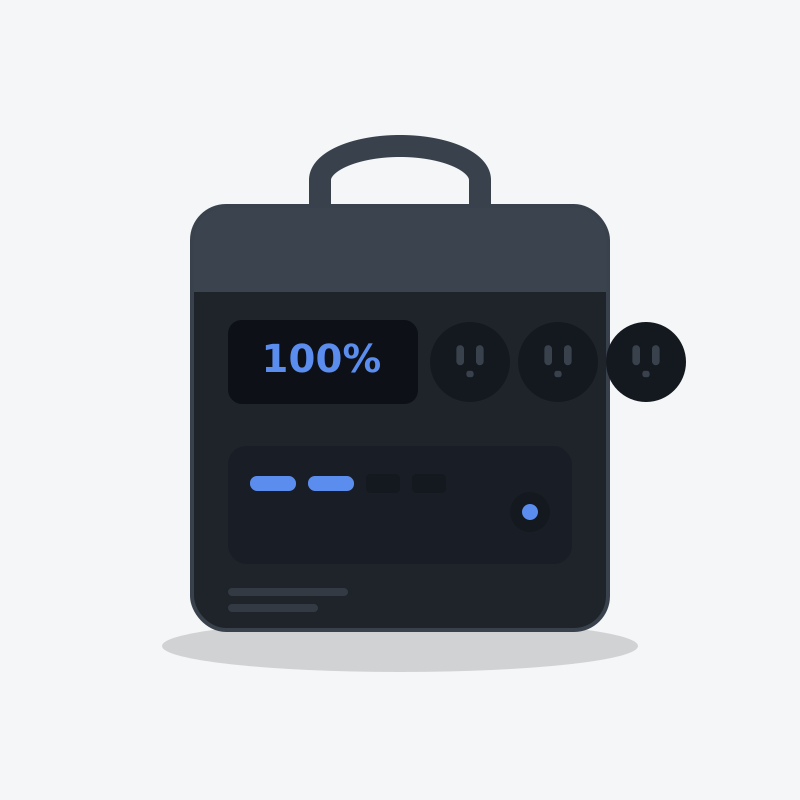
Anker
Anker SOLIX C1000
The best-built 1kWh unit on the market, and the one that fits an RV bay without a shoehorn.
- Capacity
- 1,056 Wh
- AC output
- 1,800W
- Weight
- 28.44 lb
What's good
- The most compact 1kWh box here — it genuinely fits where others don't
- Anker's warranty service is the least painful in this category
- Full wall recharge in under an hour
- Quiet fan behaviour under moderate load
What's annoying
- Expansion battery caps you at about 2,112Wh and is expensive
- Fewer solar input options than EcoFlow
- Anker discounts less often, so you rarely catch a deep sale
Who this is wrong for
People who need to run more than 1800W. And it won't grow with you — expansion is limited.
Questions people actually ask
What is a PSPS?
How long do PSPS outages last?
Are solar panels worth it for PSPS?
Will a portable power station run my AC during a PSPS?
Should I get a home battery instead?
Who wrote this
Dhruvil Domadiya
Founder and editor, GreenCommuteGuide
I started GreenCommuteGuide because backup power is sold with numbers that sound impressive and mean very little — watt-hours on the box, surge ratings that turn out to be a boost mode, charge times quoted to 80% and printed as though they were full. I set the rules this site runs on: every spec is checked against the manufacturer's own documentation, anything we have not verified is marked as unverified on the page rather than quietly published, prices are never shown because they go stale, and every review names at least one product not to buy and who it is wrong for. Where I have not tested something myself, the page says so.
- · Sets and enforces the editorial standards on this site — unverified claims are flagged on the page, and the build fails if they are not
- · Specs are taken from manufacturers' own published documentation, never from retailer listings, and the source and date are recorded for each product
- · No payment is accepted for a rating, a ranking, or a positive verdict
Read this next
- Your State's GridBackup Power for Texas Outages: What Actually Works HereERCOT is its own grid with its own failure modes, and Texas outages hit in heat as often as ice. Here is what to buy for both.
- RV, Camping & Off-GridBest Solar Panels for Portable Power StationsThe rated watts on the box is not what you get. Here is what a panel really produces, how many you need, and when panels are a waste of money.
- Home Outage & BackupBest Solar Generators for Power Outages in 2026Which battery actually gets your family through the night, which one is a waste of money, and how to tell the difference before you spend.
- Home Outage & BackupHow to Keep Food Cold During a Power OutageYour fridge holds cold for four hours. Your freezer holds it for two days. Here is how to stretch both, and exactly when to throw things out.