Home Outage & Backup
How to Keep Food Cold During a Power Outage
Your fridge holds cold for four hours. Your freezer holds it for two days. Here is how to stretch both, and exactly when to throw things out.
We earn a commission on purchases made through links on this page, at no extra cost to you. How this works.

What's in this article
You open it on day two to grab the milk. And there is a smell that was not there yesterday.
That is the moment most people learn what a power outage actually costs. Not the darkness. Six hundred dollars of groceries and an afternoon of hauling bags to the curb.
Most of that is preventable, and a lot of it is preventable for free.
The two numbers to remember
Four hours. That is how long an unopened fridge stays safe. verify
Forty-eight hours. That is a full freezer, unopened. Half full, cut it to about 24. verify
Those numbers assume the door stays shut. Every open costs you real time, and people open the fridge out of habit within twenty minutes of the power going out.
Free things to do in the first ten minutes
Move fridge food into the freezer if there is room. The freezer is colder and holds it longer.
Fill the empty space. Air holds almost no cold. Water does. Jugs of water, bags of ice, anything with mass — pack the gaps in your freezer and it will hold twice as long.
Group things together. A tight cluster of frozen items keeps itself cold. Spread out on separate shelves, they each warm on their own.
Put a thermometer inside. Cheap appliance thermometer, in the fridge, right now, before you need it. It removes the argument on day two about whether the chicken is fine.
When to power it, and how
If you own a battery, the instinct is to plug the fridge in and leave it. That is not the most efficient way to do it.
A fridge does not need continuous power. It needs to be brought back down to temperature periodically. Running it for an hour every three hours uses far less energy than running it continuously, and the food never notices.
| Appliance | EcoFlow DELTA 21,024 Wh | Anker SOLIX C10001,056 Wh |
|---|---|---|
| Full-size refrigerator~150W running, cycles ~35% of the time | 17 hr | 17 hr |
| Chest freezer~120W running, cycles ~30% of the time | 24 hr | 25 hr |
| Mini fridge~90W running, cycles ~30% of the time | 32 hr | 33 hr |
A 1kWh unit covering a fridge overnight is not marketing. That is what the arithmetic says, because the compressor only runs about a third of the time.
What to throw out, honestly
The rule is 40°F for two hours. Above that, for longer than that, bin it.
Throw out without arguing: meat, poultry, fish, eggs, milk, soft cheese, cooked leftovers, cut fruit, anything with mayonnaise, opened baby formula.
Usually fine: butter, hard cheese, whole uncut fruit and vegetables, unopened juice, jam, ketchup, mustard, bread, most condiments.
Refreeze only if it still has ice crystals or has stayed at or below 40°F. Fully thawed and warm means gone.
The cheap plan for people with no battery
A cooler and a bag of ice, bought before the storm.
Move the things you will actually reach for — milk, drinks, whatever the kids want — into the cooler and leave the fridge sealed. That way the fridge door stays shut for its full four hours while you use the cooler like a snack drawer.
Freeze water bottles in advance. They cost nothing, they buy you hours, and afterward they are just drinking water.
The one purchase actually worth making
If your outages are short, a cooler and ice genuinely solves this. Don't let anyone tell you that you need a battery for a four-hour outage.
If your outages run overnight or longer, a 1,000Wh-class unit with at least 1,800W output covers the fridge and a lot more. That is the size that stops you throwing food away, and it costs a fraction of the whole-home systems people get talked into.
What we would not buy for this: anything under about 500Wh. It cannot start a fridge compressor reliably and it will not last the night if it does. For a fridge specifically, small units are a waste of money — buy the cooler instead and spend the difference on something that works.
If you want the actual arithmetic rather than a recommendation, how long a 1000Wh unit runs a fridge shows why the answer is about twenty hours and not the six the obvious sum gives you. And when you are ready to pick one, our outage recommendations name who each unit is wrong for — including the one we would not buy at all.
The picks, in detail
Specs come from data/products.json, so they're the same everywhere on this site.
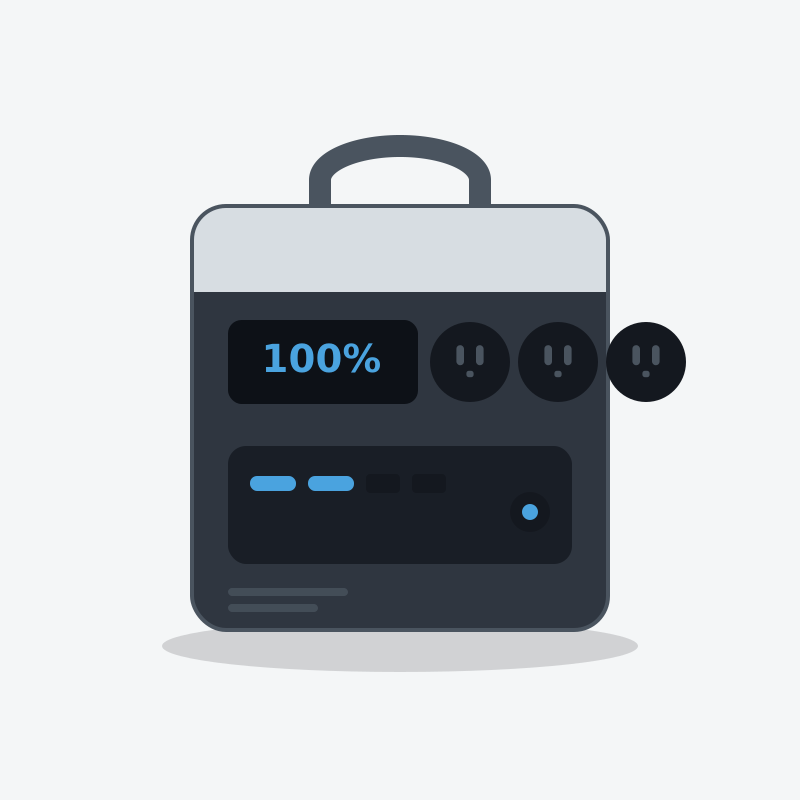
EcoFlow
EcoFlow DELTA 2
The one most people should buy. It refills fast enough that a short sunny break between storm bands actually matters.
- Capacity
- 1,024 Wh
- AC output
- 1,800W
- Weight
- 27 lb
What's good
- Wall recharge is genuinely quick — useful when power flickers back for an hour
- LiFePO4 cells, so it tolerates being left plugged in for years
- Six AC outlets means no daisy-chained power strips on the kitchen counter
- Add an extra battery later instead of buying a whole second unit
What's annoying
- The fan is audible in a quiet bedroom at night
- 1800W ceiling rules out most space heaters and hair dryers
- Expansion batteries cost nearly as much as the unit itself
Who this is wrong for
Anyone who needs to power a well pump, an electric water heater or a central AC. It will not start them, and it is not a whole-home unit.
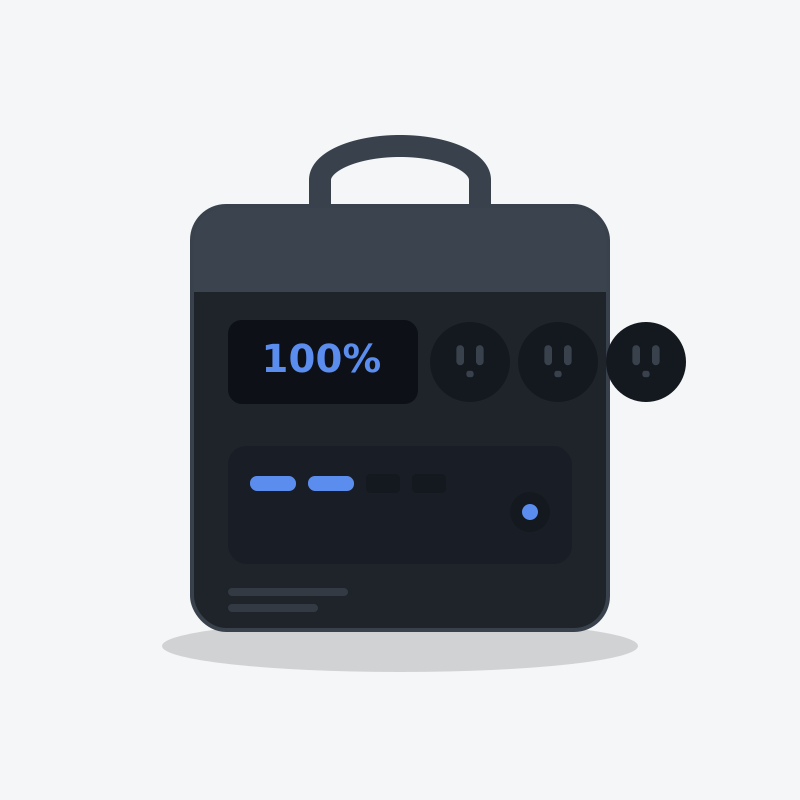
Anker
Anker SOLIX C1000
The best-built 1kWh unit on the market, and the one that fits an RV bay without a shoehorn.
- Capacity
- 1,056 Wh
- AC output
- 1,800W
- Weight
- 28.44 lb
What's good
- The most compact 1kWh box here — it genuinely fits where others don't
- Anker's warranty service is the least painful in this category
- Full wall recharge in under an hour
- Quiet fan behaviour under moderate load
What's annoying
- Expansion battery caps you at about 2,112Wh and is expensive
- Fewer solar input options than EcoFlow
- Anker discounts less often, so you rarely catch a deep sale
Who this is wrong for
People who need to run more than 1800W. And it won't grow with you — expansion is limited.
Questions people actually ask
How long does food last in the fridge without power?
What temperature is unsafe?
Can I refreeze food that thawed?
How big a battery do I need for my fridge?
Should I put dry ice in my freezer?
Who wrote this
Dhruvil Domadiya
Founder and editor, GreenCommuteGuide
I started GreenCommuteGuide because backup power is sold with numbers that sound impressive and mean very little — watt-hours on the box, surge ratings that turn out to be a boost mode, charge times quoted to 80% and printed as though they were full. I set the rules this site runs on: every spec is checked against the manufacturer's own documentation, anything we have not verified is marked as unverified on the page rather than quietly published, prices are never shown because they go stale, and every review names at least one product not to buy and who it is wrong for. Where I have not tested something myself, the page says so.
- · Sets and enforces the editorial standards on this site — unverified claims are flagged on the page, and the build fails if they are not
- · Specs are taken from manufacturers' own published documentation, never from retailer listings, and the source and date are recorded for each product
- · No payment is accepted for a rating, a ranking, or a positive verdict
Read this next
- Home Outage & BackupBest Solar Generators for Power Outages in 2026Which battery actually gets your family through the night, which one is a waste of money, and how to tell the difference before you spend.
- Home Outage & BackupHurricane Prep Checklist: The Power Backup EditionEverything to do before the storm, in the order that matters. Written for the week you actually have, not the year you should have had.
- Run This ApplianceCan a Solar Generator Run a Refrigerator?Yes, and it takes less battery than you have been told. Here is the math, the surge trap, and the size that actually saves your food.
- Your State's GridMidwest Ice Storm Backup Power: Staying Warm When the Lines Come DownIf you have gas heat, one 400-watt load keeps your whole house warm. That single fact is worth more than any battery comparison.