Battery & Tech Basics
Can You Fly With a Power Station? The 100Wh Rule Explained
Almost certainly not. Every unit worth owning is above the FAA's hard 160Wh ceiling, and no airline can approve an exception. Here is the rule, the arithmetic, and what to take instead.
We earn a commission on purchases made through links on this page, at no extra cost to you. How this works.
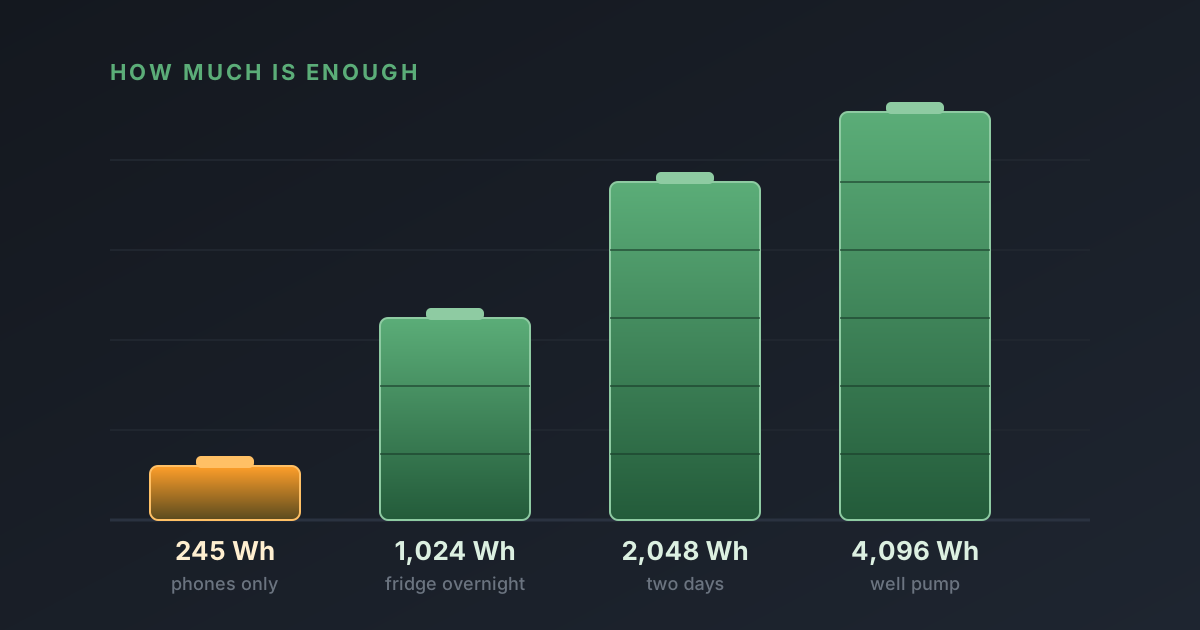
What's in this article
This is not an airline policy you can argue with at the gate. It is a federal hazardous-materials rule, and the check-in agent has no authority to waive it.
Where your unit falls
Find the watt-hour rating on the back or bottom of the unit. It is printed there by law. Then:
| Capacity | Status |
|---|---|
| Under 100Wh (about 27,000mAh) | Carry-on, no approval needed |
| 100–160Wh | Carry-on with prior airline approval, two spares maximum |
| Over 160Wh | Forbidden on passenger aircraft |
Which means the entire category — every Jackery, EcoFlow, Bluetti and Anker power station — sits in the bottom row. So do most "camping" batteries, most CPAP travel batteries above 160Wh, and a good number of laptop-grade bricks.
The 100–160Wh middle band exists mostly for professional camera batteries and extended-life laptop packs. It is not a loophole for a small power station. Even if you found a 155Wh unit, airlines want the request and the UN38.3 test documentation days ahead, not at the gate.
The mAh trick that gets people fined
Manufacturers advertise milliamp-hours, because the number is bigger and looks better. Airlines regulate watt-hours. The conversion is:
Wh = (mAh ÷ 1,000) × volts
Most power banks run at 3.7V nominal, so a 20,000mAh bank is about 74Wh — comfortably legal. A 27,000mAh bank is right at the 100Wh line.
The trap is that power stations are usually quoted in Wh already, and when they are quoted in mAh the voltage is much higher than 3.7V. If a listing says "300,000mAh" with no voltage, assume it is far over the limit and check the label.
Watt-hours to amp-hours covers the arithmetic in both directions if you want to check something before you pack it.
Checked baggage is not the workaround
This is the mistake that gets bags pulled apart. Power banks and spare lithium batteries are prohibited in checked baggage entirely — they must be in the cabin, on your person or in your carry-on, where a crew member can reach one that starts smoking.
So a 1,000Wh unit is banned from the cabin for being too large, and banned from the hold for being a lithium battery. There is no third compartment.
And LiFePO4 does not get you a pass. Aviation authorities do not make exceptions for different lithium chemistries, however much more stable the cells are on the ground.
What to actually do instead
Ship it. Ground freight has its own lithium rules, but they are workable, and both UPS and FedEx will move a properly declared and packaged unit. Check the current requirements with the carrier before you pack it — the paperwork depends on watt-hours and on whether the unit is shipped alone or with equipment. This is the standard answer for van-lifers and photographers moving gear to a shoot.
Rent at the other end. For a one-week trip, renting a unit locally costs less than shipping a heavy one both ways.
Buy a legal battery for the actual job. Ask what you needed the power station for, because the honest answer is usually "phones and a laptop for a long travel day." A 99Wh power bank does that and boards without a conversation. Several manufacturers deliberately build to 99Wh for exactly this reason.
If it is a CPAP: most travel CPAP batteries are sold in under-100Wh and 100–160Wh versions specifically so they can fly. Buy the under-100Wh one even though it is smaller, unless you are certain you will get airline approval in writing. And carry the machine as a medical device — it does not count against your carry-on allowance on US carriers. verify Our CPAP power guide covers the at-home sizing, which is a different problem with different answers.
The one exception worth knowing
Batteries over 160Wh are prohibited, except for certain batteries used with approved mobility devices — wheelchairs and scooters. That exception is narrow, has its own set of rules about terminals and packaging, and requires talking to the airline well in advance. It does not extend to a power station you plan to use for something else on the trip.
Driving instead?
None of this applies on the road. A power station in a car is unrestricted, and you can charge it while you drive — though far more slowly than most people expect, around ten hours for a 1,000Wh unit from a standard 12V socket.
If the trip is drivable, that is the answer, and it is why this category is so much more popular with road-trippers than with fliers.
The short version
- Over 160Wh is forbidden on passenger aircraft. Every power station is over 160Wh.
- Under 100Wh flies free in carry-on. 100–160Wh needs written airline approval and documentation days ahead.
- No lithium battery of any size goes in checked baggage.
- Ship the unit, rent one there, or buy a 99Wh power bank for the flight.
Rules do change, and airlines layer their own restrictions on top of the federal ones. Check the FAA's PackSafe page and your specific carrier's dangerous-goods page in the week before you fly.
The picks, in detail
Specs come from data/products.json, so they're the same everywhere on this site.
Anker
Anker SOLIX C300
The one you actually carry. Small, quiet, and built better than anything else this size.
- Capacity
- 288 Wh
- AC output
- 300W
- Weight
- 9.1 lb
What's good
- Built-in light that is actually useful, not a gimmick
- Three USB-C ports, one of them high wattage for laptops
- Charges from empty in about an hour
What's annoying
- 300W ceiling — this powers electronics, not appliances
- Small capacity disappears fast if you plug in anything with a motor
- Priced close to units with three times the capacity on sale
Who this is wrong for
Home backup. If your outage plan is a 288Wh box, you don't have an outage plan.
EcoFlow
EcoFlow DELTA 2
The one most people should buy. It refills fast enough that a short sunny break between storm bands actually matters.
- Capacity
- 1,024 Wh
- AC output
- 1,800W
- Weight
- 27 lb
What's good
- Wall recharge is genuinely quick — useful when power flickers back for an hour
- LiFePO4 cells, so it tolerates being left plugged in for years
- Six AC outlets means no daisy-chained power strips on the kitchen counter
- Add an extra battery later instead of buying a whole second unit
What's annoying
- The fan is audible in a quiet bedroom at night
- 1800W ceiling rules out most space heaters and hair dryers
- Expansion batteries cost nearly as much as the unit itself
Who this is wrong for
Anyone who needs to power a well pump, an electric water heater or a central AC. It will not start them, and it is not a whole-home unit.
Questions people actually ask
Can you fly with a power station?
What is the 100Wh rule for batteries on planes?
Can I put a power station in checked baggage?
How do I convert mAh to watt-hours for a flight?
Does LiFePO4 get an exemption for flying?
Who wrote this
Dhruvil Domadiya
Founder and editor, GreenCommuteGuide
I started GreenCommuteGuide because backup power is sold with numbers that sound impressive and mean very little — watt-hours on the box, surge ratings that turn out to be a boost mode, charge times quoted to 80% and printed as though they were full. I set the rules this site runs on: every spec is checked against the manufacturer's own documentation, anything we have not verified is marked as unverified on the page rather than quietly published, prices are never shown because they go stale, and every review names at least one product not to buy and who it is wrong for. Where I have not tested something myself, the page says so.
- · Sets and enforces the editorial standards on this site — unverified claims are flagged on the page, and the build fails if they are not
- · Specs are taken from manufacturers' own published documentation, never from retailer listings, and the source and date are recorded for each product
- · No payment is accepted for a rating, a ranking, or a positive verdict
Read this next
- Battery & Tech Basics9 Things a Solar Generator Will NOT RunEvery product page tells you what these can power. Nobody tells you what they can't. Here is the honest list, with the numbers.
- Run This ApplianceBest Solar Generator for a CPAP MachineYou need one night, not a whole house. Turn the humidifier off and a small battery does the job for a fraction of what people tell you to spend.
- Battery & Tech BasicsWhy Is My Power Station Losing Charge in Storage?Some loss is normal and some is the unit quietly eating itself. How to tell which you have, and the storage habit that prevents the expensive version.
- Battery & Tech BasicsHow to Store a Power Station Over Winter (Without Wrecking It)Store it at about half charge, indoors, and never charge it while it is below freezing. That last one destroys batteries permanently and almost nobody knows it.