Run This Appliance
Best Solar Generator for a CPAP Machine
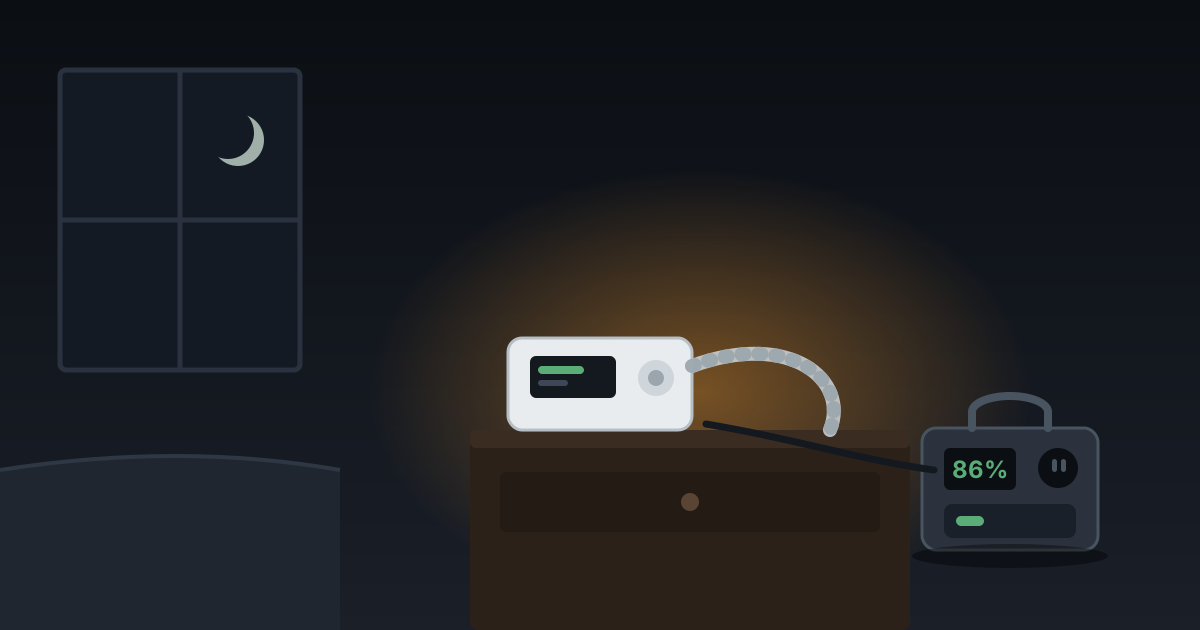
You need one night, not a whole house. Turn the humidifier off and a small battery does the job for a fraction of what people tell you to spend.
We earn a commission on purchases made through links on this page, at no extra cost to you. How this works.
What's in this article
It is not the fridge that keeps you awake in a storm. It is knowing that when the wind takes the line down, you are not sleeping, and tomorrow is going to be rough.
Here is the good news, and it is genuinely good. This is the cheapest backup power problem there is.
Most people shopping for a CPAP battery get talked into three times what they need.
The short version
In a hurry? Find your row and go. The details are below if you want them.
Best Overall
Most people, most outages
EcoFlow DELTA 2
1,024 Wh · 1,800W · 27 lb
Best Budget
Phones and a CPAP, nothing more
Anker SOLIX C300
288 Wh · 300W · 9.1 lb
Best for RV
Fits the bay, survives the road
Anker SOLIX C1000
1,056 Wh · 1,800W · 28.44 lb
Best Whole-Home
Well pump, furnace, 240V circuits
EcoFlow DELTA Pro 3
4,096 Wh · 4,000W · 113 lb
Specs unverified
The one setting that halves your cost
Turn off the heated humidifier.
That's it. That's the whole trick.
A CPAP motor sips power — around 40 watts. verify The heater that warms the water is what doubles it, and it's the least essential part of the machine.
Over eight hours: about 300 watt-hours without the humidifier, closer to 700 with it. verify
Use the heated hose setting sparingly too — it's the same problem in a different place.
Use the DC cable if you have one
Most CPAP machines ship with, or offer, a 12V DC cable.
Your battery stores DC. The AC outlet converts it to AC, and then your CPAP's brick converts it straight back to DC. You lose energy at both ends for no reason.
Plug into the battery's 12V port instead and you get meaningfully more hours out of the same pack. verify Check your machine's manual for the right cable — do not improvise one.
What we'd actually buy
For one night, cheaply: Anker SOLIX C300
288Wh. That covers a humidifier-off CPAP for a night with a little margin. verify
It's light, it's quiet, and it costs a fraction of what people get sold for this job. Three USB-C ports means your phone charges off the same box without another brick.
Who it's wrong for: anyone who wants the humidifier on, or who also wants to keep a fridge running. It cannot do either. If your outage worry is bigger than "I need to sleep," buy bigger.
If you want the humidifier on: step up to roughly 700–1,000Wh
This is the size bracket rather than a single pick, because the humidifier is what decides it.
With the heated humidifier running, draw can roughly triple. verify A 288Wh unit that comfortably covers a dry-air night will not get you to morning with the humidifier on, and finding that out at 3am is the wrong time.
Around 700Wh covers a humidified night with margin. Around 1,000Wh covers it and leaves room for phones, a lamp and the router — which is why most people who start here end up buying the 1kWh unit below anyway.
What to check before buying: your machine's actual draw with your settings, from its manual or a plug-in meter. CPAP consumption varies more between machines and pressure settings than any table can capture.
If you also want your food to survive: EcoFlow DELTA 2
Once you're protecting the fridge as well as the CPAP, you're in a different size class.
1,024Wh runs the CPAP all night and still has plenty left for the fridge, the modem and phones. verify It refills from a wall outlet fast, which matters if power flickers back mid-outage.
Who it's wrong for: somebody who genuinely only needs the CPAP. You'd be buying triple what the job requires.
| Appliance | Anker SOLIX C300288 Wh | EcoFlow DELTA 21,024 Wh |
|---|---|---|
| CPAP (no humidifier)~40W running | 6.1 hr | 22 hr |
| CPAP with heated humidifier~90W running | 2.7 hr | 9.7 hr |
| Full-size refrigerator~150W running, cycles ~35% of the time | Won't start it | 17 hr |
What not to buy
Don't buy a "CPAP battery" from a medical supply company. They're often priced far above a general-purpose power station with the same or less capacity, and they do nothing else. A standard power station runs your CPAP and your phone and your lamp.
Don't buy a lead-acid jump starter for this. They're heavy, they hold much less usable energy than the label implies, and they hate being deeply discharged. They also die after a couple of years of sitting.
Don't buy a 100Wh power bank. It will not make it through a night, and finding that out at 3am is a bad way to find out.
Two nights or more
One night is easy. Three nights is a different question.
At that point you need a way to put energy back in: a solar panel, or a 12V adapter that charges from your car. The car option is unglamorous and it works — your car is already in the driveway, and idling it for half an hour puts a real dent in the problem.
The straight answer
Turn the humidifier off, use the DC cable, and buy something in the 300-500Wh range.
That solves the problem for most people, for less money than nearly every article on this subject will tell you. Spend the difference on a solar panel if your outages run long, or don't spend it at all.
The picks, in detail
Specs come from data/products.json, so they're the same everywhere on this site.
Anker
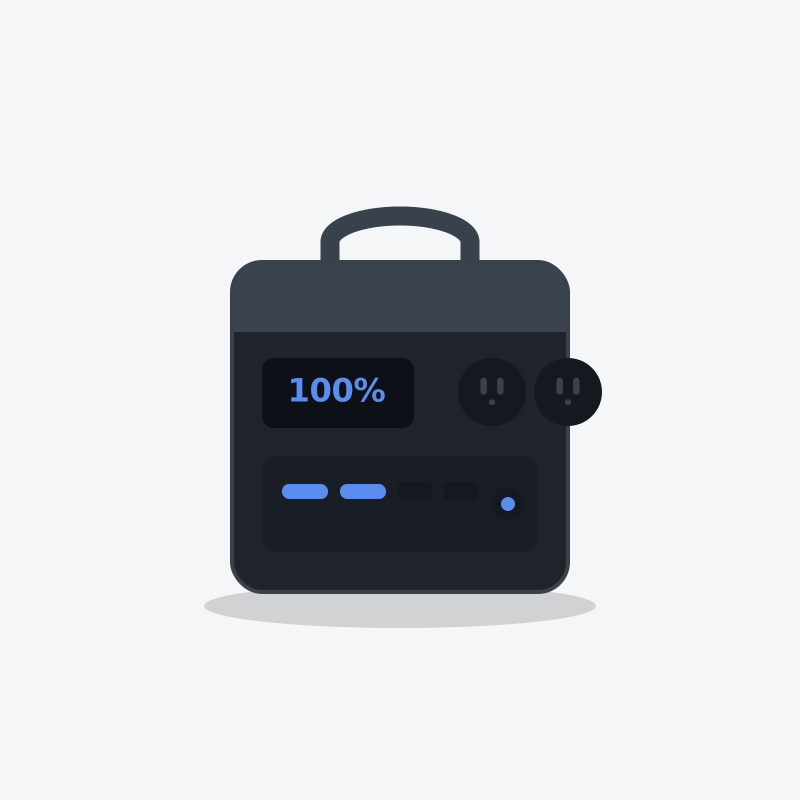
Anker SOLIX C300
The one you actually carry. Small, quiet, and built better than anything else this size.
- Capacity
- 288 Wh
- AC output
- 300W
- Weight
- 9.1 lb
What's good
- Built-in light that is actually useful, not a gimmick
- Three USB-C ports, one of them high wattage for laptops
- Charges from empty in about an hour
What's annoying
- 300W ceiling — this powers electronics, not appliances
- Small capacity disappears fast if you plug in anything with a motor
- Priced close to units with three times the capacity on sale
Who this is wrong for
Home backup. If your outage plan is a 288Wh box, you don't have an outage plan.
EcoFlow
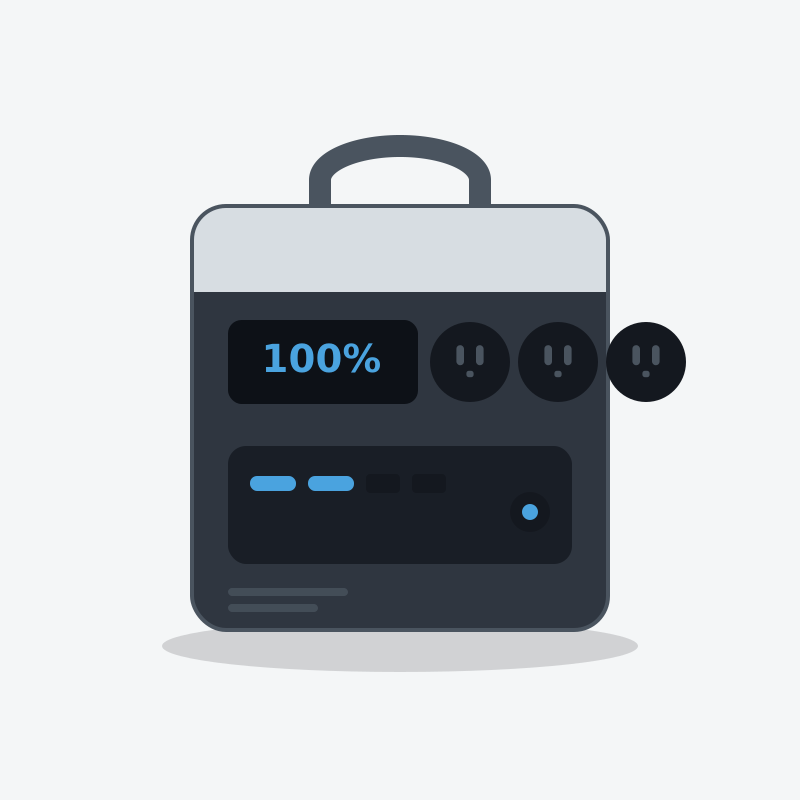
EcoFlow DELTA 2
The one most people should buy. It refills fast enough that a short sunny break between storm bands actually matters.
- Capacity
- 1,024 Wh
- AC output
- 1,800W
- Weight
- 27 lb
What's good
- Wall recharge is genuinely quick — useful when power flickers back for an hour
- LiFePO4 cells, so it tolerates being left plugged in for years
- Six AC outlets means no daisy-chained power strips on the kitchen counter
- Add an extra battery later instead of buying a whole second unit
What's annoying
- The fan is audible in a quiet bedroom at night
- 1800W ceiling rules out most space heaters and hair dryers
- Expansion batteries cost nearly as much as the unit itself
Who this is wrong for
Anyone who needs to power a well pump, an electric water heater or a central AC. It will not start them, and it is not a whole-home unit.
Questions people actually ask
How many watt-hours does a CPAP use per night?
Can I run my CPAP on a small power station?
Should I use the DC output instead of the AC outlet?
Will a power station run my CPAP quietly enough to sleep?
Is a power station enough for someone with sleep apnea in a long outage?
Who wrote this
Dhruvil Domadiya
Founder and editor, GreenCommuteGuide
I started GreenCommuteGuide because backup power is sold with numbers that sound impressive and mean very little — watt-hours on the box, surge ratings that turn out to be a boost mode, charge times quoted to 80% and printed as though they were full. I set the rules this site runs on: every spec is checked against the manufacturer's own documentation, anything we have not verified is marked as unverified on the page rather than quietly published, prices are never shown because they go stale, and every review names at least one product not to buy and who it is wrong for. Where I have not tested something myself, the page says so.
- · Sets and enforces the editorial standards on this site — unverified claims are flagged on the page, and the build fails if they are not
- · Specs are taken from manufacturers' own published documentation, never from retailer listings, and the source and date are recorded for each product
- · No payment is accepted for a rating, a ranking, or a positive verdict
Read this next
- Run This ApplianceBest Solar Generator for Medical Equipment at HomeA battery should be one layer of your plan, never the whole plan. Here is how to size it properly and what to arrange before you need it.
- Home Outage & BackupBest Solar Generators for Power Outages in 2026Which battery actually gets your family through the night, which one is a waste of money, and how to tell the difference before you spend.
- Sizing & CalculatorsWhat Size Solar Generator Do I Need? (Free Calculator)Skip the guesswork. Tick the things you need to keep running, get a real watt-hour number, and see which units can actually do it.
- Battery & Tech BasicsWhy Won't My Power Station Charge from Solar?The panel is in full sun and the screen still says 0W. Nine causes, ordered by how often they turn out to be the one, starting with the voltage rule nobody mentions.