Home Outage & Backup
Does Homeowners Insurance Cover Food Spoiled in an Outage?
Sometimes — and the deciding factor is usually where the power failed, not how much food you lost. Here is how to check your own policy in about four minutes.
We earn a commission on purchases made through links on this page, at no extra cost to you. How this works.
What's in this article
This is a plain-English summary of how these policies commonly work. Policy language varies enormously between carriers and between states, nothing here overrides what is written in your own documents, and we are not insurance advisers.
The two kinds of outage, as far as your insurer is concerned
On-premises. A tree drops your service drop. Something fails in your own panel. The damage starts at your house. This is the version most commonly covered, because it looks like property damage, which is what the policy is for.
Off-premises. A substation trips, a line goes down three miles away, the utility sheds load. Your house is fine; the grid is not. Many standard policies exclude this outright unless you have bought an endorsement.
If you live somewhere with regular grid-wide outages — much of Texas, the Florida hurricane belt, anywhere with rolling shutoffs — the off-premises case is the one you will actually experience, and it is the one your base policy is least likely to pay for.
How to find out in four minutes
Open your policy PDF and search the text for these words, in this order:
- "spoilage" — if it appears, you have some coverage. Note the dollar figure beside it.
- "refrigerated" or "food" — some carriers call it refrigerated property coverage.
- "off-premises power" or "power interruption" — this is where the on/off-premises exclusion lives. Read this sentence twice.
- "deductible" near the spoilage clause — some carriers apply your full deductible, which makes a $400 loss worthless to claim. Others waive it for this specific coverage.
If none of those words appear, you do not have it, and you should assume a spoilage claim will be denied.
The math that stops most claims
Say your deductible is $1,000, which is common, and you lost $600 of food.
You get nothing. The loss is below the deductible, so the claim pays zero — unless your policy has a specific spoilage sublimit that pays without the deductible applying, which some do and many do not.
Now say your deductible is $500 and the spoilage sublimit is $500. You could recover the full $500. But you have now filed a claim, and a filed claim sits on your CLUE report for five to seven years. verify Two small claims in that window can move you into a worse rate tier or, with some carriers, out of the renewal pool entirely. Insurers do not distinguish much between a $500 claim and a $5,000 one when counting frequency.
What this has to do with backup power
This is the honest version of the payback argument for a battery, and it is not the one the manufacturers make.
A full fridge and freezer for a family of four is somewhere in the $300–$800 range to replace. verify If your policy has a $1,000 deductible and an off-premises exclusion — a very ordinary combination — then a grid outage means you eat that cost yourself, every time.
Two of those in five years pays for a mid-size power station outright. Three of them pays for it twice.
That is a real argument. It is also an argument that only works if your power actually goes out more than once every few years. If it does not, the arithmetic says buy the ice, not the battery — and we would rather say so than sell you something.
We ran the full version, including the cases where the answer is no, in is a solar generator worth it. Or just count the outages you have had since 2020.
| Appliance | EcoFlow DELTA 21,024 Wh | Anker SOLIX C10001,056 Wh |
|---|---|---|
| Full-size refrigerator~150W running, cycles ~35% of the time | 17 hr | 17 hr |
| Chest freezer~120W running, cycles ~30% of the time | 24 hr | 25 hr |
| Wi-Fi router + modem~20W running | 44 hr | 45 hr |
The fridge row is the one that matters here. A 1kWh unit covers a typical fridge overnight — which is the difference between a claim and no claim for most outages. The arithmetic is here, and it comes out at roughly twenty hours rather than the six the obvious sum suggests.
If you are going to claim, do this on the day
Whatever you decide about the policy, do these four things while the food is still in the fridge, because none of them can be done later:
Photograph everything before you throw it out. Open the door, photograph the shelves, then photograph items individually with the labels visible. Adjusters ask for this and people never have it.
Write the list as you bin things, with prices. Guessing from memory a week later is how claims get reduced.
Note the start and end time of the outage. Your utility's outage map usually has an archive, and screenshots of it are worth more than your recollection. Some utilities will confirm the interval in writing if you ask.
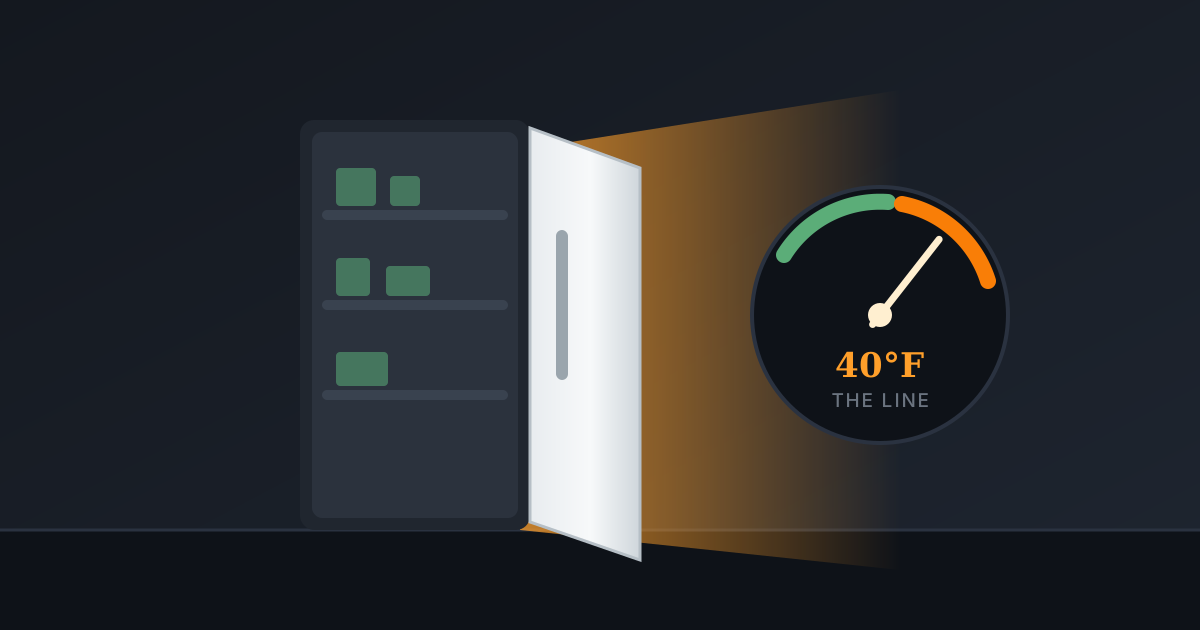
Keep a fridge thermometer. The USDA line is that food above 40°F for more than two hours is unsafe, and a photo of a thermometer reading 52°F is much harder to argue with than "it felt warm."
That last one is worth owning regardless of insurance — it is also how you decide what is safe to keep. What to throw out and what is fine covers the rules, and how long a freezer holds covers the timing.
The bit worth knowing about renters
Renters insurance often includes the same coverage, usually with a lower sublimit and the same on-premises language. If you rent, the building's outage is not your landlord's liability in most states — the food is yours and so is the loss. Check the same four words in your own policy.
The short version
- Coverage exists in many policies but is typically capped near $500.
- The common exclusion is off-premises power failure, which is exactly the kind of outage most people get.
- Your deductible often wipes out the claim entirely; a claim on your record can cost more than the food.
- Photograph the food, list it with prices, and screenshot the utility's outage timeline the same day.
- Two uncovered fridge-fulls in five years costs about the same as a mid-size power station. That is the real payback case.
The picks, in detail
Specs come from data/products.json, so they're the same everywhere on this site.
EcoFlow
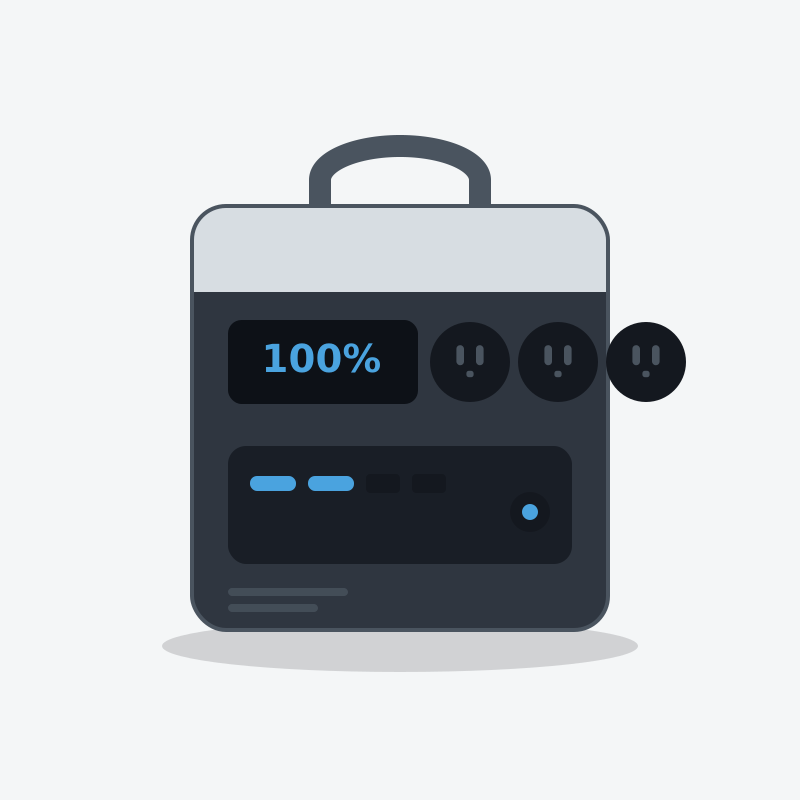
EcoFlow DELTA 2
The one most people should buy. It refills fast enough that a short sunny break between storm bands actually matters.
- Capacity
- 1,024 Wh
- AC output
- 1,800W
- Weight
- 27 lb
What's good
- Wall recharge is genuinely quick — useful when power flickers back for an hour
- LiFePO4 cells, so it tolerates being left plugged in for years
- Six AC outlets means no daisy-chained power strips on the kitchen counter
- Add an extra battery later instead of buying a whole second unit
What's annoying
- The fan is audible in a quiet bedroom at night
- 1800W ceiling rules out most space heaters and hair dryers
- Expansion batteries cost nearly as much as the unit itself
Who this is wrong for
Anyone who needs to power a well pump, an electric water heater or a central AC. It will not start them, and it is not a whole-home unit.
Anker
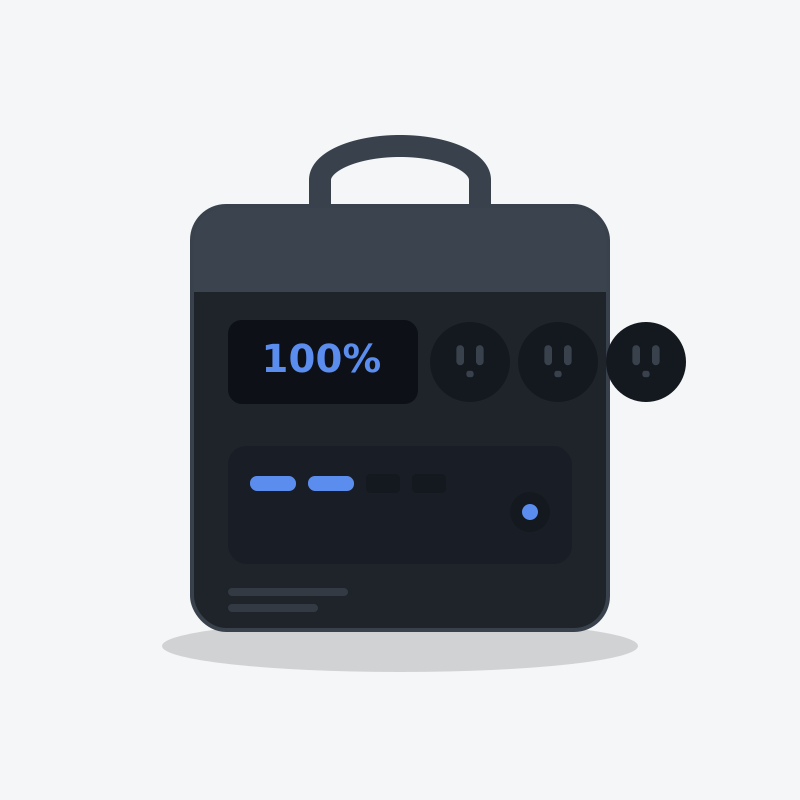
Anker SOLIX C1000
The best-built 1kWh unit on the market, and the one that fits an RV bay without a shoehorn.
- Capacity
- 1,056 Wh
- AC output
- 1,800W
- Weight
- 28.44 lb
What's good
- The most compact 1kWh box here — it genuinely fits where others don't
- Anker's warranty service is the least painful in this category
- Full wall recharge in under an hour
- Quiet fan behaviour under moderate load
What's annoying
- Expansion battery caps you at about 2,112Wh and is expensive
- Fewer solar input options than EcoFlow
- Anker discounts less often, so you rarely catch a deep sale
Who this is wrong for
People who need to run more than 1800W. And it won't grow with you — expansion is limited.
Questions people actually ask
Does homeowners insurance cover food spoiled in a power outage?
How much does insurance pay for spoiled food?
Should I file a claim for spoiled food?
What is an off-premises power failure exclusion?
Does renters insurance cover food spoilage?
Who wrote this
Dhruvil Domadiya
Founder and editor, GreenCommuteGuide
I started GreenCommuteGuide because backup power is sold with numbers that sound impressive and mean very little — watt-hours on the box, surge ratings that turn out to be a boost mode, charge times quoted to 80% and printed as though they were full. I set the rules this site runs on: every spec is checked against the manufacturer's own documentation, anything we have not verified is marked as unverified on the page rather than quietly published, prices are never shown because they go stale, and every review names at least one product not to buy and who it is wrong for. Where I have not tested something myself, the page says so.
- · Sets and enforces the editorial standards on this site — unverified claims are flagged on the page, and the build fails if they are not
- · Specs are taken from manufacturers' own published documentation, never from retailer listings, and the source and date are recorded for each product
- · No payment is accepted for a rating, a ranking, or a positive verdict
Read this next
- Home Outage & BackupHow to Keep Food Cold During a Power OutageYour fridge holds cold for four hours. Your freezer holds it for two days. Here is how to stretch both, and exactly when to throw things out.
- Home Outage & BackupHow Long Will a Freezer Stay Cold Without Power?48 hours full, 24 hours half full — if you keep the door shut. Here is how to stretch that, and exactly when to throw things out.
- Battery & Tech BasicsIs a Solar Generator Worth It? The Honest MathIt depends on one number: how often your power actually goes out. Here is the arithmetic, including the cases where the answer is no.
- Sizing & CalculatorsHow Long Will a 1000Wh Power Station Run a Fridge?Roughly 18 to 22 hours for a normal fridge — far longer than the arithmetic suggests, because of one thing about compressors most calculators get wrong.