Battery & Tech Basics
Can a Power Station Charge an Electric Car? (You Have It Backwards)
A 1,000Wh unit adds about three miles of range. The useful version of this idea runs the other way — your car is a far bigger battery than anything you can buy.
We earn a commission on purchases made through links on this page, at no extra cost to you. How this works.
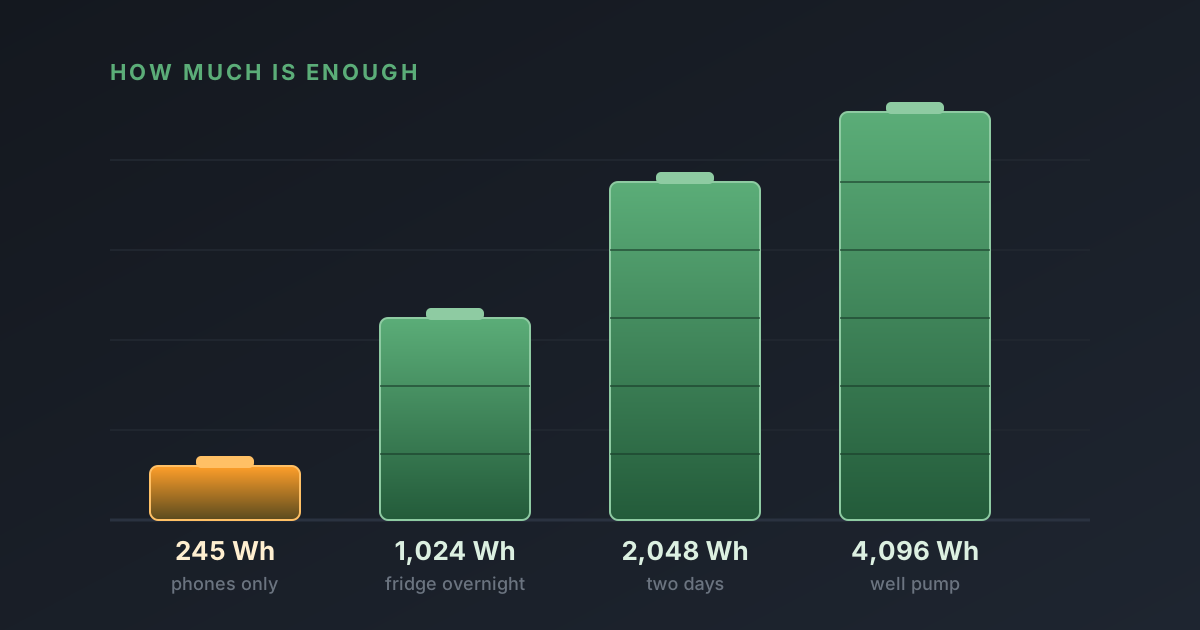
What's in this article
The math that ends the first question
An efficient EV travels roughly 3 to 4 miles per kilowatt-hour. So:
| Power station | Range added | Charge time (at 300W) |
|---|---|---|
| 500Wh | ~1.5 miles | ~2 hours |
| 1,000Wh | ~3 miles | ~3.5 hours |
| 2,000Wh | ~6 miles | ~7 hours |
| 4,000Wh | ~13 miles | ~14 hours |
Assuming 3.3 mi/kWh and losses in both the inverter and the car's onboard charger. Cold weather makes all of these worse.
Even the $3,000+ unit gets you thirteen miles. If you are stranded, thirteen miles might genuinely be the difference between sitting there and reaching a charger — which is the one legitimate use of this. But as a plan, it is not a plan.
There is also a compatibility wall. Most EVs charging from a standard 120V outlet want to draw around 1,200 watts, and many will not initiate a charge at all below a minimum current. A small unit either refuses to start the session or trips on the load. You need a 1,500W+ inverter just to begin, and then you are running that unit flat out for hours.
The version that actually works: the car powers the house
Several manufacturers now build vehicle-to-load (V2L) or vehicle-to-home (V2H) capability into their EVs and trucks. Some offer outlets built into the vehicle; some support powering a home through dedicated equipment.
The capability, the hardware required and the availability vary a great deal between manufacturers, models and model years. Check what your specific vehicle actually supports before planning around it — this is one of the fastest-moving areas in the category and we are not going to publish a table that will be wrong in six months.
But the scale is worth understanding. A modest EV pack is around 60kWh. A whole American house uses roughly 30kWh a day, and during an outage — when you are running four things, not forty — closer to 5 to 10kWh. That is days of backup sitting in your driveway.
No portable power station comes close, and none ever will, because they weigh 30 pounds and a car weighs 4,000.
What this means if you own an EV
Your backup power problem may already be solved, if your vehicle supports it. Find out. Look up your model's V2L or V2H capability, what equipment it needs, and what the outlet ratings are. This is a free answer that a lot of EV owners never look for.
If it does not support it, buy a power station like anyone else — and size it for the fridge and the heat, not for the car.
Do not buy a power station intending to charge the car in an outage. Three miles. It is the clearest no-buy on this site.
Keep the car charged before a storm. Same logic as filling a gas tank. If your vehicle has V2L and the pack is at 80% when the grid fails, you have a very good week. At 15%, you have a problem and no way to fix it.
The gas generator comparison
People ask whether a gas generator can charge an EV, and the answer is yes but badly. A 2,000W inverter generator adds maybe 6 miles per hour of running, burning fuel to do it. A DC fast charger does in ten minutes what that generator does in a day.
If range anxiety is the underlying worry, the answer is charging infrastructure planning, not backup power. If outage anxiety is the worry, the car is the asset, not the problem.
The one genuinely useful case
Keep a small power station in the vehicle for 12V accessories, phone charging, laptops and a tire inflator, and to jump-start a friend's gas car. Those are real uses that a 300–500Wh unit serves well, and it does not need to interact with the traction battery at all.
That is a $200–$300 purchase with a clear job. Buying a $3,000 unit to add thirteen miles is not.
The short version
- A 1,000Wh power station adds about three miles of range. This is not a viable charging plan.
- Many EVs will not even start a charge session from a small inverter.
- The useful direction is the reverse: an EV pack holds 60–100kWh, enough to run a house for days.
- Check whether your specific vehicle supports V2L or V2H, and what hardware it needs.
- Charge the car before the storm. That is the single most valuable thing an EV owner can do.
The picks, in detail
Specs come from data/products.json, so they're the same everywhere on this site.
EcoFlow
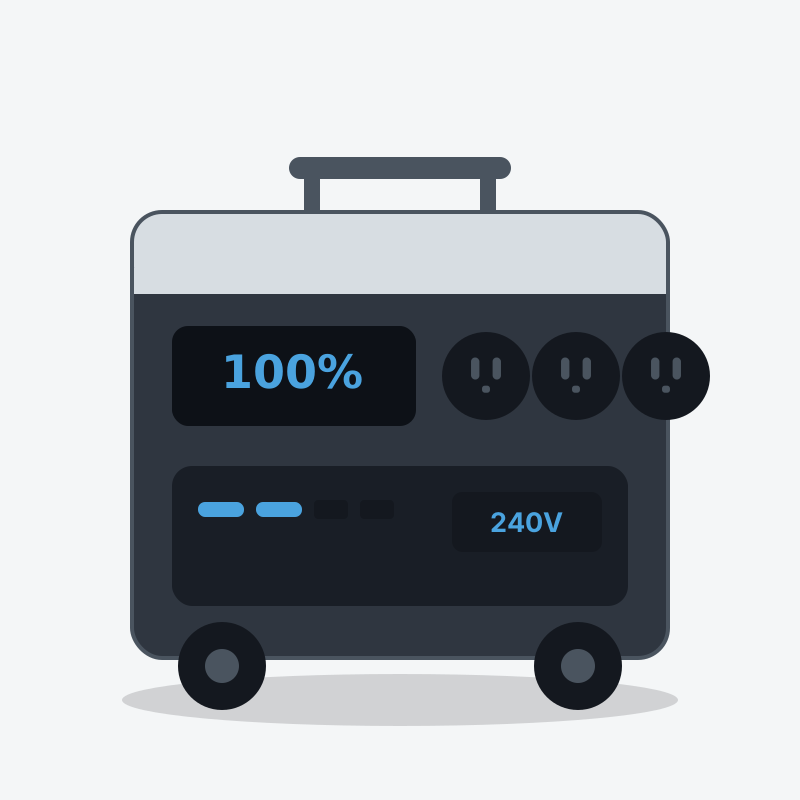
EcoFlow DELTA Pro 3
Specs unverifiedThe first portable unit that can honestly claim to back up parts of a house, including 240V circuits.
- Capacity
- 4,096 Wh
- AC output
- 4,000W
- Weight
- 113 lb
What's good
- 240V output covers well pumps and some dryers, which almost nothing else portable does
- Pairs with a transfer switch so you stop running extension cords through a window
- Chains with extra batteries into genuinely serious capacity
What's annoying
- Costs about the same as a permanently installed standby generator once you add a transfer switch
- 113 lb means it lives where you put it
- The install to make it useful is an electrician job, not a weekend project
Who this is wrong for
Anyone who wants to move it more than once. It has wheels for a reason, and stairs will beat you.
Anker
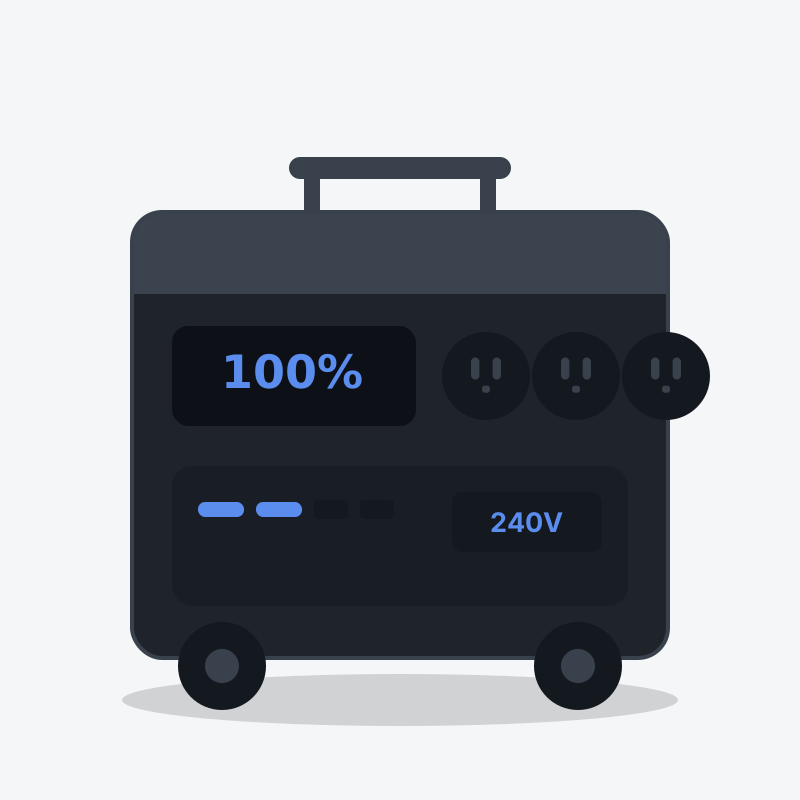
Anker SOLIX F3800
A home backup system wearing a portable power station's clothes. Treat it as an install, not a purchase.
- Capacity
- 3,840 Wh
- AC output
- 6,000W
- Weight
- 132.3 lb
What's good
- 6000W output covers nearly anything in a normal house, one at a time
- Real 240V, so the well pump and the dryer are on the table
- Stacks with expansion batteries into a very large bank
What's annoying
- 132 lb, and it needs a permanent home
- The transfer switch and electrician push the real cost well past the sticker
- At this price a standby generator deserves a serious look
Who this is wrong for
Renters. You cannot get the value out of it without wiring work you don't own.
Questions people actually ask
Can a power station charge an electric car?
Can an electric car power my house?
How much range does a power station add to an EV?
Is V2L worth having on an EV?
Who wrote this
Dhruvil Domadiya
Founder and editor, GreenCommuteGuide
I started GreenCommuteGuide because backup power is sold with numbers that sound impressive and mean very little — watt-hours on the box, surge ratings that turn out to be a boost mode, charge times quoted to 80% and printed as though they were full. I set the rules this site runs on: every spec is checked against the manufacturer's own documentation, anything we have not verified is marked as unverified on the page rather than quietly published, prices are never shown because they go stale, and every review names at least one product not to buy and who it is wrong for. Where I have not tested something myself, the page says so.
- · Sets and enforces the editorial standards on this site — unverified claims are flagged on the page, and the build fails if they are not
- · Specs are taken from manufacturers' own published documentation, never from retailer listings, and the source and date are recorded for each product
- · No payment is accepted for a rating, a ranking, or a positive verdict
Read this next
- Battery & Tech BasicsIs a Solar Generator Worth It? The Honest MathIt depends on one number: how often your power actually goes out. Here is the arithmetic, including the cases where the answer is no.
- Battery & Tech Basics9 Things a Solar Generator Will NOT RunEvery product page tells you what these can power. Nobody tells you what they can't. Here is the honest list, with the numbers.
- Sizing & CalculatorsHow Many Watts to Run a House During an Outage?The honest number is far smaller than the internet says — because you are not running a house, you are running four things in it.
- Battery & Tech BasicsWhat Extension Cord Do You Need for a Power Station?12 gauge, and shorter than you think. A thin 100-foot cord is why a fridge that should start on your battery doesn't.