Sizing & Calculators
How Many Watts to Run a House During an Outage?
The honest number is far smaller than the internet says — because you are not running a house, you are running four things in it.
We earn a commission on purchases made through links on this page, at no extra cost to you. How this works.
What's in this article
Type this question into Google and you get numbers between 3,000 and 12,000 watts. All of them are technically right and all of them are answering a question you didn't ask.
Because you are not trying to run a house. You're trying to keep four things alive in one.
Those are very different numbers.
The two questions people confuse
"How many watts to run my house normally?" — 5,000 to 7,500 watts for a typical US home, more with electric heat or an electric range. verify That's a standby generator conversation.
"How many watts to get through an outage?" — about 400.
Here's how that second number is built.
Adding it up honestly
| What | Running watts |
|---|---|
| Full-size fridge | ~150 |
| Wi-Fi router + modem | ~20 |
| LED lights, whole room | ~40 |
| Phones and a laptop | ~65 |
| Box fan | ~75 |
| All of it, at once | ~350 |
verify on each of those.
That's the entire outage for most households. Three hundred and fifty watts.
The number that actually matters
Running watts is the easy part. Startup surge is what trips units.
Anything with a motor spikes hard for under a second when it kicks on:
- Fridge: ~150W running, ~900W spike verify
- Sump pump: ~600W running, ~1,800W spike verify
- Well pump: ~800W running, ~2,500W spike verify
- Window AC 8,000 BTU: ~750W running, ~2,200W spike verify
If your inverter can't supply that instant, it shuts off. Full battery, doesn't matter.
So the real shopping rule is: find your biggest spike, then buy something that clears it comfortably. Capacity is the second question, not the first.
What each size actually covers
Swipe the table sideways to see every column.
| Price | |||||||
|---|---|---|---|---|---|---|---|
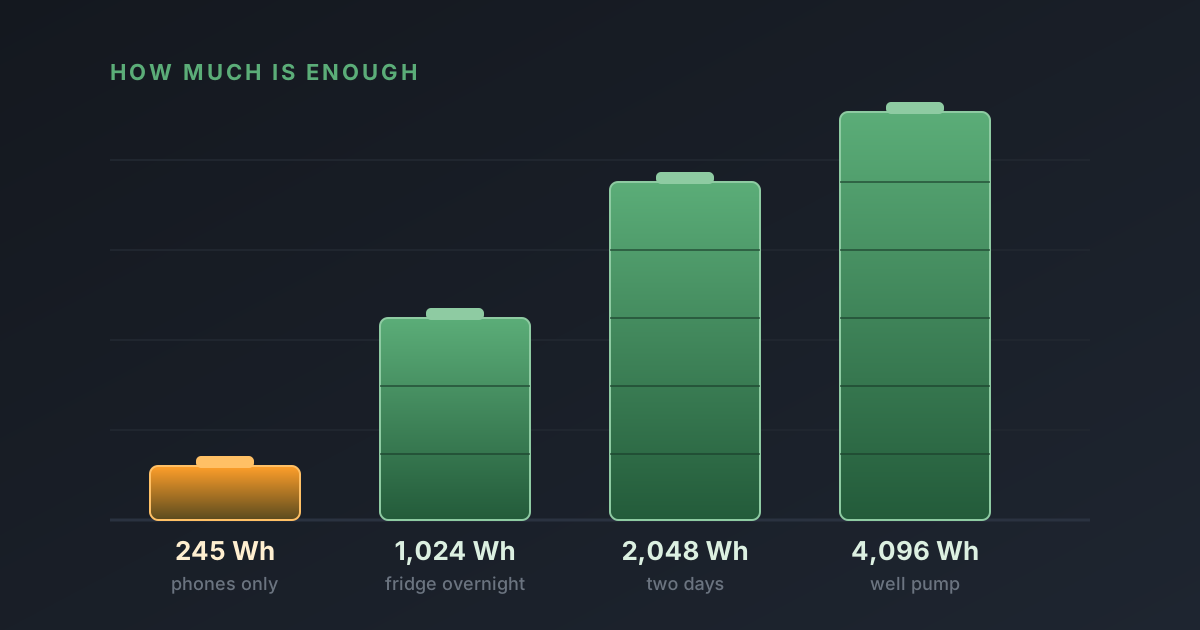
| EcoFlowEcoFlow DELTA Pro 3LiFePO4 · expandable | 4,096 Wh | 4,000W | 6,000W | 113 lb | — | 5 yr | Check price for EcoFlow DELTA Pro 3 (opens in a new tab, affiliate link) |
| BluettiBluetti AC200LLiFePO4 · expandable | 2,048 Wh | 2,400W | 3,600W | 61.9 lb | 55 min | 4 yr | Check price for Bluetti AC200L (opens in a new tab, affiliate link) |
| EcoFlowEcoFlow DELTA 2LiFePO4 · expandable | 1,024 Wh | 1,800W | 2,700W | 27 lb | 1h 20m | 5 yr | Check price for EcoFlow DELTA 2 (opens in a new tab, affiliate link) |
Specs come from data/products.json. Capacity is the figure on the box — real usable output is roughly 85% of it once you account for inverter losses.
1,800W output — fridge, internet, lights, fans, phones, a TV. Covers the 350W list with a lot of headroom for the fridge spike. This is where most people should be.
2,400W output — the above plus a small window AC for a couple of hours, or several things running simultaneously without thinking.
4,000W and 240V — well pump, some dryers, actual circuits. Needs a transfer switch and an electrician.
5,000W+ — you're buying a generator now, not a battery.
The things that break the budget
Four appliances account for almost all the difference between a $700 answer and a $4,000 one:
Electric heat. A 1,500W space heater eats a kilowatt-hour every forty minutes. Nothing portable solves this. If you have gas heat, powering just the furnace blower — around 400W — warms the whole house instead.
Air conditioning. A window unit is hours, not nights. Central air isn't a conversation.
Well pump. 240V and a huge spike. Different product category entirely.
Electric range or water heater. Don't. Use a camp stove and accept cold showers for two days.
Doing it for your own house
Go look at the label on the back of each appliance you actually care about.
If it lists watts, that's your number. If it lists amps, multiply by 120.
Then remember duty cycle — anything with a compressor or a thermostat cycles on and off. A fridge labelled 150W runs about a third of the time, so its daily energy use is far lower than 150 × 24. Missing this is the most expensive mistake in this whole category.
A Kill A Watt meter costs about as much as a pizza and gives you the real numbers for your actual appliances. If you're about to spend a thousand dollars, spending twenty to be sure is easy arithmetic.
Straight answer
About 400 watts runs what matters in a normal house during a normal outage.
Buy a unit with at least 1,800W output so the fridge spike never troubles it, and pick your capacity based on how many hours you need.
Anyone quoting you 7,500 watts is answering the question "how do I run my house as if nothing happened." That's a different product, a different budget, and for most people, a different problem entirely.
The picks, in detail
Specs come from data/products.json, so they're the same everywhere on this site.
EcoFlow
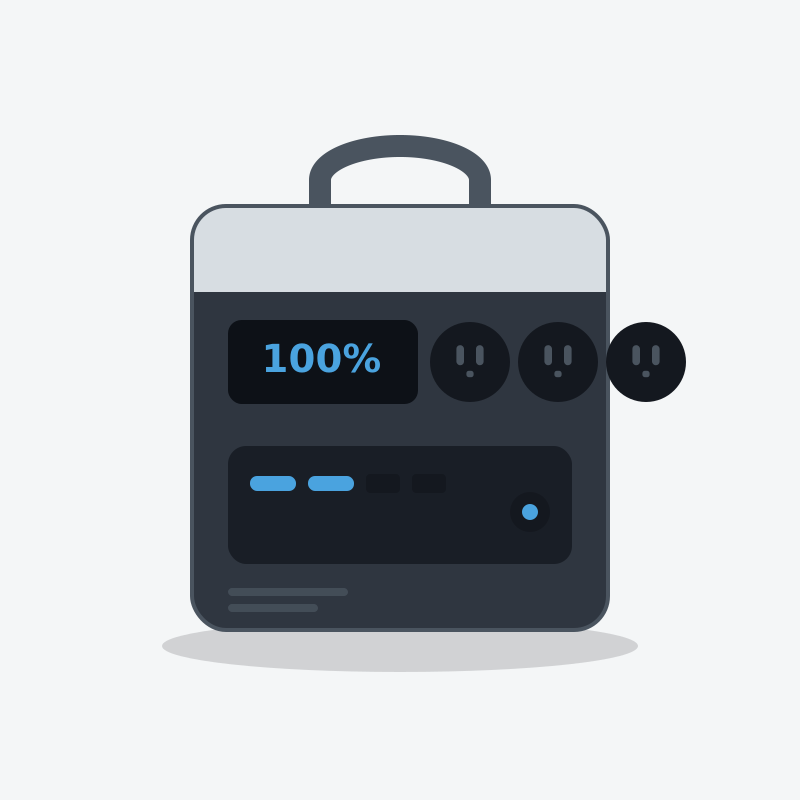
EcoFlow DELTA 2
The one most people should buy. It refills fast enough that a short sunny break between storm bands actually matters.
- Capacity
- 1,024 Wh
- AC output
- 1,800W
- Weight
- 27 lb
What's good
- Wall recharge is genuinely quick — useful when power flickers back for an hour
- LiFePO4 cells, so it tolerates being left plugged in for years
- Six AC outlets means no daisy-chained power strips on the kitchen counter
- Add an extra battery later instead of buying a whole second unit
What's annoying
- The fan is audible in a quiet bedroom at night
- 1800W ceiling rules out most space heaters and hair dryers
- Expansion batteries cost nearly as much as the unit itself
Who this is wrong for
Anyone who needs to power a well pump, an electric water heater or a central AC. It will not start them, and it is not a whole-home unit.

Bluetti
Bluetti AC200L
Specs unverifiedA lot of battery for the money, with the port selection of a small workshop.
- Capacity
- 2,048 Wh
- AC output
- 2,400W
- Weight
- 61.9 lb
What's good
- Expandable, unlike most Bluetti units at this size
- A genuinely useful spread of ports including a 30A RV outlet
- Fast recharge for a 2kWh unit
What's annoying
- Shorter warranty than EcoFlow and Jackery offer
- Big and awkward to store
- Bluetti's US service turnaround has been inconsistent
Who this is wrong for
Small apartments. It's physically large and you will trip over it.
EcoFlow
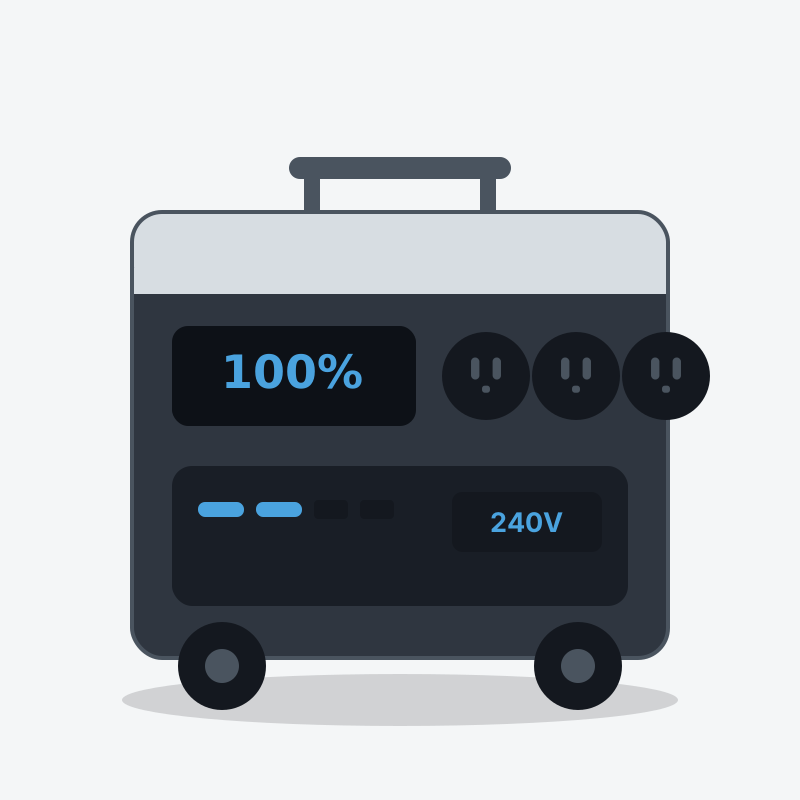
EcoFlow DELTA Pro 3
Specs unverifiedThe first portable unit that can honestly claim to back up parts of a house, including 240V circuits.
- Capacity
- 4,096 Wh
- AC output
- 4,000W
- Weight
- 113 lb
What's good
- 240V output covers well pumps and some dryers, which almost nothing else portable does
- Pairs with a transfer switch so you stop running extension cords through a window
- Chains with extra batteries into genuinely serious capacity
What's annoying
- Costs about the same as a permanently installed standby generator once you add a transfer switch
- 113 lb means it lives where you put it
- The install to make it useful is an electrician job, not a weekend project
Who this is wrong for
Anyone who wants to move it more than once. It has wheels for a reason, and stairs will beat you.
Questions people actually ask
How many watts does it take to run a house?
How many watts to run a refrigerator?
Will 2000 watts run a house?
How many watts for a whole house generator?
Is 1000 watts enough for an outage?
Who wrote this
Dhruvil Domadiya
Founder and editor, GreenCommuteGuide
I started GreenCommuteGuide because backup power is sold with numbers that sound impressive and mean very little — watt-hours on the box, surge ratings that turn out to be a boost mode, charge times quoted to 80% and printed as though they were full. I set the rules this site runs on: every spec is checked against the manufacturer's own documentation, anything we have not verified is marked as unverified on the page rather than quietly published, prices are never shown because they go stale, and every review names at least one product not to buy and who it is wrong for. Where I have not tested something myself, the page says so.
- · Sets and enforces the editorial standards on this site — unverified claims are flagged on the page, and the build fails if they are not
- · Specs are taken from manufacturers' own published documentation, never from retailer listings, and the source and date are recorded for each product
- · No payment is accepted for a rating, a ranking, or a positive verdict
Read this next
- Sizing & CalculatorsWhat Size Solar Generator Do I Need? (Free Calculator)Skip the guesswork. Tick the things you need to keep running, get a real watt-hour number, and see which units can actually do it.
- Sizing & CalculatorsWatt-Hours Explained: Wh, Ah and kWh Made SimpleWatts is how fast. Watt-hours is how much. Get those two straight and every spec sheet in this category stops being confusing.
- Sizing & CalculatorsSurge Watts vs Running Watts: What Actually Trips Your UnitYour battery is big enough and it still shut off. This is why, and it is the spec almost nobody checks before buying.
- Home Outage & BackupDo You Need a Transfer Switch for a Solar Generator?Extension cords work fine for most people. Here is exactly when they stop working, what a transfer switch costs, and the shortcut that kills lineworkers.