Battery & Tech Basics
What Extension Cord Do You Need for a Power Station?
12 gauge, and shorter than you think. A thin 100-foot cord is why a fridge that should start on your battery doesn't.
We earn a commission on purchases made through links on this page, at no extra cost to you. How this works.
What's in this article
Why the cord matters at all
Every foot of wire has resistance, and resistance turns voltage into heat. Push a big load down a thin, long cord and the voltage arriving at the appliance is meaningfully lower than the voltage leaving the battery.
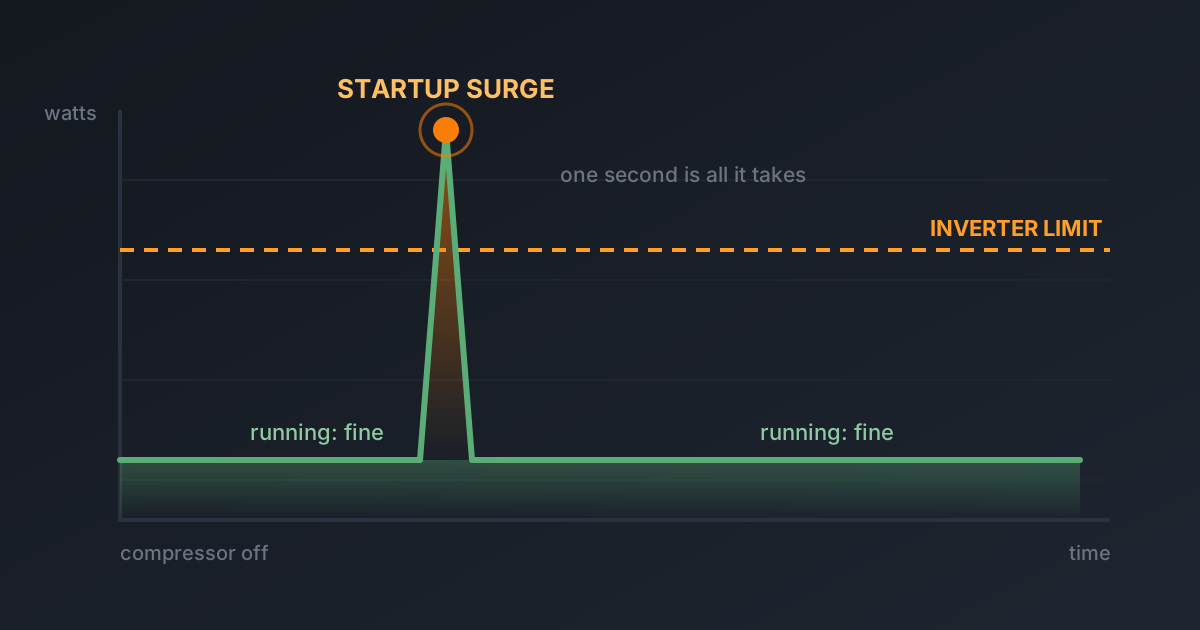
Motors hate this. A fridge compressor trying to start on 108 volts instead of 120 draws more current to compensate, which drops the voltage further, which makes it draw more still. The result is either a compressor that stalls, or a power station that reads the spike as an overload and shuts down.
You then blame the battery. The battery was fine.
The gauge table
Lower gauge number means thicker wire. This is backwards from every other measurement in your life and it catches everyone.
| Load | Up to 25 ft | 25–50 ft | 50–100 ft |
|---|---|---|---|
| Under 500W (lights, electronics) | 16 AWG | 16 AWG | 14 AWG |
| 500–1,000W (fridge, fans) | 14 AWG | 14 AWG | 12 AWG |
| 1,000–1,500W (microwave, kettle) | 14 AWG | 12 AWG | 12 AWG |
| 1,500W+ or any motor | 12 AWG | 12 AWG | 10 AWG |
General US 120V guidance. When in doubt, go thicker — a heavier cord is never the wrong choice, only the more expensive one.
The practical answer for most households: buy one 25-foot and one 50-foot 12-gauge cord and stop thinking about it. They cost $25–$45 each, they handle everything a portable power station can produce, and you will never have to work out which cord is which in the dark.
Five rules that matter more than the table
Uncoil it completely. A cord coiled on a reel under load builds heat with nowhere to go. This is a genuine fire cause, not a theoretical one. Unwind the whole thing even if you only need ten feet.
Never daisy-chain cords. Two 50-foot cords joined is worse than one 100-foot cord, because you have added resistance at the joint plus the length. If you need 100 feet, buy 100 feet.
Check the rating on the cord itself. It is printed on the jacket: gauge, length, and often an amp rating. A cord with no printing on it is a cord you should not trust with a compressor.
Outdoor runs need outdoor cords. Look for a W in the type code and a jacket meant for wet conditions. An indoor cord run through a wet doorway is an obvious hazard that people create every hurricane season.
Do not run cords under rugs or through doorways that close on them. Compression damages the insulation, and you will not see the damage.
What this means for your fridge
The most common real-world setup on this site is a power station in the hallway and a refrigerator in the kitchen. If that is 30 feet:
- 14 gauge minimum, 12 gauge preferred. A fridge compressor spikes to around 900W on start, and voltage drop at the moment of the spike is exactly when it hurts.
- Nothing else on that cord. A shared cord with a fan and a lamp adds load at precisely the wrong moment.
- Plug the fridge directly into the cord, not through a power strip.
If your fridge trips the unit despite adequate inverter headroom, the cord is the first thing to swap before concluding the battery is undersized. See Why Does My Fridge Trip the Power Station?
Power strips: yes, with a caveat
A surge-protecting power strip on a power station is fine and often convenient — several small loads on one outlet.
Two conditions: keep the total load well under the strip's rating, and do not put a motor on a strip shared with electronics. The startup spike from a compressor can trip the strip's own protection, killing everything plugged into it including your router.
Motors get their own cord. Everything else can share.
What we would buy
Two 12-gauge cords, 25 ft and 50 ft, in a colour you can see in the dark. A cheap outlet tester. That is under $80 total, and it is the difference between a backup plan that works and one that trips at 2am.
Store them with the power station, not in the garage with the Christmas lights. In an outage, the equipment you cannot find is equipment you do not own.
The short version
- 12 gauge for anything long or over 1,000W. 14 gauge for short moderate runs. 16 gauge for lamps only.
- Lower gauge number = thicker wire = less voltage drop.
- Always uncoil the cord fully. Never join two cords together.
- Voltage drop on a thin cord is a common reason a fridge will not start on an adequately-sized battery.
- Buy one 25 ft and one 50 ft 12-gauge cord and keep them with the unit.
The picks, in detail
Specs come from data/products.json, so they're the same everywhere on this site.
EcoFlow
EcoFlow DELTA 2
The one most people should buy. It refills fast enough that a short sunny break between storm bands actually matters.
- Capacity
- 1,024 Wh
- AC output
- 1,800W
- Weight
- 27 lb
What's good
- Wall recharge is genuinely quick — useful when power flickers back for an hour
- LiFePO4 cells, so it tolerates being left plugged in for years
- Six AC outlets means no daisy-chained power strips on the kitchen counter
- Add an extra battery later instead of buying a whole second unit
What's annoying
- The fan is audible in a quiet bedroom at night
- 1800W ceiling rules out most space heaters and hair dryers
- Expansion batteries cost nearly as much as the unit itself
Who this is wrong for
Anyone who needs to power a well pump, an electric water heater or a central AC. It will not start them, and it is not a whole-home unit.
Bluetti
Bluetti AC180
More watts per dollar than the famous brands, if you don't mind a slightly clunkier app.
- Capacity
- 1,152 Wh
- AC output
- 1,800W
- Weight
- 35.3 lb
What's good
- 2,700W of surge headroom, which is what actually starts a fridge compressor
- More capacity than the Jackery 1000 for often less money
- Takes expansion batteries, so it can grow to a serious bank later
- Quiet charging mode keeps it civilised in a bedroom
What's annoying
- 35 lb is heavy for 1.1kWh
- The app has historically been the weakest of the four big brands
- Full wall recharge is slower than the headline number suggests - the fast figure everyone quotes is to 80%, not full
- Only one USB-C port
Who this is wrong for
Anyone who wants hand-holding. Bluetti's documentation assumes you'll figure it out.
Questions people actually ask
What extension cord should I use with a power station?
Does extension cord gauge matter for a power station?
Why will my fridge not start on a long extension cord?
Can I use a power strip with a power station?
Who wrote this
Dhruvil Domadiya
Founder and editor, GreenCommuteGuide
I started GreenCommuteGuide because backup power is sold with numbers that sound impressive and mean very little — watt-hours on the box, surge ratings that turn out to be a boost mode, charge times quoted to 80% and printed as though they were full. I set the rules this site runs on: every spec is checked against the manufacturer's own documentation, anything we have not verified is marked as unverified on the page rather than quietly published, prices are never shown because they go stale, and every review names at least one product not to buy and who it is wrong for. Where I have not tested something myself, the page says so.
- · Sets and enforces the editorial standards on this site — unverified claims are flagged on the page, and the build fails if they are not
- · Specs are taken from manufacturers' own published documentation, never from retailer listings, and the source and date are recorded for each product
- · No payment is accepted for a rating, a ranking, or a positive verdict
Read this next
- Run This ApplianceWhy Does My Fridge Trip the Power Station?The compressor spikes to about 900 watts for half a second. That is the whole answer, and no amount of extra battery fixes it.
- Battery & Tech BasicsPower Station Says Overload — What Now?Get it running again in two minutes, then find out whether it was a one-off or the unit telling you it is too small for the job. The two need different answers.
- Home Outage & BackupDo You Need a Transfer Switch for a Solar Generator?Extension cords work fine for most people. Here is exactly when they stop working, what a transfer switch costs, and the shortcut that kills lineworkers.
- Battery & Tech BasicsCan a Power Station Charge an Electric Car? (You Have It Backwards)A 1,000Wh unit adds about three miles of range. The useful version of this idea runs the other way — your car is a far bigger battery than anything you can buy.