Run This Appliance
Can a Power Station Run a Coffee Maker?
Yes, and it costs less battery than you think — about 100Wh for a full pot. The mistake is leaving the warming plate on afterwards.
We earn a commission on purchases made through links on this page, at no extra cost to you. How this works.
What's in this article
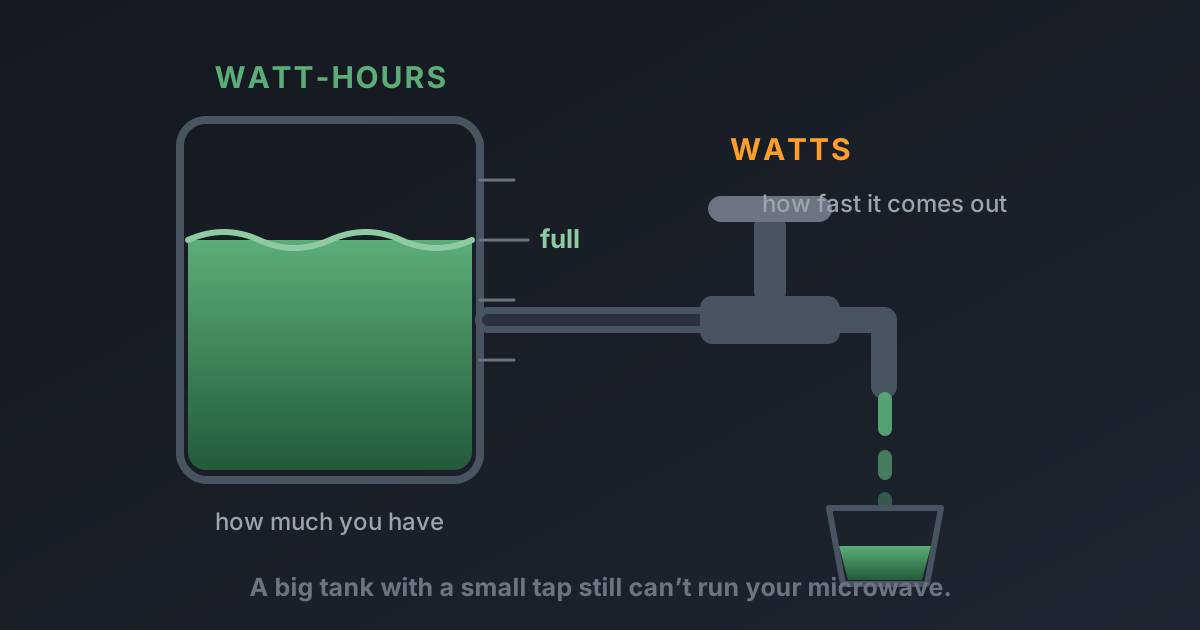
The two numbers
Watts (the wall): a drip coffee maker pulls 900–1,200 watts while heating. This is the number that decides whether your unit can run it at all. Under 1,000W of inverter and you will get an overload error.
Watt-hours (the cost): it only heats for about five minutes. 1,000 watts for five minutes is roughly 85Wh, call it 100Wh with losses.
| Appliance | Watts | Time | Energy used |
|---|---|---|---|
| Drip maker, 12-cup brew | 900–1,200W | ~5 min | ~100Wh |
| Warming plate | 60–100W | 2 hours | ~160Wh |
| Single-serve pod machine | 1,200–1,500W | ~2 min | ~45Wh |
| Electric kettle, 1 litre | 1,200–1,500W | ~4 min | ~90Wh |
| Espresso machine (pump) | 1,000–1,500W | varies | 50–150Wh |
Typical US 120V appliances. Your model's label gives the real wattage.
Look at rows one and two. The warming plate uses more energy than the brew does. Pour the coffee into a thermos and switch the machine off — that single habit saves more battery than any other trick in this article.
Which machines will and will not start
Will run on a 1,500W inverter: most drip makers, most pod machines, most kettles, most espresso machines.
Might not: cheap 600–1,000W inverters, which are common in the 300–500Wh class. A 1,200W pod machine on a 1,000W inverter trips instantly.
Will not, ever: anything with a built-in grinder plus a boiler running simultaneously on a small unit, and commercial machines.
This is a case where the surge is not the problem — heating elements are resistive and draw steadily rather than spiking. The continuous rating is what matters. If your unit says 1,500W continuous, you are fine.
The better answer during a long outage
If the power has been out for two days and you are rationing battery, do not use the coffee maker. Use a pour-over cone or a French press, and heat the water on a camp stove or a gas burner.
Reasons:
Gas stoves usually still work. Many US gas ranges light with a match even when the igniter has no power. Check yours — this is worth knowing before you need it.
Boiling water covers more than coffee. The same pot handles tea, instant meals and washing up.
A thermos of hot water in the morning is three coffees over four hours, on one heating event.
The battery you did not spend on coffee is battery available for the fridge, and the fridge is the appliance holding $400 of food.
When the coffee maker is exactly the right call
Short outages. A four-hour blackout with a full battery is not a rationing situation, and there is real value in a house where the morning still feels normal. 100Wh out of 1,000 is nothing.
The same goes for camping and tailgating, where the whole point of the battery is small comforts. A 500Wh unit with a 1,000W+ inverter makes coffee for a weekend without noticing.
What to buy
Do not buy a power station for coffee. Buy one for the fridge or the heat, and enjoy coffee as a side effect.
If you are picking between two units and you do want kitchen appliances to work, the 1,500W inverter is the line worth crossing. Below it, you are limited to fans, lights and electronics; above it, the microwave, kettle and coffee maker all come into range. That single spec changes what a battery feels like to live with more than an extra 500Wh of capacity does.
We break the same tradeoff down in Can a Power Station Run a Microwave?.
The short version
- A drip coffee maker draws 900–1,200W but only for five minutes: about 100Wh per pot.
- You need 1,200W+ of continuous inverter rating. Capacity is not the constraint here.
- The warming plate costs more than the brew. Use a thermos and switch it off.
- In a multi-day outage, use a French press and a gas burner and save the battery for food.
- If kitchen appliances matter to you, buy the 1,500W inverter rather than the extra capacity.
The picks, in detail
Specs come from data/products.json, so they're the same everywhere on this site.
EcoFlow
EcoFlow DELTA 2
The one most people should buy. It refills fast enough that a short sunny break between storm bands actually matters.
- Capacity
- 1,024 Wh
- AC output
- 1,800W
- Weight
- 27 lb
What's good
- Wall recharge is genuinely quick — useful when power flickers back for an hour
- LiFePO4 cells, so it tolerates being left plugged in for years
- Six AC outlets means no daisy-chained power strips on the kitchen counter
- Add an extra battery later instead of buying a whole second unit
What's annoying
- The fan is audible in a quiet bedroom at night
- 1800W ceiling rules out most space heaters and hair dryers
- Expansion batteries cost nearly as much as the unit itself
Who this is wrong for
Anyone who needs to power a well pump, an electric water heater or a central AC. It will not start them, and it is not a whole-home unit.
Bluetti
Bluetti AC180
More watts per dollar than the famous brands, if you don't mind a slightly clunkier app.
- Capacity
- 1,152 Wh
- AC output
- 1,800W
- Weight
- 35.3 lb
What's good
- 2,700W of surge headroom, which is what actually starts a fridge compressor
- More capacity than the Jackery 1000 for often less money
- Takes expansion batteries, so it can grow to a serious bank later
- Quiet charging mode keeps it civilised in a bedroom
What's annoying
- 35 lb is heavy for 1.1kWh
- The app has historically been the weakest of the four big brands
- Full wall recharge is slower than the headline number suggests - the fast figure everyone quotes is to 80%, not full
- Only one USB-C port
Who this is wrong for
Anyone who wants hand-holding. Bluetti's documentation assumes you'll figure it out.
Questions people actually ask
Can a power station run a coffee maker?
How many watts does a coffee maker use?
Why does my coffee maker drain the battery?
What is the better way to make coffee in a long outage?
Who wrote this
Dhruvil Domadiya
Founder and editor, GreenCommuteGuide
I started GreenCommuteGuide because backup power is sold with numbers that sound impressive and mean very little — watt-hours on the box, surge ratings that turn out to be a boost mode, charge times quoted to 80% and printed as though they were full. I set the rules this site runs on: every spec is checked against the manufacturer's own documentation, anything we have not verified is marked as unverified on the page rather than quietly published, prices are never shown because they go stale, and every review names at least one product not to buy and who it is wrong for. Where I have not tested something myself, the page says so.
- · Sets and enforces the editorial standards on this site — unverified claims are flagged on the page, and the build fails if they are not
- · Specs are taken from manufacturers' own published documentation, never from retailer listings, and the source and date are recorded for each product
- · No payment is accepted for a rating, a ranking, or a positive verdict
Read this next
- Run This ApplianceCan a Power Station Run a Microwave?Yes, if the inverter is big enough — and the surprise is that it barely dents the battery. The number that stops people is watts, not watt-hours.
- Battery & Tech BasicsPower Station Says Overload — What Now?Get it running again in two minutes, then find out whether it was a one-off or the unit telling you it is too small for the job. The two need different answers.
- Run This ApplianceKeeping Insulin and Medication Cold in a Power OutageThe first thing to know is that most insulin does not need a fridge as urgently as people think. The second is what to do about the insulin that does.
- Run This ApplianceHow Long Can a Power Station Run a Fan? (The Best Deal in Summer Backup)A day and a half on a 1,000Wh unit. Fans are the single most efficient thing you can plug into a battery in a heat wave, and almost nobody plans around them.