Battery & Tech Basics
Power Station Says Overload — What Now?
Get it running again in two minutes, then find out whether it was a one-off or the unit telling you it is too small for the job. The two need different answers.
We earn a commission on purchases made through links on this page, at no extra cost to you. How this works.
What's in this article
First, get it running again
- Unplug everything from the AC outlets. Not just the thing you think did it.
- Switch the AC output off at the button. On some units the error holds until you do this.
- Wait thirty seconds. The inverter needs a moment to reset.
- Switch AC back on. The error should clear.
- Reconnect one appliance at a time, largest first, watching the wattage display after each.
If the error returns with nothing plugged in, skip to the fault section at the bottom.
Now work out which limit you hit
This is the part that decides whether you have a habit to change or a unit that is wrong for the job.
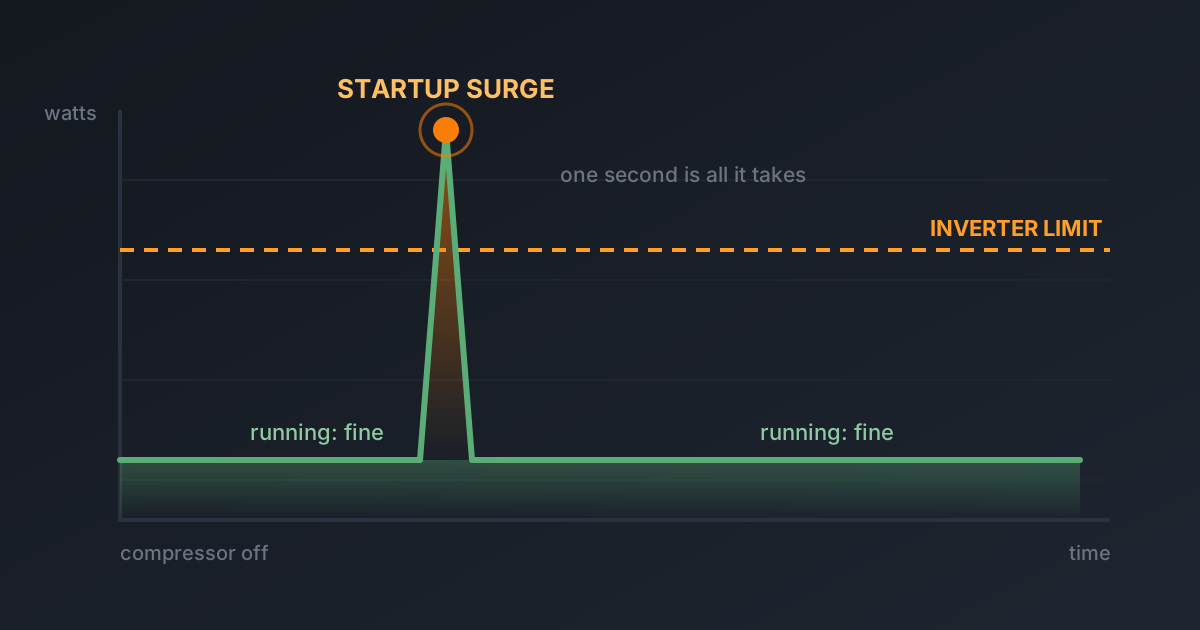
Did it trip the instant something switched on? That is a surge trip. A motor or compressor spiked past the surge ceiling for a fraction of a second.
Did it run fine for a while and then quit? That is a continuous overload. Your total draw sat above the inverter's sustained rating.
The distinction matters because a surge trip can happen at 200W of actual load, and a continuous overload cannot.
Surge trips: what actually spikes
Anything with a motor or a compressor draws far more starting than running.
| Appliance | Running | Startup spike |
|---|---|---|
| Full-size fridge | ~150W | ~900W |
| Chest freezer | ~100W | ~700W |
| Sump pump (1/3 HP) | ~600W | ~1,800W |
| Window AC (8,000 BTU) | ~750W | ~2,200W |
| Well pump (1/2 HP) | ~800W | ~2,500W |
| Space heater | 1,500W | no spike — 1,500W immediately |
verify on each figure above.
Note the last row. Heating elements have no startup spike at all — they just demand their full draw from the first instant. That is why a heater that is under your rating always works, and a fridge that is far under it sometimes does not.
Fixes for surge trips:
- Start things one at a time. Let the fridge finish its startup before plugging in anything else.
- A soft starter, if the culprit is an air conditioner. It smooths the spike and is standard practice on RV rooftop units.
- More surge headroom. Aim for at least 20 percent above your largest spike. This one means a different unit.
Fridge tripping it specifically is common enough that we wrote it up on its own.
Continuous overloads: do the arithmetic
Add up the running watts of everything connected. If that total is above your inverter's continuous rating, it will trip — the only question is how long it takes.
A worked example on an 1,800W unit:
| Running | Watts |
|---|---|
| Fridge | 150 |
| Space heater | 1,500 |
| Laptop + router | 100 |
| Two LED lamps | 20 |
| Total | 1,770 |
That is inside the rating with 30W to spare — until the fridge compressor kicks on and briefly asks for 900. Then you are at roughly 2,500W and it trips.
This is why "it worked for an hour then failed" is such a common story. The load did not change. The compressor cycled.
Fixes:
- Unplug the largest thing, which is nearly always a heating appliance
- Run high-draw items one at a time rather than together
- Leave real headroom — target 70 to 80 percent of the rating, not 98
The things that are simply too big
Some appliances are not a sizing problem. They are out of reach for portable units, and no setting changes that.
- Electric water heaters
- Electric ranges and ovens
- Central air conditioning
- Electric clothes dryers
- Well pumps above roughly 1/2 HP, on most units
If your overload is one of these, the honest answer is that this class of product does not do it. We list the full set in 9 things a solar generator will not run.
When it is a genuine fault
Everything so far assumes the protection circuit is right. Occasionally it is not.
Treat it as a fault when:
- The error appears with nothing plugged in
- It trips on a load you have measured well under the rating
- It trips instantly every time regardless of what is connected
- The case is hot while idle, or swollen, or smells acrid
That last one is not a troubleshooting step. Disconnect it, put it outside away from anything flammable, and contact the manufacturer without opening it.
If this keeps happening, you sized wrong
Worth being direct about, because it is the actual conclusion for a lot of people reading this.
An overload error once is a lesson. An overload error every time the fridge cycles is the unit telling you it cannot do the job you bought it for. There is no firmware update for that.
Before replacing it, get the number right — work out your real requirement, paying attention to the surge column rather than the watt-hours. Then look at what we recommend for outages, where every unit is listed with who it is wrong for as well as who it suits.
Swipe the table sideways to see every column.
| Price | |||||||
|---|---|---|---|---|---|---|---|
| BluettiBluetti AC180LiFePO4 · expandable | 1,152 Wh | 1,800W | 2,700W | 35.3 lb | 1h 48m | 5 yr | Check price for Bluetti AC180 (opens in a new tab, affiliate link) |
| AnkerAnker SOLIX C1000LiFePO4 · expandable | 1,056 Wh | 1,800W | 2,400W | 28.44 lb | 58 min | 5 yr | Check price for Anker SOLIX C1000 (opens in a new tab, affiliate link) |
| EcoFlowEcoFlow DELTA 2LiFePO4 · expandable | 1,024 Wh | 1,800W | 2,700W | 27 lb | 1h 20m | 5 yr | Check price for EcoFlow DELTA 2 (opens in a new tab, affiliate link) |
Specs come from data/products.json. Capacity is the figure on the box — real usable output is roughly 85% of it once you account for inverter losses.
The short version
Unplug, reset, reconnect one at a time. That fixes the immediate problem almost every time.
Then decide honestly which limit you hit. Continuous overload is a habit you can change. Repeated surge trips on a normal household appliance are a purchase you need to redo — and knowing which one you have is worth the two minutes it takes.
The picks, in detail
Specs come from data/products.json, so they're the same everywhere on this site.
EcoFlow
EcoFlow DELTA 2
The one most people should buy. It refills fast enough that a short sunny break between storm bands actually matters.
- Capacity
- 1,024 Wh
- AC output
- 1,800W
- Weight
- 27 lb
What's good
- Wall recharge is genuinely quick — useful when power flickers back for an hour
- LiFePO4 cells, so it tolerates being left plugged in for years
- Six AC outlets means no daisy-chained power strips on the kitchen counter
- Add an extra battery later instead of buying a whole second unit
What's annoying
- The fan is audible in a quiet bedroom at night
- 1800W ceiling rules out most space heaters and hair dryers
- Expansion batteries cost nearly as much as the unit itself
Who this is wrong for
Anyone who needs to power a well pump, an electric water heater or a central AC. It will not start them, and it is not a whole-home unit.
Anker
Anker SOLIX C1000
The best-built 1kWh unit on the market, and the one that fits an RV bay without a shoehorn.
- Capacity
- 1,056 Wh
- AC output
- 1,800W
- Weight
- 28.44 lb
What's good
- The most compact 1kWh box here — it genuinely fits where others don't
- Anker's warranty service is the least painful in this category
- Full wall recharge in under an hour
- Quiet fan behaviour under moderate load
What's annoying
- Expansion battery caps you at about 2,112Wh and is expensive
- Fewer solar input options than EcoFlow
- Anker discounts less often, so you rarely catch a deep sale
Who this is wrong for
People who need to run more than 1800W. And it won't grow with you — expansion is limited.
Bluetti
Bluetti AC180
More watts per dollar than the famous brands, if you don't mind a slightly clunkier app.
- Capacity
- 1,152 Wh
- AC output
- 1,800W
- Weight
- 35.3 lb
What's good
- 2,700W of surge headroom, which is what actually starts a fridge compressor
- More capacity than the Jackery 1000 for often less money
- Takes expansion batteries, so it can grow to a serious bank later
- Quiet charging mode keeps it civilised in a bedroom
What's annoying
- 35 lb is heavy for 1.1kWh
- The app has historically been the weakest of the four big brands
- Full wall recharge is slower than the headline number suggests - the fast figure everyone quotes is to 80%, not full
- Only one USB-C port
Who this is wrong for
Anyone who wants hand-holding. Bluetti's documentation assumes you'll figure it out.
Questions people actually ask
How do I clear an overload error on a power station?
Does an overload error damage the power station?
Why does my power station overload with plenty of battery left?
What is the difference between an overload and a surge trip?
Can I use a power station at 100 percent of its rated output?
Who wrote this
Dhruvil Domadiya
Founder and editor, GreenCommuteGuide
I started GreenCommuteGuide because backup power is sold with numbers that sound impressive and mean very little — watt-hours on the box, surge ratings that turn out to be a boost mode, charge times quoted to 80% and printed as though they were full. I set the rules this site runs on: every spec is checked against the manufacturer's own documentation, anything we have not verified is marked as unverified on the page rather than quietly published, prices are never shown because they go stale, and every review names at least one product not to buy and who it is wrong for. Where I have not tested something myself, the page says so.
- · Sets and enforces the editorial standards on this site — unverified claims are flagged on the page, and the build fails if they are not
- · Specs are taken from manufacturers' own published documentation, never from retailer listings, and the source and date are recorded for each product
- · No payment is accepted for a rating, a ranking, or a positive verdict
Read this next
- Sizing & CalculatorsSurge Watts vs Running Watts: What Actually Trips Your UnitYour battery is big enough and it still shut off. This is why, and it is the spec almost nobody checks before buying.
- Battery & Tech BasicsWhy Did My Power Station Shut Off By Itself?Nine times out of ten it is the startup surge, not the battery. Here is how to tell which of the five causes you have, in about a minute.
- Run This ApplianceWhy Does My Fridge Trip the Power Station?The compressor spikes to about 900 watts for half a second. That is the whole answer, and no amount of extra battery fixes it.
- Home Outage & BackupBest Solar Generators for Power Outages in 2026Which battery actually gets your family through the night, which one is a waste of money, and how to tell the difference before you spend.