Run This Appliance
Keeping Insulin and Medication Cold in a Power Outage
The first thing to know is that most insulin does not need a fridge as urgently as people think. The second is what to do about the insulin that does.
We earn a commission on purchases made through links on this page, at no extra cost to you. How this works.
What's in this article
Step one: read the actual storage line
Every prescription has a storage instruction, and they are not the same. Roughly:
- In-use insulin — usually room temperature for a defined number of days, and specifically must not be frozen.
- Unopened insulin — refrigerated, typically 36–46°F.
- Some biologics and injectables — narrower ranges and shorter grace periods.
- Most tablets — no refrigeration at all, but keep them out of heat above about 86°F.
Two practical rules apply to almost all of them: do not freeze and do not cook. Freezing destroys insulin outright, and a hot car in July will ruin more medication than any outage.
Call your pharmacy and ask what happens to your prescription after 8, 24 and 48 hours without refrigeration. Do it on a normal Tuesday. Write the answer on a card and tape it inside the fridge door. During the outage you will not want to be on hold.
Step two: use the fridge you already have
A closed refrigerator holds safe temperature for about four hours. That is free, and it is enough for most outages.
Push it further: keep the medication in the back of the middle shelf, not the door. The door is the warmest part of the fridge and the first place to fail. Put a fridge thermometer next to it so you are reading a number instead of guessing.
Frozen water bottles in the fridge extend the hold time meaningfully. Freeze a few now.
Step three: powered options, cheapest first
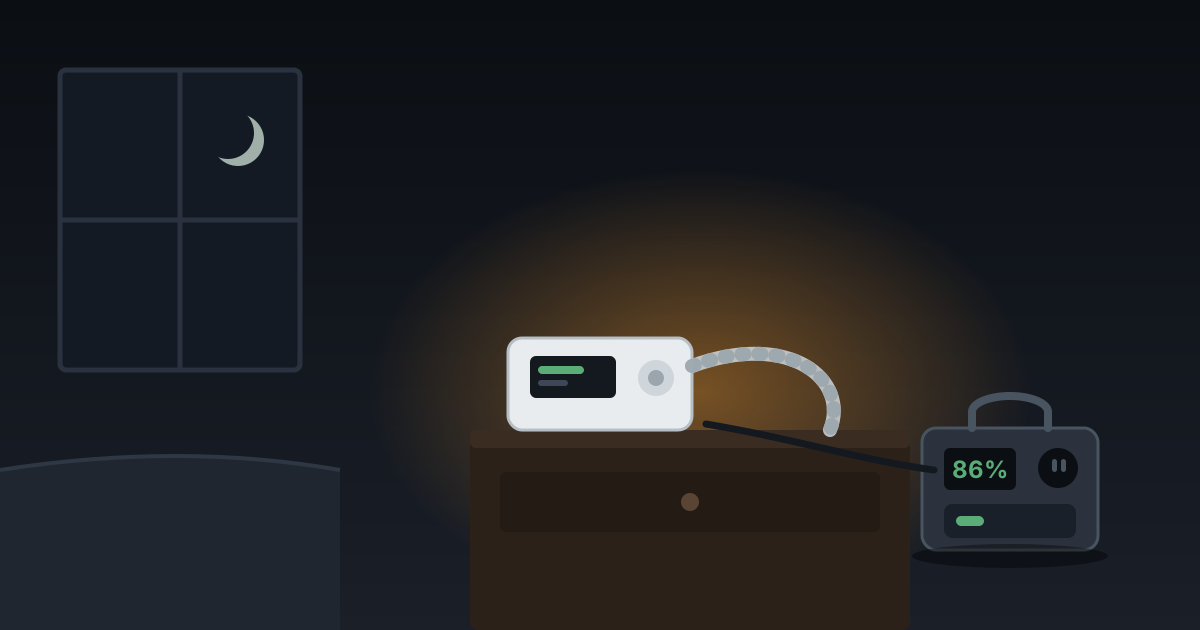
A 12V medication cooler. These draw roughly 40–60 watts, which is nothing. A 500Wh power station runs one for the best part of a day; a 1,000Wh unit runs it for two. This is the correct answer for most people, and the whole setup — small cooler plus small battery — is a few hundred dollars.
A powered cooler you already own for camping usually works the same way. Check its temperature range: many camping coolers cool to a fixed number of degrees below ambient rather than to a set temperature, which in a 90°F house may not get you to 46°F.
Running the whole fridge off a power station. Works, costs more energy, and is the right call if you also have food to protect. A typical fridge on a 1,000Wh unit runs 18 to 22 hours.
Do not buy a 2,000Wh+ battery solely to keep insulin cold. A small cooler and a small battery does the job for a quarter of the money, and it is portable, which matters if you end up leaving the house.
Step four: the unpowered backup that always works
A hard cooler with ice packs — not loose ice — keeps medication in range for a day or more, and it needs no electricity at all.
Two things to get right:
Never let the medication touch the ice pack directly. Insulin against a frozen pack will freeze, and frozen insulin is ruined even after it thaws. Wrap the vial or pen in a towel, or put it in a small container inside the cooler.
Put the thermometer inside the cooler. Same principle as everything else on this site: read the number, do not estimate it.
Evaporative cooling pouches are the other option worth knowing. They use no power at all, work by wetting a gel layer, and hold a moderate temperature for a couple of days. They are not a substitute for refrigeration where refrigeration is required, but they are excellent for a hot house or for travelling.
Step five: the call you should make before the outage
If someone in the house depends on refrigerated medication or on powered medical equipment, get on your utility's medical baseline or life-support customer list. It does not guarantee your power stays on, but it usually means priority restoration information, advance notice of planned shutoffs, and in some states a higher usage allowance at a lower rate.
It is free, it takes a form signed by your doctor, and almost nobody does it. See Medical Baseline and Life-Support Utility Programs.
Also ask your pharmacy about their emergency supply policy. Many will replace medication spoiled in a declared emergency, and many will fill early ahead of a forecast storm. Both are worth knowing before you need them.
The plan, in order
- Know your medication's actual storage requirement, in writing, before anything happens.
- Keep the fridge shut. Four hours is free.
- Move to a hard cooler with ice packs, medication wrapped, thermometer inside.
- If the outage is going long, run a 12V medication cooler off a small power station.
- Be on your utility's medical baseline list, and know your pharmacy's emergency policy.
The short version
- In-use insulin usually tolerates room temperature for a defined period; unopened supply is the urgent problem.
- Never let medication freeze, and never store it against an ice pack.
- A 12V medication cooler draws 40–60W, so a small battery runs it for a day or more.
- A hard cooler with ice packs is the zero-power backup and it works.
- Register for your utility's medical baseline program now, not during the storm.
If you are ever unsure whether medication is still safe to use, ask your pharmacist rather than guessing. Replacing a vial is cheaper than the alternative.
The picks, in detail
Specs come from data/products.json, so they're the same everywhere on this site.
Anker
Anker SOLIX C300
The one you actually carry. Small, quiet, and built better than anything else this size.
- Capacity
- 288 Wh
- AC output
- 300W
- Weight
- 9.1 lb
What's good
- Built-in light that is actually useful, not a gimmick
- Three USB-C ports, one of them high wattage for laptops
- Charges from empty in about an hour
What's annoying
- 300W ceiling — this powers electronics, not appliances
- Small capacity disappears fast if you plug in anything with a motor
- Priced close to units with three times the capacity on sale
Who this is wrong for
Home backup. If your outage plan is a 288Wh box, you don't have an outage plan.
EcoFlow
EcoFlow DELTA 2
The one most people should buy. It refills fast enough that a short sunny break between storm bands actually matters.
- Capacity
- 1,024 Wh
- AC output
- 1,800W
- Weight
- 27 lb
What's good
- Wall recharge is genuinely quick — useful when power flickers back for an hour
- LiFePO4 cells, so it tolerates being left plugged in for years
- Six AC outlets means no daisy-chained power strips on the kitchen counter
- Add an extra battery later instead of buying a whole second unit
What's annoying
- The fan is audible in a quiet bedroom at night
- 1800W ceiling rules out most space heaters and hair dryers
- Expansion batteries cost nearly as much as the unit itself
Who this is wrong for
Anyone who needs to power a well pump, an electric water heater or a central AC. It will not start them, and it is not a whole-home unit.
Questions people actually ask
How do I keep insulin cold during a power outage?
Does insulin have to be refrigerated?
What is the best way to keep medication cold without power?
Who should I call before an outage happens?
Who wrote this
Dhruvil Domadiya
Founder and editor, GreenCommuteGuide
I started GreenCommuteGuide because backup power is sold with numbers that sound impressive and mean very little — watt-hours on the box, surge ratings that turn out to be a boost mode, charge times quoted to 80% and printed as though they were full. I set the rules this site runs on: every spec is checked against the manufacturer's own documentation, anything we have not verified is marked as unverified on the page rather than quietly published, prices are never shown because they go stale, and every review names at least one product not to buy and who it is wrong for. Where I have not tested something myself, the page says so.
- · Sets and enforces the editorial standards on this site — unverified claims are flagged on the page, and the build fails if they are not
- · Specs are taken from manufacturers' own published documentation, never from retailer listings, and the source and date are recorded for each product
- · No payment is accepted for a rating, a ranking, or a positive verdict
Read this next
- Run This ApplianceBest Solar Generator for Medical Equipment at HomeA battery should be one layer of your plan, never the whole plan. Here is how to size it properly and what to arrange before you need it.
- Home Outage & BackupHow to Keep Food Cold During a Power OutageYour fridge holds cold for four hours. Your freezer holds it for two days. Here is how to stretch both, and exactly when to throw things out.
- Run This ApplianceCan a Power Station Run a Coffee Maker?Yes, and it costs less battery than you think — about 100Wh for a full pot. The mistake is leaving the warming plate on afterwards.
- Run This ApplianceHow Long Can a Power Station Run a Fan? (The Best Deal in Summer Backup)A day and a half on a 1,000Wh unit. Fans are the single most efficient thing you can plug into a battery in a heat wave, and almost nobody plans around them.