Run This Appliance
Can a Power Station Run a Portable AC Unit?
Yes, for about an hour. That is the whole honest answer, and here is what to do instead when it is 105°F and the grid is down.
We earn a commission on purchases made through links on this page, at no extra cost to you. How this works.
What's in this article
The arithmetic
A portable AC does not just remove heat — it also has to fight the hot air it pulls back into the room through the gap around the hose. That inefficiency shows up in the wattage.
| Unit size | Running watts | Startup surge |
|---|---|---|
| 8,000 BTU | 900–1,100W | 2,000W+ |
| 10,000 BTU | 1,100–1,300W | 2,400W+ |
| 12,000 BTU | 1,300–1,500W | 2,800W+ |
Typical figures for single-hose US units. Dual-hose models are more efficient per BTU but draw similar power.
A 10,000 BTU unit at 1,200 watts, on a 1,000Wh battery, gives you 50 minutes. On a 2,000Wh battery, an hour and forty. On a 4,000Wh battery — a unit costing over $3,000 — you get about three and a half hours.
Compressors also do not cycle off much in real heat. Unlike a fridge, an AC fighting a 100°F afternoon runs close to continuously, so you do not get the duty-cycle discount that makes freezers and fridges so much cheaper than they look.
Surge is the second wall
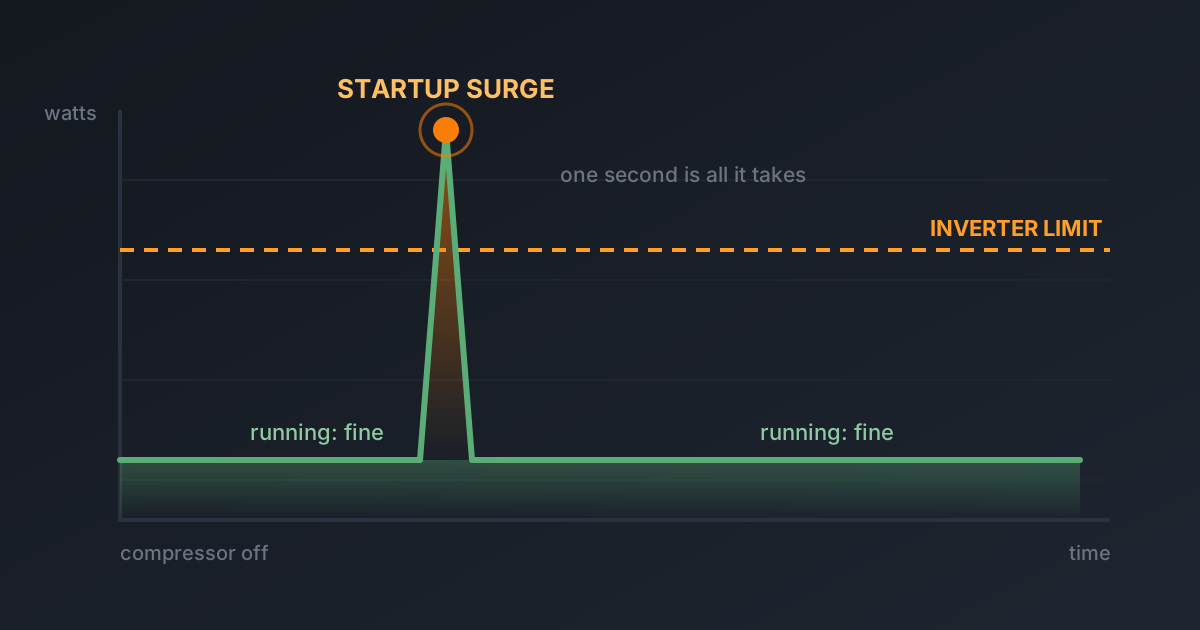
Even if you accept the short runtime, most units will not start. A 2,400-watt surge on a 1,800W inverter is an instant overload error, and your battery shuts off with 95% charge showing.
You need a power station in the 3,000W+ inverter class, or a unit with a soft-start-equipped AC. That is a $2,500-and-up purchase to get 90 minutes of cooling.
What actually works in the heat
This is the part worth reading, because heat kills more Americans in outages than cold does.
Fans, and lots of them. A box fan draws 50–100 watts. A 1,000Wh battery runs one for a full day and a half. Moving air over skin lowers your effective temperature by several degrees, and it costs a twentieth of what AC costs. See Can a Power Station Run a Ceiling Fan or Box Fan?.
Water. Wet a shirt or a towel, sit in front of the fan. Evaporation does the work the compressor was going to do, for free. This is not a folk remedy — it is the same physics, without the electricity.
Close the house in the morning, open it at night. Blinds down, windows shut while the sun is up. Open everything the moment the outside temperature drops below the inside. Most people do this backwards.
Go to one room. A single small room with a fan, blinds down and the door shut is survivable. The whole house is not.
Leave. This is the honest one. When the heat index goes past about 105°F and there is no power, the correct move is a cooling center, a mall, a library, or a friend's house across town on a different circuit. No battery you can afford changes that. Buying a power station and then staying in a dangerously hot house because you own one is the failure mode we worry about most.
The one AC that does make sense on a battery
A window unit is a genuinely different proposition. It is more efficient than a portable, it draws less for the same cooling, and a small 5,000 BTU unit at around 450 watts runs for two hours on a 1,000Wh battery — or overnight on a 4,000Wh one. That is still expensive cooling, but it is not absurd.
We covered the honest numbers in Can a Power Station Run a Window AC Unit?.
If cooling is genuinely the reason you are buying, buy the window unit and the bigger battery, not the portable and the mid-size one.
Do not buy this combination
Do not buy a 1,000Wh unit to run a portable AC. It will not start it, and if it does, you get under an hour. This is the most common wrong purchase in the summer half of this category, and it is usually made in a panic during a heat wave.
Do not buy a 12,000 BTU portable expecting the battery to catch up on solar. A 200W panel produces roughly 1 kWh on a good day. Your AC eats that in 50 minutes.
If you already own both
Use them together, but use them right. Run the AC for 30–40 minutes to knock the room temperature down, in the one room you have closed off, then shut it off and run a fan on the cooled air. You will get several usable hours out of a battery instead of one continuous one — the same burst logic that works for freezers.
Do it in the evening, not the afternoon. Cooling a room at 4pm against a 105°F exterior is throwing energy away; cooling it at 9pm keeps you comfortable through the night.
The short version
- A 10,000 BTU portable AC draws about 1,200W and empties a 1,000Wh battery in under an hour.
- Startup surge of 2,000W+ means most mid-size units will not even start it.
- Fans plus water plus one closed room is the plan that actually works, at a twentieth of the power.
- A small window unit is meaningfully more efficient if you must have compressor cooling.
- Past a heat index of about 105°F with no power, leaving the house is the right answer, not a bigger battery.
The picks, in detail
Specs come from data/products.json, so they're the same everywhere on this site.

Bluetti
Bluetti AC200L
Specs unverifiedA lot of battery for the money, with the port selection of a small workshop.
- Capacity
- 2,048 Wh
- AC output
- 2,400W
- Weight
- 61.9 lb
What's good
- Expandable, unlike most Bluetti units at this size
- A genuinely useful spread of ports including a 30A RV outlet
- Fast recharge for a 2kWh unit
What's annoying
- Shorter warranty than EcoFlow and Jackery offer
- Big and awkward to store
- Bluetti's US service turnaround has been inconsistent
Who this is wrong for
Small apartments. It's physically large and you will trip over it.
EcoFlow
EcoFlow DELTA Pro 3
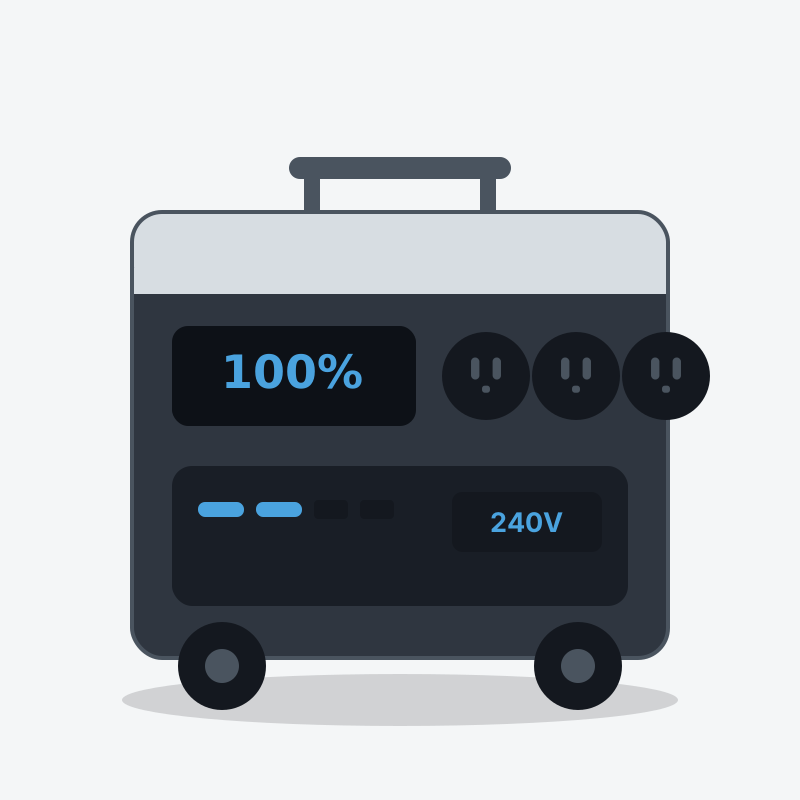
Specs unverifiedThe first portable unit that can honestly claim to back up parts of a house, including 240V circuits.
- Capacity
- 4,096 Wh
- AC output
- 4,000W
- Weight
- 113 lb
What's good
- 240V output covers well pumps and some dryers, which almost nothing else portable does
- Pairs with a transfer switch so you stop running extension cords through a window
- Chains with extra batteries into genuinely serious capacity
What's annoying
- Costs about the same as a permanently installed standby generator once you add a transfer switch
- 113 lb means it lives where you put it
- The install to make it useful is an electrician job, not a weekend project
Who this is wrong for
Anyone who wants to move it more than once. It has wheels for a reason, and stairs will beat you.
Questions people actually ask
Can a power station run a portable AC unit?
How many watts does a portable air conditioner use?
What should I use instead of an AC in an outage?
Is any air conditioning practical on a battery?
Who wrote this
Dhruvil Domadiya
Founder and editor, GreenCommuteGuide
I started GreenCommuteGuide because backup power is sold with numbers that sound impressive and mean very little — watt-hours on the box, surge ratings that turn out to be a boost mode, charge times quoted to 80% and printed as though they were full. I set the rules this site runs on: every spec is checked against the manufacturer's own documentation, anything we have not verified is marked as unverified on the page rather than quietly published, prices are never shown because they go stale, and every review names at least one product not to buy and who it is wrong for. Where I have not tested something myself, the page says so.
- · Sets and enforces the editorial standards on this site — unverified claims are flagged on the page, and the build fails if they are not
- · Specs are taken from manufacturers' own published documentation, never from retailer listings, and the source and date are recorded for each product
- · No payment is accepted for a rating, a ranking, or a positive verdict
Read this next
- Run This ApplianceCan a Power Station Run a Window AC Unit?Yes, for a few hours, and only on a big unit. Here is the honest math, the surge that trips most batteries, and what to do instead.
- Your State's GridPhoenix Heat Outages: The Backup Power RealityNo battery you can afford will air-condition a house at 115°F. Here is what backup power is actually for in Arizona, and the decision that matters more than any purchase.
- Battery & Tech Basics9 Things a Solar Generator Will NOT RunEvery product page tells you what these can power. Nobody tells you what they can't. Here is the honest list, with the numbers.
- Run This ApplianceKeeping Insulin and Medication Cold in a Power OutageThe first thing to know is that most insulin does not need a fridge as urgently as people think. The second is what to do about the insulin that does.