Sizing & Calculators
Watt-Hours Explained: Wh, Ah and kWh Made Simple
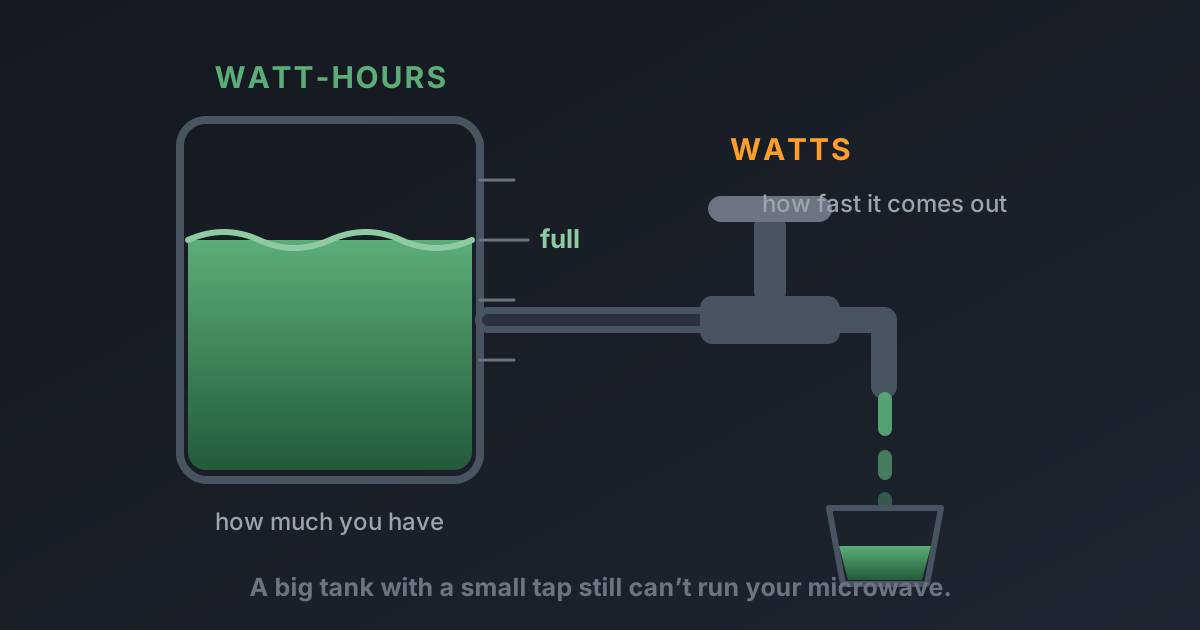
Watts is how fast. Watt-hours is how much. Get those two straight and every spec sheet in this category stops being confusing.
We earn a commission on purchases made through links on this page, at no extra cost to you. How this works.
What's in this article
You're comparing two batteries. One says 1000Wh. The other says 100Ah. A third says 1kWh.
They're describing the same kind of thing in three different languages, and one of them is deliberately confusing.
Ten minutes here and no spec sheet in this category will trip you up again.
The only analogy you need
Think about a car.
Watts is your speed. Miles per hour. How hard the thing is working right now.
Watt-hours is your fuel tank. How far you can go before you stop.
A 100W light bulb runs at 100 watts whether it's on for one minute or ten hours. The wattage never changes. What changes is how many watt-hours it has eaten.
Why this matters when you're shopping
Two units, same price. One is 2,000Wh with a 1,000W inverter. The other is 1,000Wh with an 1,800W inverter.
The first has a bigger tank. The second has a bigger engine.
If you need to run a 1,500W appliance, the first one simply cannot do it. It doesn't do it slowly. It refuses, and shuts off.
Capacity tells you how long. Output tells you whether.
Amp-hours, and why they're used to confuse you
Amp-hours (Ah) measure charge, not energy. To get energy you need voltage too.
Amp-hours × volts = watt-hours.
A 100Ah battery at 12V is 1,200Wh. A 100Ah battery at 24V is 2,400Wh. Same "100Ah" on the label, twice the energy.
That's why RV and marine listings quote amp-hours: it makes small batteries sound bigger. Whenever you see Ah, find the voltage before you compare anything.
Kilowatt-hours
One kilowatt-hour = 1,000 watt-hours. It's the unit on your electric bill.
So a 1,000Wh power station holds exactly one kWh. The average US home uses somewhere around 30 kWh a day. verify
That comparison is worth sitting with. Your power station holds about 45 minutes of your normal household consumption.
Which is not a reason to despair — it's a reason to stop trying to run your whole house. You're not replacing the grid. You're keeping four important things alive.
The 15 percent nobody mentions
You don't get the number on the box.
The inverter that turns battery DC into wall-socket AC loses energy as heat. Figure on about 85 percent of the rated capacity actually reaching your appliance. verify
So a 1,000Wh unit gives you roughly 850 usable watt-hours. Cold weather takes more. This is why our runtime figures apply that discount rather than quoting the marketing number.
| Appliance | EcoFlow DELTA 21,024 Wh |
|---|---|
| Full-size refrigerator~150W running, cycles ~35% of the time | 17 hr |
| CPAP (no humidifier)~40W running | 22 hr |
| LED lights (whole room)~40W running | 22 hr |
| Microwave~1100W running | 47 min |
| Space heater (1500W)~1500W running | 35 min |
Look at the microwave and the space heater. Same battery, wildly different outcomes. That's watts doing the work — high-wattage appliances eat a tank fast no matter how big the tank is.
Doing it for your own house
Find the label on the back of the appliance. It gives watts, or it gives amps.
If it gives amps, multiply by 120 for a standard US outlet. A 5A appliance is about 600W.
Then multiply by hours. That's your watt-hours.
Then add 30 percent for inverter losses and the sensible habit of not draining a battery to zero.
That's the whole method. It's the same arithmetic our calculator runs — you can absolutely do it on the back of an envelope.
The one mistake almost everyone makes
Forgetting duty cycle.
Your fridge is labeled 150W. It does not use 150W for 24 hours. The compressor runs about a third of the time, so the real daily figure is closer to 1,200Wh, not 3,600Wh. verify
Anything with a compressor or a thermostat cycles: fridges, freezers, well pumps, sump pumps, air conditioners.
Miss this and you'll size for three times what you need, and spend accordingly. It's the single most expensive misunderstanding in this whole category.
The picks, in detail
Specs come from data/products.json, so they're the same everywhere on this site.
EcoFlow
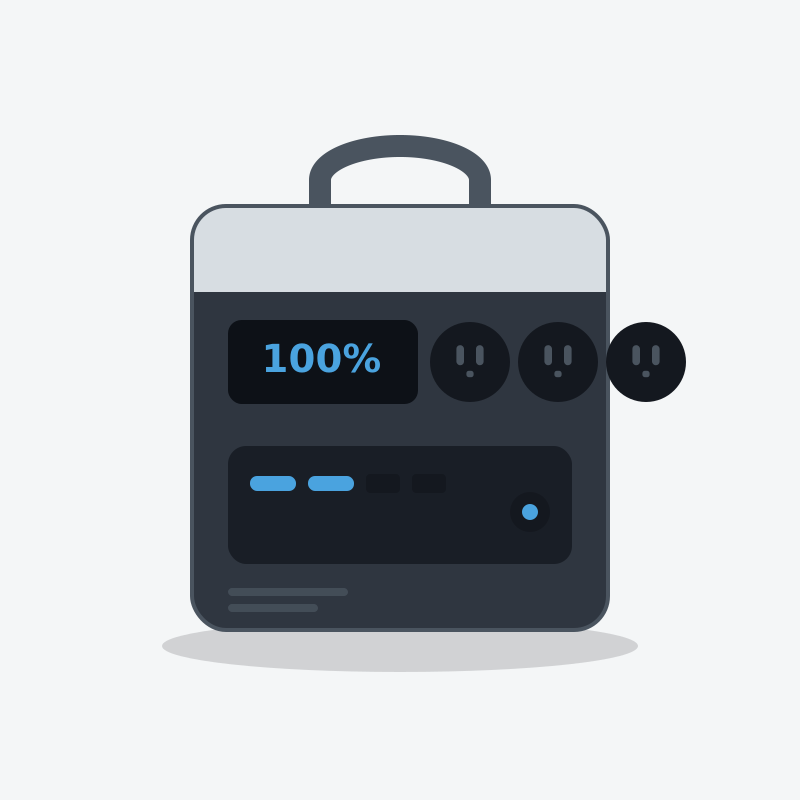
EcoFlow DELTA 2
The one most people should buy. It refills fast enough that a short sunny break between storm bands actually matters.
- Capacity
- 1,024 Wh
- AC output
- 1,800W
- Weight
- 27 lb
What's good
- Wall recharge is genuinely quick — useful when power flickers back for an hour
- LiFePO4 cells, so it tolerates being left plugged in for years
- Six AC outlets means no daisy-chained power strips on the kitchen counter
- Add an extra battery later instead of buying a whole second unit
What's annoying
- The fan is audible in a quiet bedroom at night
- 1800W ceiling rules out most space heaters and hair dryers
- Expansion batteries cost nearly as much as the unit itself
Who this is wrong for
Anyone who needs to power a well pump, an electric water heater or a central AC. It will not start them, and it is not a whole-home unit.
Questions people actually ask
What is the difference between watts and watt-hours?
How do I convert amp-hours to watt-hours?
What is a kilowatt-hour?
Why does my power station give less than its rated watt-hours?
Is a higher watt-hour number always better?
Who wrote this
Dhruvil Domadiya
Founder and editor, GreenCommuteGuide
I started GreenCommuteGuide because backup power is sold with numbers that sound impressive and mean very little — watt-hours on the box, surge ratings that turn out to be a boost mode, charge times quoted to 80% and printed as though they were full. I set the rules this site runs on: every spec is checked against the manufacturer's own documentation, anything we have not verified is marked as unverified on the page rather than quietly published, prices are never shown because they go stale, and every review names at least one product not to buy and who it is wrong for. Where I have not tested something myself, the page says so.
- · Sets and enforces the editorial standards on this site — unverified claims are flagged on the page, and the build fails if they are not
- · Specs are taken from manufacturers' own published documentation, never from retailer listings, and the source and date are recorded for each product
- · No payment is accepted for a rating, a ranking, or a positive verdict
Read this next
- Sizing & CalculatorsWhat Size Solar Generator Do I Need? (Free Calculator)Skip the guesswork. Tick the things you need to keep running, get a real watt-hour number, and see which units can actually do it.
- Sizing & CalculatorsSurge Watts vs Running Watts: What Actually Trips Your UnitYour battery is big enough and it still shut off. This is why, and it is the spec almost nobody checks before buying.
- Sizing & CalculatorsHow Long Will a 1000Wh Power Station Run a Fridge?Roughly 18 to 22 hours for a normal fridge — far longer than the arithmetic suggests, because of one thing about compressors most calculators get wrong.
- Sizing & CalculatorsHow Many Watts to Run a House During an Outage?The honest number is far smaller than the internet says — because you are not running a house, you are running four things in it.