Run This Appliance
Best Solar Generator for Medical Equipment at Home
A battery should be one layer of your plan, never the whole plan. Here is how to size it properly and what to arrange before you need it.
We earn a commission on purchases made through links on this page, at no extra cost to you. How this works.
What's in this article
If you're reading this, someone in your house depends on a machine that needs electricity. That changes the tone of everything below.
So let's start with the part that matters most, before any product talk.
Size for double, then check surge
Normal sizing advice adds 30% headroom. For medical equipment, double your calculation.
Reasons: outages run longer than forecast, cold reduces capacity, batteries age, and the cost of being wrong is not spoiled food.
Then check the surge rating separately. Anything with a compressor — a concentrator, some pumps — spikes at startup. A unit that can't supply that instant trips regardless of how full it is.
What the common equipment actually draws
These are typical figures. Get your own model's real draw from its label or your supplier — variation between models is large and this is not a place to rely on an internet estimate.
| Equipment | Typical running draw | Notes |
|---|---|---|
| CPAP, humidifier off | ~40W | verify Turning the humidifier off roughly halves the load |
| CPAP, humidifier on | ~90W | verify The heater is most of the cost |
| Home oxygen concentrator | ~350W | verify Continuous, and it is a heavy sustained load |
| Portable concentrator | far lower | Varies enormously by model |
| Feeding pump | low | Usually has its own internal battery |
| Powered wheelchair charger | varies | Charges intermittently, not continuous |
| Appliance | EcoFlow DELTA 21,024 Wh | Bluetti AC200L2,048 Wh | EcoFlow DELTA Pro 34,096 Wh |
|---|---|---|---|
| CPAP (no humidifier)~40W running | 22 hr | 44 hr | 87 hr |
| CPAP with heated humidifier~90W running | 9.7 hr | 19 hr | 39 hr |
| Oxygen concentrator~350W running | 2.5 hr | 5.0 hr | 9.9 hr |
| Full-size refrigerator~150W running, cycles ~35% of the time | 17 hr | 33 hr | 66 hr |
Look at the oxygen concentrator row. That is the load that changes your budget, because it runs continuously and it runs all night.
What we'd buy
CPAP only: roughly 700–1,000Wh
A size bracket rather than one product, because the humidifier setting moves the requirement more than the model choice does.
Around 700Wh covers a night with the humidifier on, or two nights without. verify Units at this size are light, quiet at these loads, and sit on a nightstand without dominating the room.
Not enough for: anyone with an oxygen concentrator. A continuous 350W load is a different problem entirely and nothing in this bracket is close.
Before you buy: measure your own machine. CPAP draw varies enough between models and pressure settings that a generic figure is a starting point, not an answer — and for equipment someone depends on overnight, the margin needs to be real rather than estimated.
CPAP plus the fridge: EcoFlow DELTA 2
1,024Wh, 1,800W output. Runs the CPAP all night and still protects the food, which is the realistic combined problem for most households.
Refills from the wall in about 80 minutes, so a brief return of power genuinely restores your night. verify
Who it's wrong for: continuous high-draw equipment. Same limitation.
Oxygen concentrator, one night: Bluetti AC200L
2,048Wh. Roughly five hours on a 350W concentrator with real-world losses — so this is one night with careful management, not two.
If that sounds tight, it is. That's the honest number, and it's why the doubling rule matters here.
Who it's wrong for: anyone who needs multi-day coverage. Then you're in the next category.
Multi-day, or life-critical: EcoFlow DELTA Pro 3
4,096Wh, expandable, with 240V if you also need a well pump.
At this level you should also be pricing a standby generator and talking to an electrician about a transfer switch. It stops being a purchase and becomes an installation.
Practical things that cost nothing
Turn the CPAP humidifier off. It roughly halves the draw. A dry throat for one night beats a dead battery at 4am.
Use the DC output where your device supports it. Running through the AC inverter converts DC to AC and back to DC, losing energy twice. Check the voltage and polarity carefully first — getting it wrong damages the device.
Keep it plugged in permanently. LiFePO4 units are designed for this, and it means the pack is at 100% whenever the grid drops instead of at 60%.
Test it under real load before you need it. Ten minutes, on a normal day. Finding out your unit trips on the concentrator's startup is not something to discover in an emergency.
What we would not buy
A "medical battery" from a medical supply company at three times the price — unless it's the manufacturer's own unit for your specific device, in which case it may genuinely be the right choice. A generic branded battery at a medical markup usually isn't.
Anything under 500Wh for a concentrator. It will not last and the false confidence is worse than having nothing.
A gas generator as the primary plan. It cannot run indoors, and carbon monoxide kills people every year after storms. For medical equipment specifically, the battery's ability to sit safely in the same room is the entire point.
The honest summary
For a CPAP, this is a solved problem for a few hundred dollars.
For a concentrator, it's expensive, and one battery buys you one night. Plan accordingly — and please make the supplier call and the utility registration today, before you buy anything at all.
The picks, in detail
Specs come from data/products.json, so they're the same everywhere on this site.
EcoFlow
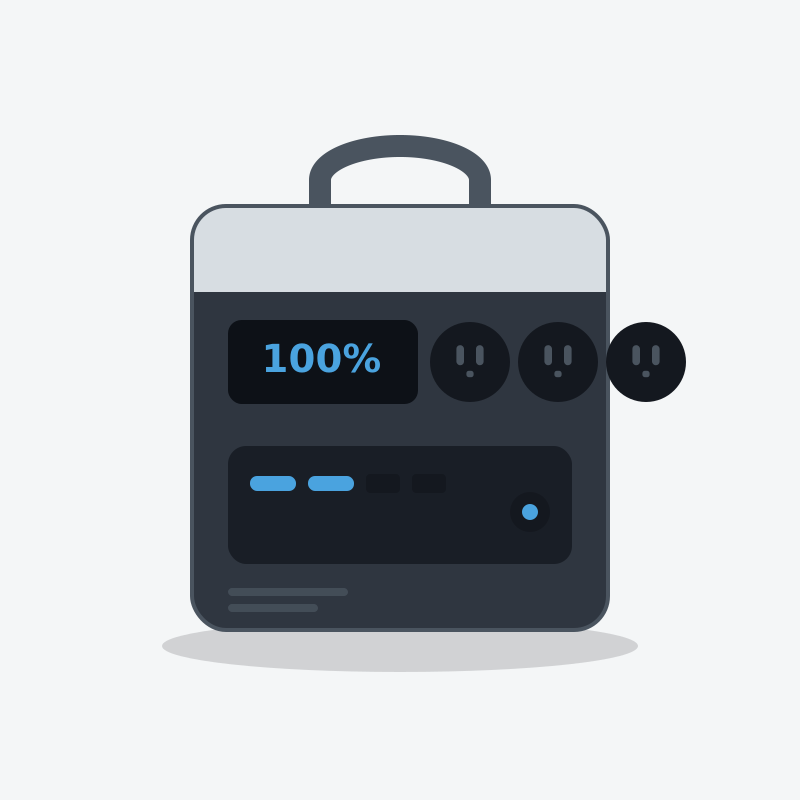
EcoFlow DELTA 2
The one most people should buy. It refills fast enough that a short sunny break between storm bands actually matters.
- Capacity
- 1,024 Wh
- AC output
- 1,800W
- Weight
- 27 lb
What's good
- Wall recharge is genuinely quick — useful when power flickers back for an hour
- LiFePO4 cells, so it tolerates being left plugged in for years
- Six AC outlets means no daisy-chained power strips on the kitchen counter
- Add an extra battery later instead of buying a whole second unit
What's annoying
- The fan is audible in a quiet bedroom at night
- 1800W ceiling rules out most space heaters and hair dryers
- Expansion batteries cost nearly as much as the unit itself
Who this is wrong for
Anyone who needs to power a well pump, an electric water heater or a central AC. It will not start them, and it is not a whole-home unit.
Bluetti
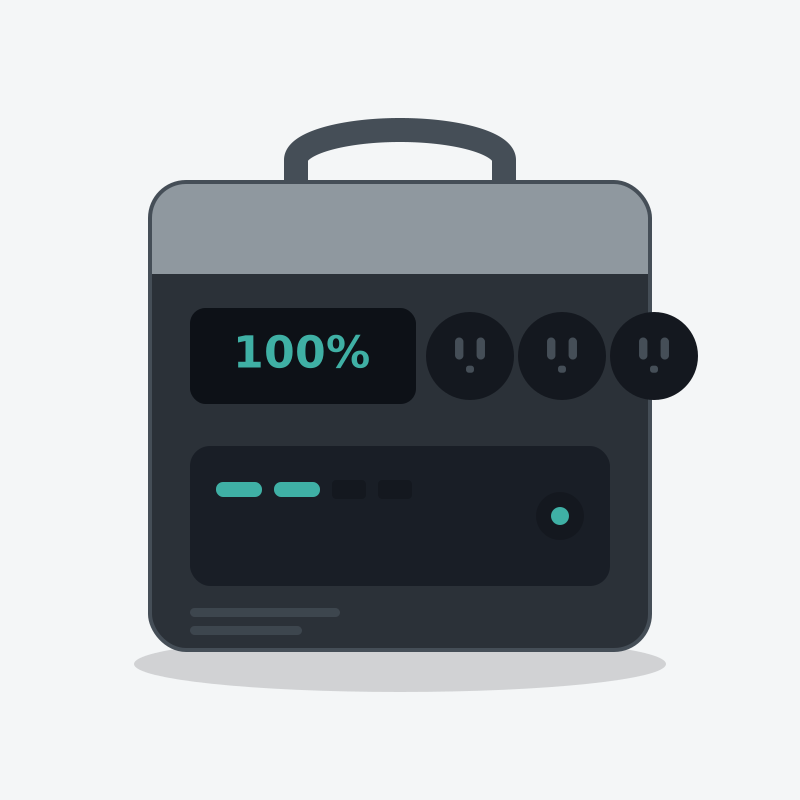
Bluetti AC200L
Specs unverifiedA lot of battery for the money, with the port selection of a small workshop.
- Capacity
- 2,048 Wh
- AC output
- 2,400W
- Weight
- 61.9 lb
What's good
- Expandable, unlike most Bluetti units at this size
- A genuinely useful spread of ports including a 30A RV outlet
- Fast recharge for a 2kWh unit
What's annoying
- Shorter warranty than EcoFlow and Jackery offer
- Big and awkward to store
- Bluetti's US service turnaround has been inconsistent
Who this is wrong for
Small apartments. It's physically large and you will trip over it.
EcoFlow
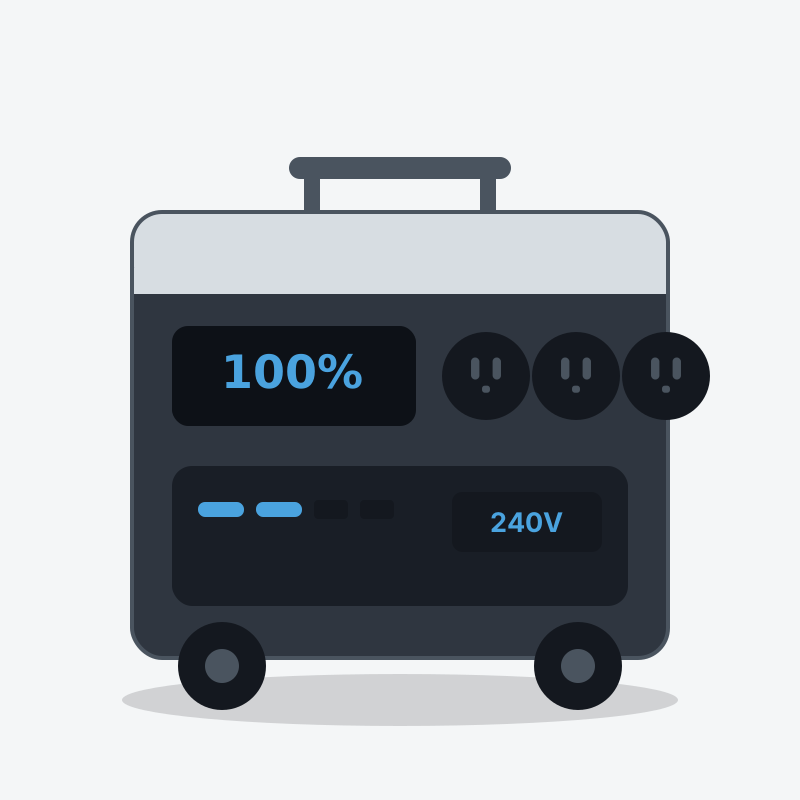
EcoFlow DELTA Pro 3
Specs unverifiedThe first portable unit that can honestly claim to back up parts of a house, including 240V circuits.
- Capacity
- 4,096 Wh
- AC output
- 4,000W
- Weight
- 113 lb
What's good
- 240V output covers well pumps and some dryers, which almost nothing else portable does
- Pairs with a transfer switch so you stop running extension cords through a window
- Chains with extra batteries into genuinely serious capacity
What's annoying
- Costs about the same as a permanently installed standby generator once you add a transfer switch
- 113 lb means it lives where you put it
- The install to make it useful is an electrician job, not a weekend project
Who this is wrong for
Anyone who wants to move it more than once. It has wheels for a reason, and stairs will beat you.
Questions people actually ask
What size power station do I need for medical equipment?
Can a power station run an oxygen concentrator?
Should I tell my utility about medical equipment?
Is a battery enough for life-critical equipment?
Can I use a power station in the bedroom overnight?
Who wrote this
Dhruvil Domadiya
Founder and editor, GreenCommuteGuide
I started GreenCommuteGuide because backup power is sold with numbers that sound impressive and mean very little — watt-hours on the box, surge ratings that turn out to be a boost mode, charge times quoted to 80% and printed as though they were full. I set the rules this site runs on: every spec is checked against the manufacturer's own documentation, anything we have not verified is marked as unverified on the page rather than quietly published, prices are never shown because they go stale, and every review names at least one product not to buy and who it is wrong for. Where I have not tested something myself, the page says so.
- · Sets and enforces the editorial standards on this site — unverified claims are flagged on the page, and the build fails if they are not
- · Specs are taken from manufacturers' own published documentation, never from retailer listings, and the source and date are recorded for each product
- · No payment is accepted for a rating, a ranking, or a positive verdict
Read this next
- Run This ApplianceBest Solar Generator for a CPAP MachineYou need one night, not a whole house. Turn the humidifier off and a small battery does the job for a fraction of what people tell you to spend.
- Your State's GridCalifornia PSPS Backup Power: What to Buy Before the Next ShutoffPSPS events are scheduled, not random. That changes everything about what you should buy — and it makes solar panels far more useful here than elsewhere.
- Sizing & CalculatorsWhat Size Solar Generator Do I Need? (Free Calculator)Skip the guesswork. Tick the things you need to keep running, get a real watt-hour number, and see which units can actually do it.
- Home Outage & BackupMedical Baseline and Life-Support Utility Programs: The Free Thing Almost Nobody Signs Up ForIt takes one form and a doctor's signature. It can mean advance notice of shutoffs, priority restoration information, and in some states a lower bill. It does not mean your power stays on.