Battery & Tech Basics
Why Won't My Power Station Charge from Solar?
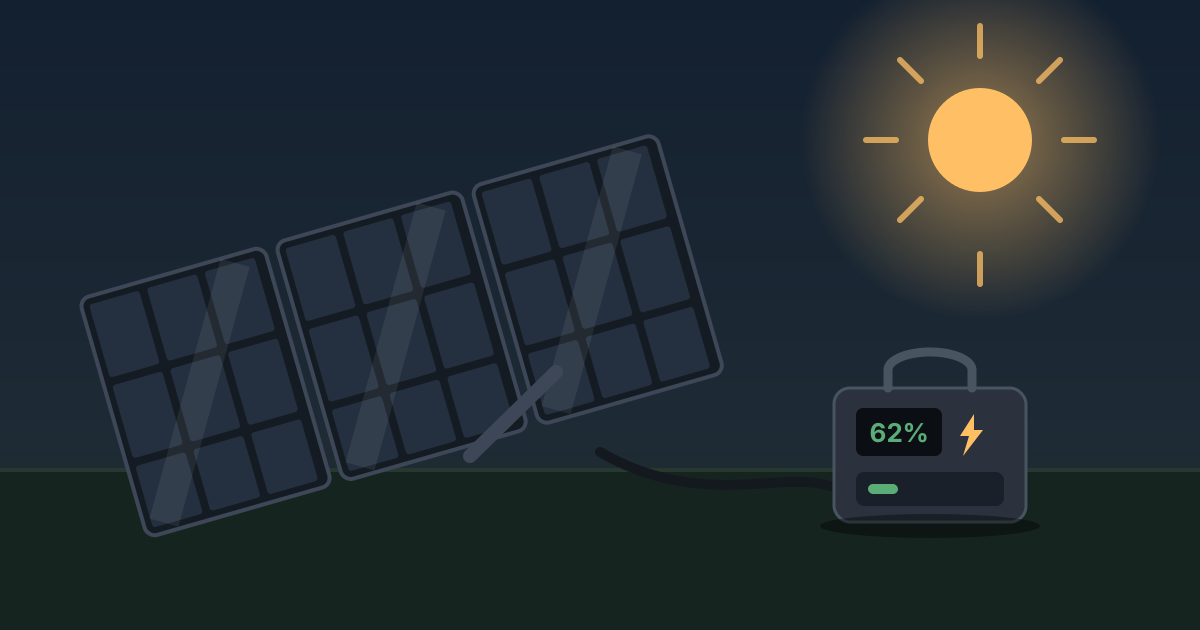
The panel is in full sun and the screen still says 0W. Nine causes, ordered by how often they turn out to be the one, starting with the voltage rule nobody mentions.
We earn a commission on purchases made through links on this page, at no extra cost to you. How this works.
What's in this article
Find yours in about two minutes
Work down. The first "yes" is almost certainly it.
Is the wall adapter still plugged in? → Unplug it and look again. Some units take AC over solar and honestly report 0W solar while doing it.
Is any part of any panel shaded — even a corner? → Move it. One shadow can take out a whole string.
Are you using one small panel, or panels wired in parallel? → Likely under the minimum voltage. Series wiring raises volts.
Does the screen read 100%, or nearly? → It has stopped on purpose.
Is the connector fully seated, and is it the right one? → MC4 connectors click. If it did not click, it is not connected.
1. Voltage below the controller's floor
This is the one that wastes whole afternoons.
Your power station does not measure sunlight. It measures volts. Below a certain figure the charge controller does not consider anything to be connected, so it reports nothing and does nothing.
A single 100W "12V" panel produces somewhere near 18V in bright sun — fine. The same panel under cloud, or early morning light, or flat on the ground, can sag below the floor while still producing current. You get 0W and a panel that feels warm to the touch.
Check the range printed next to your solar input port, or in the manual. It
looks like 11–60V, 15A, 500W max. The first number is the floor and the
second is the ceiling.
2. Partial shade — far worse than it looks
Cover a tenth of a panel and you do not lose a tenth of the output.
Cells in a panel are wired in a chain. A shaded cell stops passing current and chokes the whole chain behind it. On a series string of panels, one shaded panel can drag the entire string down. verify
The shadows that catch people are the thin ones — a washing line, a mast, a branch with no leaves on it, the edge of a roof at 4pm. They look like nothing and they cost most of your charge.
Fix it: put the panel where nothing crosses it for the hours you care about, and check again two hours later. Shadows move.
3. The AC adapter is winning
If you are testing solar with the unit still plugged into the wall, some models charge from AC and show 0W on the solar line. Nothing is wrong. It picked the faster source.
Fix it: unplug the wall adapter, wait a few seconds, and read again.
4. Connector problems
Three separate things go wrong here.
Not clicked in. MC4 connectors seat with an audible click. Push until you hear it.
Wrong adapter. Most units want XT60 or a barrel jack at the station end and MC4 at the panel end. Third-party panels often ship MC4-only and need a cable you have to buy separately.
Reversed polarity. Swapping positive and negative usually results in nothing at all rather than damage, but check it before assuming a fault.
5. It is already full
A unit at 100% stops accepting charge. So does one at 99% in the final trickle stage, where input can drop to almost nothing for a long while.
Run something off it for ten minutes and watch the solar figure come back.
6. Over the voltage ceiling
The opposite of problem one, and the only entry on this list that can cost you money.
Too many panels in series can exceed the maximum input voltage, and the controller will refuse to engage to protect itself. Some units display a warning; some just sit there.
7. Cable too long or too thin
Voltage drops over distance. A long thin extension between panel and station can pull you back under the floor from problem one.
If it charges with the panel next to the unit and stops when you run it out to the sun, this is your answer. Use thicker cable, or a shorter run.
8. Heat
Panels lose output as they get hot. A panel baking at 60°C produces noticeably less than the same panel at 25°C. verify
This never takes you to zero — it just explains why a "200W" panel makes 120W on the hottest, sunniest day of the year, which feels wrong and is normal.
9. A genuine fault
Rare, and worth checking last rather than first.
Suspect it when: the panel reads no voltage at all across its bare MC4 connectors in full sun, or the station charges fine from the wall but shows nothing from a panel you have confirmed is producing volts.
A cheap multimeter across the panel leads settles this in ten seconds. If the panel makes volts and the station ignores them, the station's controller is the problem.
What good actually looks like
Set expectations before you decide something is broken.
| Rated panel | Realistic good-day output | Why |
|---|---|---|
| 100W | ~60–75W | Lab rating assumes perfect angle and 25°C |
| 200W | ~120–150W | Same, plus more area to shade accidentally |
| 400W array | ~240–300W | Series losses and heat add up |
verify on each of those ranges.
Angle matters more than most people expect. A panel lying flat on the grass loses a large share of what the same panel makes when it is tilted to face the sun. If your panel has a kickstand, use it, and turn it through the day.
If you are buying panels to fix this
Buy for voltage compatibility first and watts second. A 400W array your controller cannot start is worth less than a 200W array it can.
Our guide to solar panels for power stations covers which connectors work with which brands, which is where most mismatches begin. If you have not settled on the station yet, work out your size first — panel choice follows from that, not the other way round.
Swipe the table sideways to see every column.
| Price | |||||||
|---|---|---|---|---|---|---|---|
| AnkerAnker SOLIX C1000LiFePO4 · expandable | 1,056 Wh | 1,800W | 2,400W | 28.44 lb | 58 min | 5 yr | Check price for Anker SOLIX C1000 (opens in a new tab, affiliate link) |
| EcoFlowEcoFlow DELTA 2LiFePO4 · expandable | 1,024 Wh | 1,800W | 2,700W | 27 lb | 1h 20m | 5 yr | Check price for EcoFlow DELTA 2 (opens in a new tab, affiliate link) |
Specs come from data/products.json. Capacity is the figure on the box — real usable output is roughly 85% of it once you account for inverter losses.
The short version
In full sun with a 0W reading, check the wall adapter first, shade second, and voltage third. Those three cover most of it.
Sunlight is almost never the problem. Volts usually are.
The picks, in detail
Specs come from data/products.json, so they're the same everywhere on this site.
EcoFlow
EcoFlow DELTA 2
The one most people should buy. It refills fast enough that a short sunny break between storm bands actually matters.
- Capacity
- 1,024 Wh
- AC output
- 1,800W
- Weight
- 27 lb
What's good
- Wall recharge is genuinely quick — useful when power flickers back for an hour
- LiFePO4 cells, so it tolerates being left plugged in for years
- Six AC outlets means no daisy-chained power strips on the kitchen counter
- Add an extra battery later instead of buying a whole second unit
What's annoying
- The fan is audible in a quiet bedroom at night
- 1800W ceiling rules out most space heaters and hair dryers
- Expansion batteries cost nearly as much as the unit itself
Who this is wrong for
Anyone who needs to power a well pump, an electric water heater or a central AC. It will not start them, and it is not a whole-home unit.
Anker
Anker SOLIX C1000
The best-built 1kWh unit on the market, and the one that fits an RV bay without a shoehorn.
- Capacity
- 1,056 Wh
- AC output
- 1,800W
- Weight
- 28.44 lb
What's good
- The most compact 1kWh box here — it genuinely fits where others don't
- Anker's warranty service is the least painful in this category
- Full wall recharge in under an hour
- Quiet fan behaviour under moderate load
What's annoying
- Expansion battery caps you at about 2,112Wh and is expensive
- Fewer solar input options than EcoFlow
- Anker discounts less often, so you rarely catch a deep sale
Who this is wrong for
People who need to run more than 1800W. And it won't grow with you — expansion is limited.
Questions people actually ask
Why does my power station show 0W from solar in full sun?
Can partial shade stop solar charging completely?
Does my power station charge from solar and the wall at the same time?
Can I damage my power station with the wrong solar panel?
Why is my solar input much lower than the panel's rating?
Who wrote this
Dhruvil Domadiya
Founder and editor, GreenCommuteGuide
I started GreenCommuteGuide because backup power is sold with numbers that sound impressive and mean very little — watt-hours on the box, surge ratings that turn out to be a boost mode, charge times quoted to 80% and printed as though they were full. I set the rules this site runs on: every spec is checked against the manufacturer's own documentation, anything we have not verified is marked as unverified on the page rather than quietly published, prices are never shown because they go stale, and every review names at least one product not to buy and who it is wrong for. Where I have not tested something myself, the page says so.
- · Sets and enforces the editorial standards on this site — unverified claims are flagged on the page, and the build fails if they are not
- · Specs are taken from manufacturers' own published documentation, never from retailer listings, and the source and date are recorded for each product
- · No payment is accepted for a rating, a ranking, or a positive verdict
Read this next
- RV, Camping & Off-GridBest Solar Panels for Portable Power StationsThe rated watts on the box is not what you get. Here is what a panel really produces, how many you need, and when panels are a waste of money.
- Battery & Tech BasicsWhy Did My Power Station Shut Off By Itself?Nine times out of ten it is the startup surge, not the battery. Here is how to tell which of the five causes you have, in about a minute.
- Run This ApplianceCan a Solar Generator Run a Refrigerator?Yes, and it takes less battery than you have been told. Here is the math, the surge trap, and the size that actually saves your food.
- Sizing & CalculatorsWhat Size Solar Generator Do I Need? (Free Calculator)Skip the guesswork. Tick the things you need to keep running, get a real watt-hour number, and see which units can actually do it.