Battery & Tech Basics
How Long Do Solar Generators Actually Last?
The cells will outlive you. Something else will break first. Here is what actually fails, and the one habit that shortens a battery's life fastest.
We earn a commission on purchases made through links on this page, at no extra cost to you. How this works.
What's in this article
Somebody's Jackery has been in their garage since 2019. It still works. Somebody else's died in year three.
Same brand tier, same rough price. The difference usually isn't luck.
The number everyone quotes, and what it means
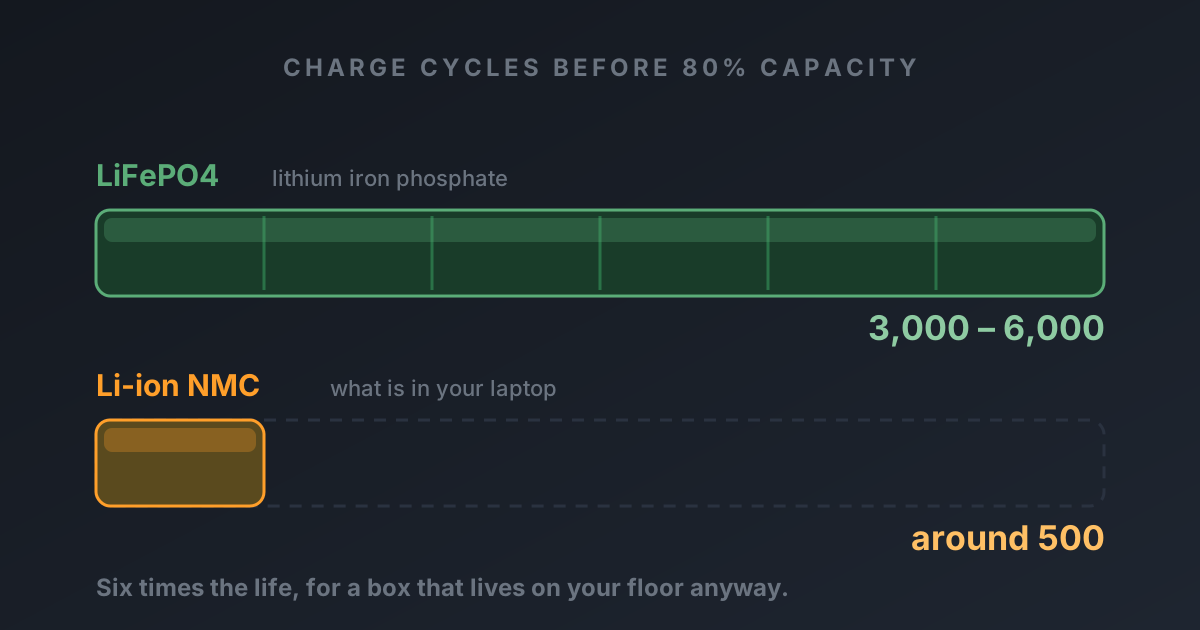
Cycle rating. LiFePO4 units are typically rated 3,000 to 6,000 cycles; older NMC lithium-ion sits around 500. verify
A cycle is one full drain and refill. Two half-drains count as one. So "3,000 cycles" doesn't mean 3,000 times you plugged it in.
And the rating isn't "it dies at 3,001." It means the pack still holds about 80 percent of its original capacity at that point. It keeps working, just with a smaller tank.
So what actually breaks?
The electronics around the battery.
The inverter. The part converting DC to household AC. It runs hot, it has capacitors, and capacitors age. This is the most common real-world failure.
The screen. LCDs fade and backlights die. Annoying rather than fatal, but it makes the thing unusable in the dark, which is when you need it.
The charging circuit. Fast charging is hard on components. The units that refill in under an hour are pushing more current through everything.
The ports. USB-C ports have a mechanical insertion rating and they get abused.
None of that is on a spec sheet. It's why a five-year warranty tells you more about expected lifespan than a cycle number does.
The thing that ages cells fastest
Heat. Not use.
A pack that lives in a hot garage or a car in summer ages substantially faster than one cycled regularly at room temperature. verify Heat is the enemy, and it works on the battery whether you're using it or not.
Which means the worst place to store your emergency power is where most people store it: the garage.
Where chemistry actually matters
For a unit that sits at 100% for months waiting for an emergency, chemistry matters more than cycles do.
LiFePO4 is relaxed about sitting full. Leave it plugged in permanently — that's how you get UPS behavior, and it's how a backup unit should live.
NMC lithium-ion degrades faster sitting at full charge, especially warm. So the battery you bought for emergencies quietly loses capacity while doing nothing at all.
Swipe the table sideways to see every column.
| Price | |||||||
|---|---|---|---|---|---|---|---|
| BluettiBluetti Elite 200 V2LiFePO4 | 2,073 Wh | 2,600W | 3,900W | 53.6 lb | 1h 20m | 5 yr | Check price for Bluetti Elite 200 V2 (opens in a new tab, affiliate link) |
| EcoFlowEcoFlow DELTA 2LiFePO4 · expandable | 1,024 Wh | 1,800W | 2,700W | 27 lb | 1h 20m | 5 yr | Check price for EcoFlow DELTA 2 (opens in a new tab, affiliate link) |
Specs come from data/products.json. Capacity is the figure on the box — real usable output is roughly 85% of it once you account for inverter losses.
What we wouldn't buy on longevity
Anything still using NMC cells, and it's a straightforward call.
Around 500 rated cycles against 3,000-plus for the LiFePO4 units above, usually paired with a two-year warranty where the competition offers five. verify
For a unit whose entire job is to sit at full charge for years, that's the wrong chemistry doing the wrong job — NMC is the chemistry that least likes being stored full.
When is one still defensible? Somebody who already owns that brand's panels and accessories and wants them to keep working. And somebody who wants a long-established US company more than they want the specs. Both are real reasons. Neither applies to most people reading this.
Getting the most years out of yours
Keep it indoors. Cool and dry beats convenient.
Leave LiFePO4 plugged in. It's ready when you need it, and the chemistry doesn't mind.
Use it occasionally. Run it down and back up a couple of times a year. A pack that never moves isn't healthier for it, and it's also how you discover a problem on a Tuesday rather than during a storm.
Don't chase the fastest charge every time. If you're not in a hurry, slower charging is gentler on everything.
Test it before storm season. Plug the fridge in for ten minutes. That habit catches more problems than any spec ever will.
Straight answer
Buy LiFePO4, keep it out of the heat, leave it plugged in.
Do that and the battery will outlast your interest in it. What eventually ends its life will be a capacitor in the inverter, some time after the warranty runs out — which is the same answer as almost every other appliance you own.
The picks, in detail
Specs come from data/products.json, so they're the same everywhere on this site.
EcoFlow
EcoFlow DELTA 2
The one most people should buy. It refills fast enough that a short sunny break between storm bands actually matters.
- Capacity
- 1,024 Wh
- AC output
- 1,800W
- Weight
- 27 lb
What's good
- Wall recharge is genuinely quick — useful when power flickers back for an hour
- LiFePO4 cells, so it tolerates being left plugged in for years
- Six AC outlets means no daisy-chained power strips on the kitchen counter
- Add an extra battery later instead of buying a whole second unit
What's annoying
- The fan is audible in a quiet bedroom at night
- 1800W ceiling rules out most space heaters and hair dryers
- Expansion batteries cost nearly as much as the unit itself
Who this is wrong for
Anyone who needs to power a well pump, an electric water heater or a central AC. It will not start them, and it is not a whole-home unit.

Bluetti
Bluetti Elite 200 V2
Specs unverifiedBluetti's answer to the criticism that their stuff felt cheap. It doesn't anymore.
- Capacity
- 2,073 Wh
- AC output
- 2,600W
- Weight
- 53.6 lb
What's good
- A very high rated cycle count — this is the spec that decides how many years you get
- Lighter than the AC200L for the same capacity
- Fast UPS switchover, good enough for a desktop PC
What's annoying
- Not expandable, which caps you permanently
- No 240V output
- Still heavier than a person expects when they see the photos
Who this is wrong for
Anyone who needs 240V. This is a 120V unit and always will be.
Questions people actually ask
How many years does a solar generator last?
What is a charge cycle?
Does leaving it plugged in all the time damage it?
What kills a power station fastest?
Is it worth repairing an old power station?
Who wrote this
Dhruvil Domadiya
Founder and editor, GreenCommuteGuide
I started GreenCommuteGuide because backup power is sold with numbers that sound impressive and mean very little — watt-hours on the box, surge ratings that turn out to be a boost mode, charge times quoted to 80% and printed as though they were full. I set the rules this site runs on: every spec is checked against the manufacturer's own documentation, anything we have not verified is marked as unverified on the page rather than quietly published, prices are never shown because they go stale, and every review names at least one product not to buy and who it is wrong for. Where I have not tested something myself, the page says so.
- · Sets and enforces the editorial standards on this site — unverified claims are flagged on the page, and the build fails if they are not
- · Specs are taken from manufacturers' own published documentation, never from retailer listings, and the source and date are recorded for each product
- · No payment is accepted for a rating, a ranking, or a positive verdict
Read this next
- Battery & Tech BasicsLiFePO4 vs Lithium-Ion: Which Battery Lasts Longer?One chemistry lasts six times longer and does not catch fire. The other is lighter. Here is why almost every good power station now uses the first one.
- Battery & Tech BasicsWhy Won't My Power Station Turn On?Dead screen, no lights, nothing. Six causes in order of likelihood — and the deep-discharge one that looks exactly like a dead unit but usually is not.
- Battery & Tech BasicsWhy Did My Power Station Shut Off By Itself?Nine times out of ten it is the startup surge, not the battery. Here is how to tell which of the five causes you have, in about a minute.
- Home Outage & BackupBest Solar Generators for Power Outages in 2026Which battery actually gets your family through the night, which one is a waste of money, and how to tell the difference before you spend.