Battery & Tech Basics
LiFePO4 vs Lithium-Ion: Which Battery Lasts Longer?
One chemistry lasts six times longer and does not catch fire. The other is lighter. Here is why almost every good power station now uses the first one.
We earn a commission on purchases made through links on this page, at no extra cost to you. How this works.
What's in this article
Your neighbor's power station is four years old and holds about half of what it used to. Yours is the same age and works like the day you bought it.
Same brand tier. Same price bracket. Different chemistry inside.
That's the whole story here, and it's the single most useful thing to understand before you spend money.
What the two names mean
LiFePO4 — lithium iron phosphate. Sometimes written LFP.
Li-ion — usually means NMC, nickel manganese cobalt. This is what's in your laptop and your phone.
Both are lithium batteries. They behave very differently.
The number that matters: cycles
A cycle is one full drain and refill.
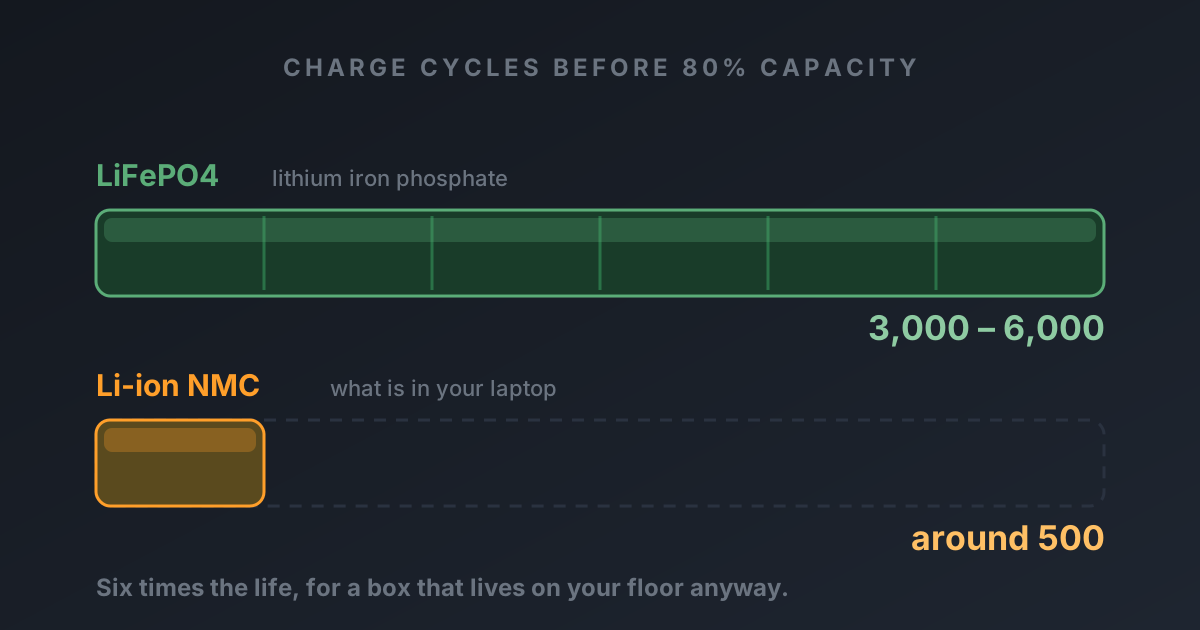
LiFePO4 packs are typically rated for 3,000 to 6,000 cycles before dropping to 80 percent of original capacity. NMC packs usually come in around 500. verify
That is not a small difference. That is roughly six times.
The one that matters more than people admit: sitting still
Here's the part that catches home backup buyers.
Your power station's job is to sit at 100 percent for months doing nothing. That's the entire point of it.
NMC chemistry does not love that. Sitting at full charge, warm, for long periods degrades it. So the battery you bought for emergencies quietly loses capacity while doing nothing at all.
LiFePO4 is far more relaxed about it. You can leave it plugged in permanently, which is exactly how you want a backup battery to live — always full, always ready, taking over the instant the grid drops.
For a home backup unit, this is arguably a bigger deal than the cycle count.
Safety
Both are safe when built properly and abused by nobody. But their failure modes differ.
NMC has a lower thermal runaway threshold. When it goes wrong, it goes wrong energetically. That's why laptop battery recalls make the news.
LiFePO4 is much more resistant to it. verify Not fireproof — don't puncture it, don't leave it in a car in Phoenix — but the difference is real, and it's why LiFePO4 is what people choose for a box that lives in a bedroom.
What NMC is still better at
Weight and size. Genuinely.
NMC packs more energy into less space and less mass. For anything you carry on your back, that matters enormously.
For a box that sits on your floor next to a fridge, it buys you very little. You lift it twice a year.
Swipe the table sideways to see every column.
| Price | |||||||
|---|---|---|---|---|---|---|---|
| BluettiBluetti Elite 200 V2LiFePO4 | 2,073 Wh | 2,600W | 3,900W | 53.6 lb | 1h 20m | 5 yr | Check price for Bluetti Elite 200 V2 (opens in a new tab, affiliate link) |
| EcoFlowEcoFlow DELTA 2LiFePO4 · expandable | 1,024 Wh | 1,800W | 2,700W | 27 lb | 1h 20m | 5 yr | Check price for EcoFlow DELTA 2 (opens in a new tab, affiliate link) |
Specs come from data/products.json. Capacity is the figure on the box — real usable output is roughly 85% of it once you account for inverter losses.
The kind we would not buy
The clearest example of this trade-off going the wrong way is the older, metal-bodied NMC unit from a long-established name.
They're tough, they're often from companies that helped invent this category, and the build genuinely feels better than the plastic competition. But they use NMC cells rated around 500 cycles, recharge from the wall in many hours rather than one, and carry a two-year warranty where LiFePO4 rivals offer five. verify
For home backup that is the wrong trade in the most direct way possible: the unit's job is to sit at 100% for years, and that is the single condition NMC handles worst.
When is one still defensible? Someone who already owns that brand's panels and accessories and wants them to keep working. And someone who weighs a US company with a long track record above the spec sheet. Those are real reasons. They're just not most people's reasons.
How to tell what you're buying
Look for "LiFePO4" or "LFP" in the spec list. Reputable brands state it plainly because it's a selling point.
If a listing doesn't say, assume NMC. A brand using LiFePO4 will always tell you.
Then look at two more things:
Cycle rating. Anything under 1,000 is NMC or a cheap pack. Over 3,000 is LiFePO4 done properly.
Warranty length. Five years signals confidence. Two years signals the manufacturer knows something about the cells.
What to actually do
For home backup, buy LiFePO4. Every time. The extra weight costs you nothing because the thing lives on your floor.
For a unit you carry hiking, NMC's weight advantage is a legitimate reason to accept the shorter life.
For everything in between — camping, RVs, van life — LiFePO4 still wins, because those uses cycle the battery often, and cycling is exactly where NMC gives up first.
The picks, in detail
Specs come from data/products.json, so they're the same everywhere on this site.
EcoFlow
EcoFlow DELTA 2
The one most people should buy. It refills fast enough that a short sunny break between storm bands actually matters.
- Capacity
- 1,024 Wh
- AC output
- 1,800W
- Weight
- 27 lb
What's good
- Wall recharge is genuinely quick — useful when power flickers back for an hour
- LiFePO4 cells, so it tolerates being left plugged in for years
- Six AC outlets means no daisy-chained power strips on the kitchen counter
- Add an extra battery later instead of buying a whole second unit
What's annoying
- The fan is audible in a quiet bedroom at night
- 1800W ceiling rules out most space heaters and hair dryers
- Expansion batteries cost nearly as much as the unit itself
Who this is wrong for
Anyone who needs to power a well pump, an electric water heater or a central AC. It will not start them, and it is not a whole-home unit.

Bluetti
Bluetti Elite 200 V2
Specs unverifiedBluetti's answer to the criticism that their stuff felt cheap. It doesn't anymore.
- Capacity
- 2,073 Wh
- AC output
- 2,600W
- Weight
- 53.6 lb
What's good
- A very high rated cycle count — this is the spec that decides how many years you get
- Lighter than the AC200L for the same capacity
- Fast UPS switchover, good enough for a desktop PC
What's annoying
- Not expandable, which caps you permanently
- No 240V output
- Still heavier than a person expects when they see the photos
Who this is wrong for
Anyone who needs 240V. This is a 120V unit and always will be.
Questions people actually ask
Is LiFePO4 better than lithium-ion?
How many years will a LiFePO4 power station last?
Is LiFePO4 actually safer?
Why do some brands still use lithium-ion?
Does cold weather hurt LiFePO4?
Who wrote this
Dhruvil Domadiya
Founder and editor, GreenCommuteGuide
I started GreenCommuteGuide because backup power is sold with numbers that sound impressive and mean very little — watt-hours on the box, surge ratings that turn out to be a boost mode, charge times quoted to 80% and printed as though they were full. I set the rules this site runs on: every spec is checked against the manufacturer's own documentation, anything we have not verified is marked as unverified on the page rather than quietly published, prices are never shown because they go stale, and every review names at least one product not to buy and who it is wrong for. Where I have not tested something myself, the page says so.
- · Sets and enforces the editorial standards on this site — unverified claims are flagged on the page, and the build fails if they are not
- · Specs are taken from manufacturers' own published documentation, never from retailer listings, and the source and date are recorded for each product
- · No payment is accepted for a rating, a ranking, or a positive verdict
Read this next
- Battery & Tech BasicsHow Long Do Solar Generators Actually Last?The cells will outlive you. Something else will break first. Here is what actually fails, and the one habit that shortens a battery's life fastest.
- Battery & Tech BasicsWhy Did My Power Station Shut Off By Itself?Nine times out of ten it is the startup surge, not the battery. Here is how to tell which of the five causes you have, in about a minute.
- Battery & Tech BasicsWhy Won't My Power Station Turn On?Dead screen, no lights, nothing. Six causes in order of likelihood — and the deep-discharge one that looks exactly like a dead unit but usually is not.
- Home Outage & BackupBest Solar Generators for Power Outages in 2026Which battery actually gets your family through the night, which one is a waste of money, and how to tell the difference before you spend.