Battery & Tech Basics
Why Did My Power Station Shut Off By Itself?
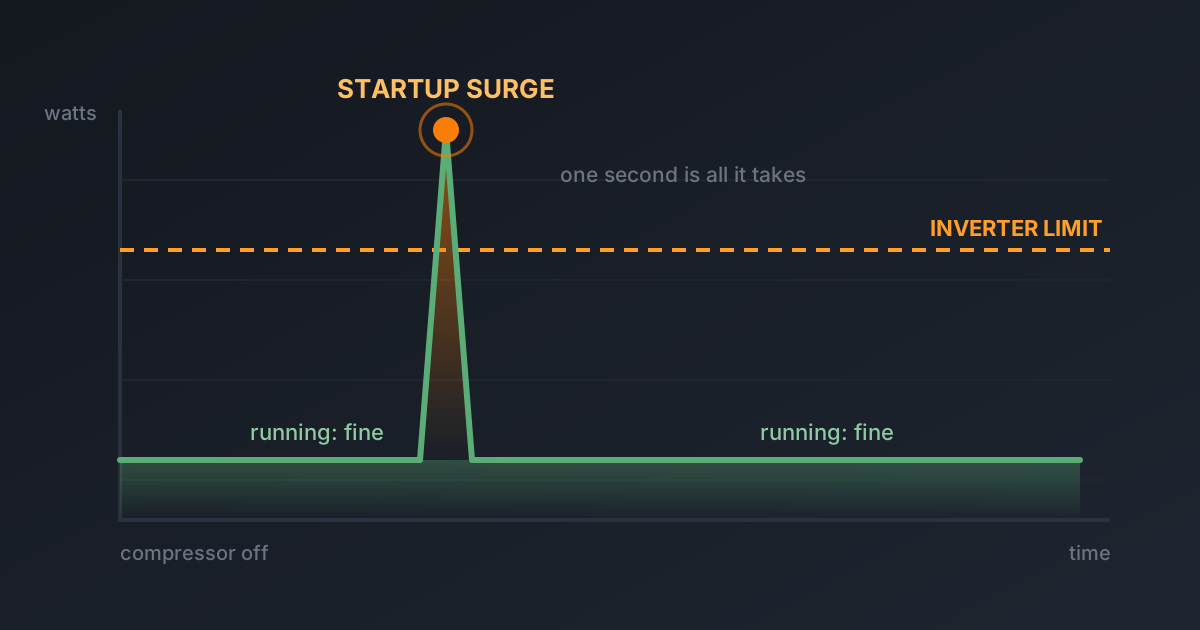
Nine times out of ten it is the startup surge, not the battery. Here is how to tell which of the five causes you have, in about a minute.
We earn a commission on purchases made through links on this page, at no extra cost to you. How this works.
What's in this article
Work out which one you have
Answer these in order. The first "yes" is your answer.
Did it shut off the instant you plugged something in, or the instant a motor kicked on? → Startup surge. Most common by a wide margin.
Was it running several things and then quit? → Continuous overload. You crossed the output ceiling, not the surge one.
Had it been running hard for a while, in a warm room or in sun? → Thermal cutoff. It'll restart once it cools.
Was it running something tiny — a phone, a lamp — when it quit? → Low-power auto-shutoff. It's a setting, not a fault.
Did the screen read 0%? → It was empty. That one's honest.
1. Startup surge — the one that catches everyone
A fridge draws around 150 watts while running. For a fraction of a second at startup it spikes near 900. verify
A well pump running at 800 watts spikes near 2,500. verify
If your inverter can't supply that instant, it doesn't run the appliance slowly. It cuts out.
Rough startup spikes:
| Appliance | Running | Startup spike |
|---|---|---|
| Full-size fridge | ~150W | ~900W |
| Sump pump (1/3 HP) | ~600W | ~1,800W |
| Window AC (8,000 BTU) | ~750W | ~2,200W |
| Well pump (1/2 HP) | ~800W | ~2,500W |
| Anything with a heating element | full load immediately | no spike, just a wall |
verify on each of those.
Fix it: a unit with at least 20% more surge headroom than your biggest appliance needs. Or fit a soft starter, which smooths the spike — common on RV air conditioners and it genuinely works.
2. Continuous overload
Different limit. This is the sustained output ceiling.
Say your unit does 1,800W continuous. Fridge (150W) plus a 1,500W space heater plus a laptop puts you over. It runs, then trips.
Fix it: unplug something. Add up the running watts of everything connected and keep the total comfortably under the rating.
3. Thermal cutoff
Inverters make heat. Run near maximum in a warm room and the protection circuit stops things before something melts.
Signs: it was working fine for a while, the case is hot, the fan was loud, and it restarts once it cools.
Fix it: clear air on all sides — a few inches is enough. Never inside a sealed cabinet, under a blanket, or in direct sun. Reduce the load if you can.
4. Low-power auto-shutoff
Most units switch the AC output off automatically when almost nothing is drawing from it. It saves the inverter idling away your battery for nothing.
Classic symptom: you plug in a phone charger, walk away, come back and the unit is off.
Fix it: in the app or the settings menu, look for "AC timeout", "auto-off" or "standby". Turn it off or extend it.
This one is a feature people report as a fault constantly.
5. It was actually empty
Worth checking before assuming anything more interesting.
Note that a unit can read 20% and still shut down under a heavy load — voltage sags as the pack empties, and heavy draw makes that worse. The last fifth of a battery is not as useful as the first.
When it is a real fault
Take it seriously if:
- It shuts off under a light load with plenty of charge
- It's hot to the touch while idle
- It won't restart after cooling for an hour
- The case is swollen, or it smells acrid
That last one — stop using it, get it outside, and contact the manufacturer. Don't open it.
Swipe the table sideways to see every column.
| Price | |||||||
|---|---|---|---|---|---|---|---|
| AnkerAnker SOLIX C1000LiFePO4 · expandable | 1,056 Wh | 1,800W | 2,400W | 28.44 lb | 58 min | 5 yr | Check price for Anker SOLIX C1000 (opens in a new tab, affiliate link) |
| EcoFlowEcoFlow DELTA 2LiFePO4 · expandable | 1,024 Wh | 1,800W | 2,700W | 27 lb | 1h 20m | 5 yr | Check price for EcoFlow DELTA 2 (opens in a new tab, affiliate link) |
Specs come from data/products.json. Capacity is the figure on the box — real usable output is roughly 85% of it once you account for inverter losses.
The short version
Shutting off with charge remaining is almost never a broken battery. It's the protection circuit doing exactly what it's for.
Find which of the five it is, and four of them are free to fix. Only the surge one costs money — and it costs less if you buy for surge in the first place.
The picks, in detail
Specs come from data/products.json, so they're the same everywhere on this site.
EcoFlow
EcoFlow DELTA 2
The one most people should buy. It refills fast enough that a short sunny break between storm bands actually matters.
- Capacity
- 1,024 Wh
- AC output
- 1,800W
- Weight
- 27 lb
What's good
- Wall recharge is genuinely quick — useful when power flickers back for an hour
- LiFePO4 cells, so it tolerates being left plugged in for years
- Six AC outlets means no daisy-chained power strips on the kitchen counter
- Add an extra battery later instead of buying a whole second unit
What's annoying
- The fan is audible in a quiet bedroom at night
- 1800W ceiling rules out most space heaters and hair dryers
- Expansion batteries cost nearly as much as the unit itself
Who this is wrong for
Anyone who needs to power a well pump, an electric water heater or a central AC. It will not start them, and it is not a whole-home unit.
Anker
Anker SOLIX C1000
The best-built 1kWh unit on the market, and the one that fits an RV bay without a shoehorn.
- Capacity
- 1,056 Wh
- AC output
- 1,800W
- Weight
- 28.44 lb
What's good
- The most compact 1kWh box here — it genuinely fits where others don't
- Anker's warranty service is the least painful in this category
- Full wall recharge in under an hour
- Quiet fan behaviour under moderate load
What's annoying
- Expansion battery caps you at about 2,112Wh and is expensive
- Fewer solar input options than EcoFlow
- Anker discounts less often, so you rarely catch a deep sale
Who this is wrong for
People who need to run more than 1800W. And it won't grow with you — expansion is limited.
Questions people actually ask
Why does my power station turn off when I plug in an appliance?
My power station has plenty of battery left but keeps shutting off. Why?
Can a power station shut off from overheating?
Is a power station that shuts off faulty?
How do I stop my power station tripping on my fridge?
Who wrote this
Dhruvil Domadiya
Founder and editor, GreenCommuteGuide
I started GreenCommuteGuide because backup power is sold with numbers that sound impressive and mean very little — watt-hours on the box, surge ratings that turn out to be a boost mode, charge times quoted to 80% and printed as though they were full. I set the rules this site runs on: every spec is checked against the manufacturer's own documentation, anything we have not verified is marked as unverified on the page rather than quietly published, prices are never shown because they go stale, and every review names at least one product not to buy and who it is wrong for. Where I have not tested something myself, the page says so.
- · Sets and enforces the editorial standards on this site — unverified claims are flagged on the page, and the build fails if they are not
- · Specs are taken from manufacturers' own published documentation, never from retailer listings, and the source and date are recorded for each product
- · No payment is accepted for a rating, a ranking, or a positive verdict
Read this next
- Sizing & CalculatorsSurge Watts vs Running Watts: What Actually Trips Your UnitYour battery is big enough and it still shut off. This is why, and it is the spec almost nobody checks before buying.
- Run This ApplianceWhy Does My Fridge Trip the Power Station?The compressor spikes to about 900 watts for half a second. That is the whole answer, and no amount of extra battery fixes it.
- Battery & Tech BasicsIs It Safe to Use a Power Station Indoors?Yes, and that is the entire reason they beat gas generators. Here are the four real risks, and the one that actually kills people.
- Sizing & CalculatorsWhat Size Solar Generator Do I Need? (Free Calculator)Skip the guesswork. Tick the things you need to keep running, get a real watt-hour number, and see which units can actually do it.