Battery & Tech Basics
Why Won't My Power Station Turn On?
Dead screen, no lights, nothing. Six causes in order of likelihood — and the deep-discharge one that looks exactly like a dead unit but usually is not.
We earn a commission on purchases made through links on this page, at no extra cost to you. How this works.
What's in this article
Try these in order
1. Plug it into the wall and wait. Not five minutes — several hours. This alone fixes most cases.
2. Long-press the power button. Hold for fifteen to twenty seconds. This is the reset on most units even where the manual does not call it one.
3. Check the room temperature. Below freezing, many units refuse to start.
4. Check the charger, not the station. Try the wall socket with something else. Try a different cable if you have one.
5. Look for a recessed reset. A pinhole needing a paperclip, usually near the ports.
6. Only then treat it as a fault.
1. Deep discharge — the big one
This is the answer more often than everything else combined, and it looks exactly like a dead unit.
Lithium packs self-discharge slowly on their own. On top of that, most power stations draw a small standby current even switched off — for the display controller, the Bluetooth radio, the clock. Leave one in a garage for a year and the pack can drift below the voltage floor its battery management system allows.
At that point the BMS disconnects the pack. Nothing responds. No lights, no screen, no click. It is behaving correctly and it looks broken.
Prevent it: recharge to somewhere around half every three to six months. Set a calendar reminder — this is the single most common way people lose a power station, and it costs nothing to avoid.
That storage habit matters more for backup units than camping ones, because a backup unit is by definition sitting unused waiting for the day you need it. More on how packs age in how long solar generators last.
2. It is too cold
Lithium chemistry slows dramatically as temperature drops, and below freezing most battery management systems will not permit discharge or charge.
A unit left in an unheated garage, a shed, or a car boot overnight in winter can be entirely unresponsive at 7am and completely normal by lunchtime indoors.
Fix it: bring it inside and let it warm gradually over a few hours. Do not point a heater at it or put it near a stove — heating one side of a cold pack quickly is worse than leaving it cold.
This catches people in exactly the conditions they bought it for. If your plan involves a garage in an ice storm, store it indoors instead.
3. The charger, not the station
Easy to skip because the station is the interesting part.
Check: the wall socket works with something else. The brick's indicator light is on, if it has one. The cable is fully seated at both ends. The barrel jack or XT60 clicked home.
Power station chargers are often high-wattage bricks that fail more readily than the unit they charge, and a failed brick presents as a dead station.
4. Button and firmware quirks
Some units need a deliberate long press, not a tap, and a short press does nothing at all when the unit is fully off rather than in standby.
Some enter a state after a firmware update where the display stays dark until a reset. A twenty-second hold on the power button clears most of these.
If yours has an app, check whether the app can see it over Bluetooth. A unit that responds to the app but has a dark screen has a display problem, not a power problem — which is a much smaller and cheaper thing to be wrong.
5. Protection latched from a previous fault
If the last thing it did was trip on an overload, a short, or overheating, some units latch that state until they are properly reset.
Disconnect everything from every port, including solar and the car charger. Then long-press. A unit will sometimes refuse to start with a shorted load still attached, and the short might be in a cheap extension lead rather than anything expensive.
6. Actually dead
Rare, and worth reaching only after the wall-charge overnight test.
Consider it genuinely faulty when:
- Six hours or more on the wall charger produces nothing at all
- It is at room temperature and the charger is confirmed working
- The case is swollen, or smells acrid
- It got wet, or was dropped hard
Swelling or a chemical smell changes the priority. Do not charge it, do not store it indoors, do not put it in a car. Get it outside away from anything that burns and contact the manufacturer.
Warranty matters more than people think here
A pack that dies from deep discharge in storage is often not covered. Manufacturers document a storage recharge interval precisely so they can point at it, and "left it in the garage for two years" is a conversation that rarely goes your way.
Warranty length varies more than the marketing suggests, and it is one of the few specs that reliably separates the serious brands from the rest:
| Warranty | |
|---|---|
| EcoFlow, Anker, Bluetti, Jackery (current LiFePO4 units) | 5 years verify |
| Older lithium-ion units, several budget brands | 2 years verify |
Worth checking before you need it rather than after.
If you are replacing it
If the unit is genuinely gone and it died of old age rather than neglect, one number is worth more attention than any other next time: chemistry.
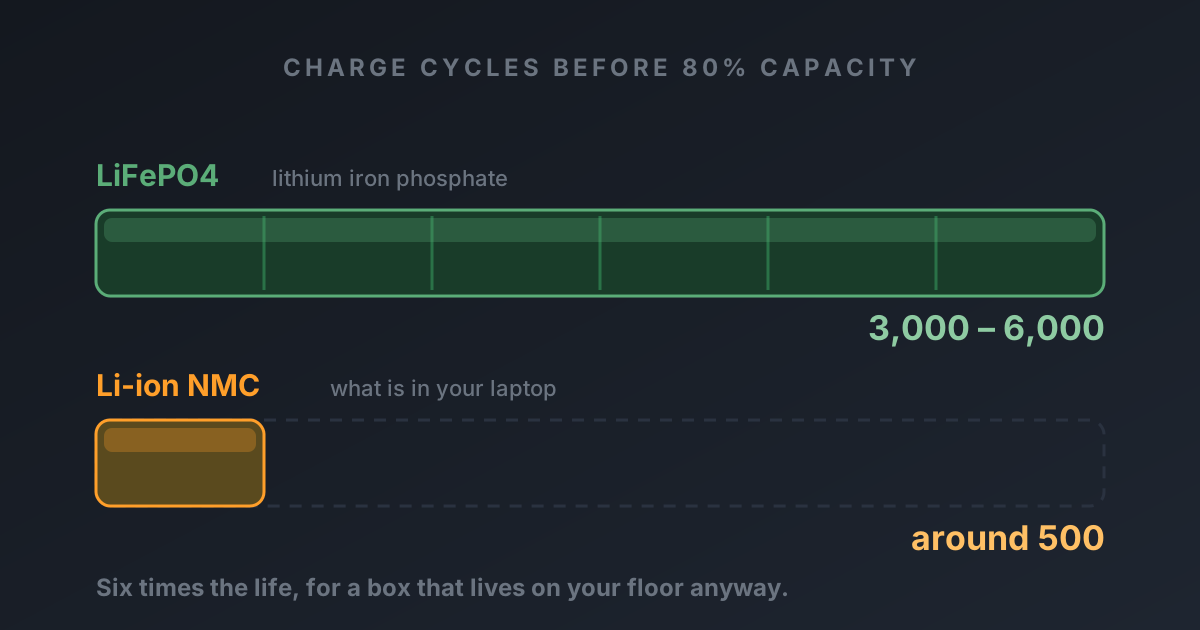
LiFePO4 packs rated for 3,000 or more cycles outlast older lithium-ion units rated near 500 by a wide margin, and the gap shows up as years of ownership rather than a spec-sheet argument. We laid out the comparison in LiFePO4 vs lithium-ion, and every unit in our outage recommendations is LiFePO4 for that reason.
Swipe the table sideways to see every column.
| Price | |||||||
|---|---|---|---|---|---|---|---|
| AnkerAnker SOLIX C1000LiFePO4 · expandable | 1,056 Wh | 1,800W | 2,400W | 28.44 lb | 58 min | 5 yr | Check price for Anker SOLIX C1000 (opens in a new tab, affiliate link) |
| EcoFlowEcoFlow DELTA 2LiFePO4 · expandable | 1,024 Wh | 1,800W | 2,700W | 27 lb | 1h 20m | 5 yr | Check price for EcoFlow DELTA 2 (opens in a new tab, affiliate link) |
Specs come from data/products.json. Capacity is the figure on the box — real usable output is roughly 85% of it once you account for inverter losses.
The short version
Plug it in and leave it overnight before deciding anything. Deep discharge after storage explains more dead power stations than every other cause combined, and it usually recovers with no sign of life for the first hour.
Then set a reminder to top it up every few months, because the failure you just had is entirely preventable and will otherwise happen again.
The picks, in detail
Specs come from data/products.json, so they're the same everywhere on this site.
EcoFlow
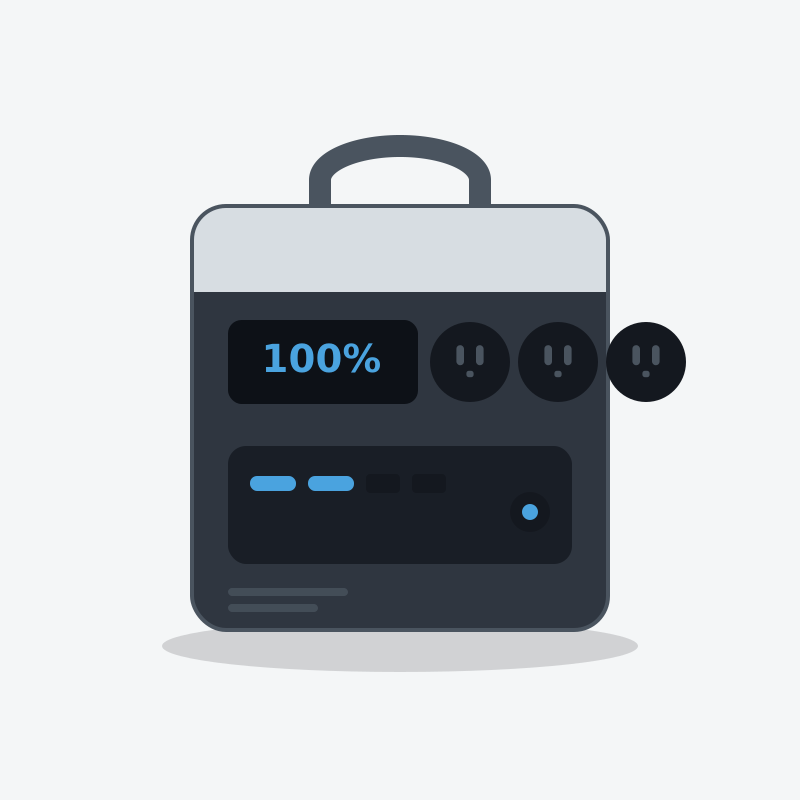
EcoFlow DELTA 2
The one most people should buy. It refills fast enough that a short sunny break between storm bands actually matters.
- Capacity
- 1,024 Wh
- AC output
- 1,800W
- Weight
- 27 lb
What's good
- Wall recharge is genuinely quick — useful when power flickers back for an hour
- LiFePO4 cells, so it tolerates being left plugged in for years
- Six AC outlets means no daisy-chained power strips on the kitchen counter
- Add an extra battery later instead of buying a whole second unit
What's annoying
- The fan is audible in a quiet bedroom at night
- 1800W ceiling rules out most space heaters and hair dryers
- Expansion batteries cost nearly as much as the unit itself
Who this is wrong for
Anyone who needs to power a well pump, an electric water heater or a central AC. It will not start them, and it is not a whole-home unit.
Anker
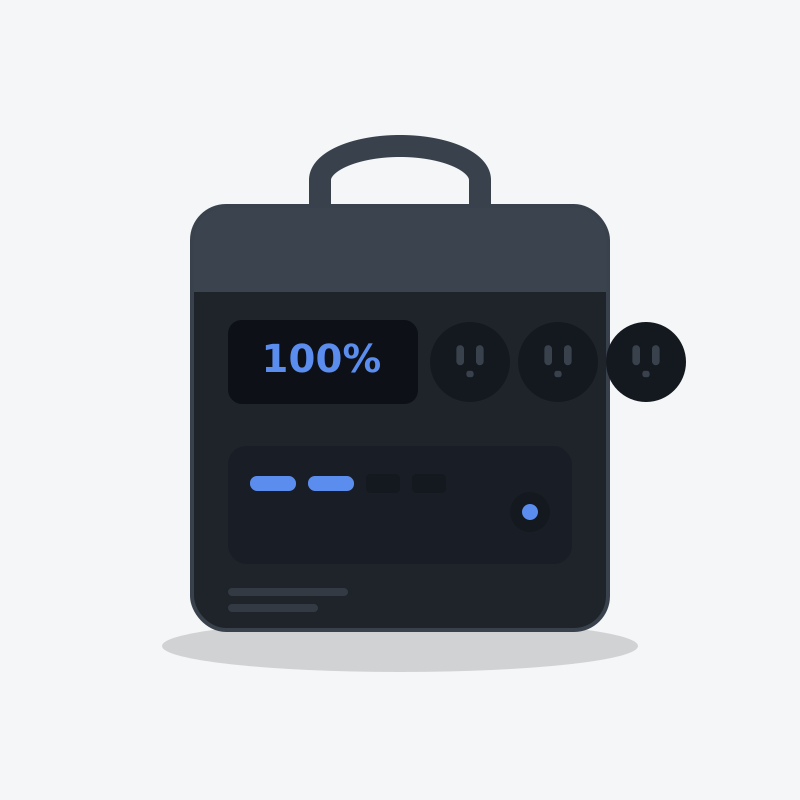
Anker SOLIX C1000
The best-built 1kWh unit on the market, and the one that fits an RV bay without a shoehorn.
- Capacity
- 1,056 Wh
- AC output
- 1,800W
- Weight
- 28.44 lb
What's good
- The most compact 1kWh box here — it genuinely fits where others don't
- Anker's warranty service is the least painful in this category
- Full wall recharge in under an hour
- Quiet fan behaviour under moderate load
What's annoying
- Expansion battery caps you at about 2,112Wh and is expensive
- Fewer solar input options than EcoFlow
- Anker discounts less often, so you rarely catch a deep sale
Who this is wrong for
People who need to run more than 1800W. And it won't grow with you — expansion is limited.
Questions people actually ask
My power station is completely dead. Is it broken?
How long should I leave a dead power station charging before giving up?
Why won't my power station turn on after storing it?
Does a power station have a reset button?
Can a power station be too cold to turn on?
Who wrote this
Dhruvil Domadiya
Founder and editor, GreenCommuteGuide
I started GreenCommuteGuide because backup power is sold with numbers that sound impressive and mean very little — watt-hours on the box, surge ratings that turn out to be a boost mode, charge times quoted to 80% and printed as though they were full. I set the rules this site runs on: every spec is checked against the manufacturer's own documentation, anything we have not verified is marked as unverified on the page rather than quietly published, prices are never shown because they go stale, and every review names at least one product not to buy and who it is wrong for. Where I have not tested something myself, the page says so.
- · Sets and enforces the editorial standards on this site — unverified claims are flagged on the page, and the build fails if they are not
- · Specs are taken from manufacturers' own published documentation, never from retailer listings, and the source and date are recorded for each product
- · No payment is accepted for a rating, a ranking, or a positive verdict
Read this next
- Battery & Tech BasicsWhy Did My Power Station Shut Off By Itself?Nine times out of ten it is the startup surge, not the battery. Here is how to tell which of the five causes you have, in about a minute.
- Battery & Tech BasicsPower Station Says Overload — What Now?Get it running again in two minutes, then find out whether it was a one-off or the unit telling you it is too small for the job. The two need different answers.
- Battery & Tech BasicsHow Long Do Solar Generators Actually Last?The cells will outlive you. Something else will break first. Here is what actually fails, and the one habit that shortens a battery's life fastest.
- Home Outage & BackupBest Solar Generators for Power Outages in 2026Which battery actually gets your family through the night, which one is a waste of money, and how to tell the difference before you spend.