Run This Appliance
Can a Solar Generator Run a Refrigerator?
Yes, and it takes less battery than you have been told. Here is the math, the surge trap, and the size that actually saves your food.
We earn a commission on purchases made through links on this page, at no extra cost to you. How this works.

What's in this article
Day two of an outage, and the question stops being theoretical. You're standing in front of the fridge doing arithmetic in your head about whether the chicken is still worth saving.
Short answer: yes, a portable battery runs a fridge, and it takes less than most people think.
Long answer has one trap in it. Let's do both.
The math, done properly
Your fridge label says something like 150 watts. verify
The instinct is to multiply that by 24 hours and conclude you need 3,600 watt-hours. That's the mistake, and it's an expensive one.
A fridge compressor doesn't run continuously. It kicks on, cools things down, and shuts off. Over a day it's actually running maybe a third of the time. verify
So the real figure is closer to 150 × 0.33 × 24, which is about 1,200 watt-hours a day.
The trap: it's not the running watts
Here's what actually goes wrong.
A fridge compressor spikes hard when it starts — somewhere near 900 watts for a fraction of a second. verify Your battery's inverter has to survive that instant.
If the surge rating is too low, the unit doesn't struggle. It trips and shuts off. And because it cuts out at the moment the compressor tries to start, your food warms up while the battery sits there showing 80 percent.
So when you shop, check the surge number first. Anything with 1,800W output and 2,700W surge handles a household fridge without breaking a sweat.
What the runtimes look like
| Appliance | Anker SOLIX C300288 Wh | EcoFlow DELTA 21,024 Wh | Anker SOLIX C10001,056 Wh | Bluetti AC1801,152 Wh |
|---|---|---|---|---|
| Full-size refrigerator~150W running, cycles ~35% of the time | Won't start it | 17 hr | 17 hr | 19 hr |
| Mini fridge~90W running, cycles ~30% of the time | 9.1 hr | 32 hr | 33 hr | 36 hr |
| Chest freezer~120W running, cycles ~30% of the time | Won't start it | 24 hr | 25 hr | 27 hr |
A 1kWh unit covering a fridge overnight isn't a marketing claim. That's what the arithmetic gives you.
The smarter way to run it
Don't leave the fridge plugged in continuously. Cycle it.
Run it for an hour, unplug for three, repeat. The internal temperature barely moves in a closed fridge, and you'll stretch a battery dramatically further.
Better still, combine that with the free stuff: keep the door shut, pack empty space with jugs of water, and move fridge items into the freezer if there's room.
Those tricks cost nothing and buy you hours before the battery even comes into it.
What size to actually buy
1,000Wh with 1,800W output. This is the answer for most people. Covers a full-size fridge overnight plus your modem, some lights and phone charging.
1,500 to 2,000Wh. If you want two days without thinking, or if you also want a fan running in summer.
Under 500Wh. Not for a fridge. It'll be marginal on the surge, and even if it starts, it won't last. Buy a cooler and ice instead — that genuinely is better value for this job.
The one we would not buy for this
The Anker SOLIX C300 is a good product and it is the wrong product here.
288Wh and a 300W output rating means it's marginal against a fridge's startup spike and empty long before morning even if it starts. verify
Who is it right for? Someone whose worry is phones, a laptop, a lamp and a CPAP. For that job it's excellent value and we recommend it happily. Just not for food.
Buying an undersized unit for a fridge is the most common way people waste money in this category. It feels like a bargain and it solves nothing.
Two days and beyond
Once you're past a day, the question changes from capacity to recharging.
A couple of hundred watts of solar meaningfully extends a fridge-sized load in decent sun. So does a 12V adapter that charges from your car — unglamorous, and it works, because your car is already outside with fuel in it.
If you're regularly facing multi-day outages with food to protect, that recharging path matters more than buying a bigger battery. A 2,000Wh unit you can't refill runs out on day two just like a 1,000Wh one. It just runs out later.
The picks, in detail
Specs come from data/products.json, so they're the same everywhere on this site.
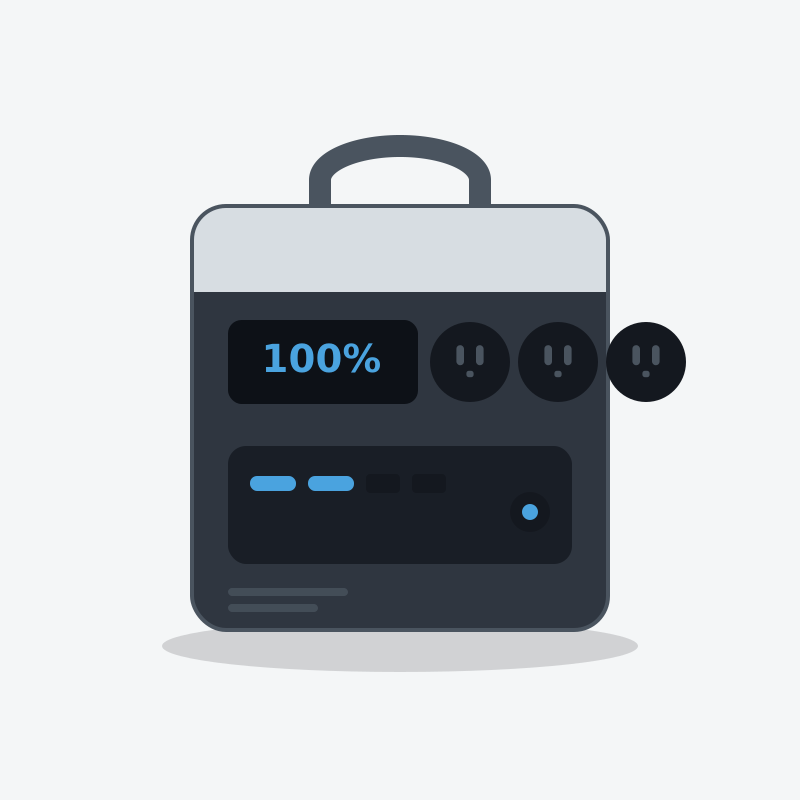
EcoFlow
EcoFlow DELTA 2
The one most people should buy. It refills fast enough that a short sunny break between storm bands actually matters.
- Capacity
- 1,024 Wh
- AC output
- 1,800W
- Weight
- 27 lb
What's good
- Wall recharge is genuinely quick — useful when power flickers back for an hour
- LiFePO4 cells, so it tolerates being left plugged in for years
- Six AC outlets means no daisy-chained power strips on the kitchen counter
- Add an extra battery later instead of buying a whole second unit
What's annoying
- The fan is audible in a quiet bedroom at night
- 1800W ceiling rules out most space heaters and hair dryers
- Expansion batteries cost nearly as much as the unit itself
Who this is wrong for
Anyone who needs to power a well pump, an electric water heater or a central AC. It will not start them, and it is not a whole-home unit.
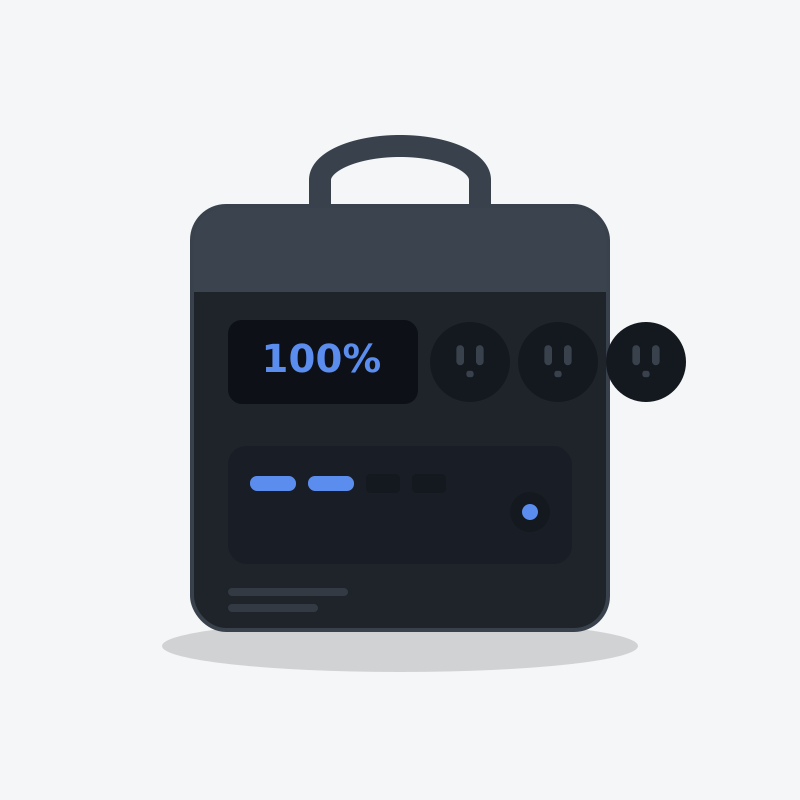
Anker
Anker SOLIX C1000
The best-built 1kWh unit on the market, and the one that fits an RV bay without a shoehorn.
- Capacity
- 1,056 Wh
- AC output
- 1,800W
- Weight
- 28.44 lb
What's good
- The most compact 1kWh box here — it genuinely fits where others don't
- Anker's warranty service is the least painful in this category
- Full wall recharge in under an hour
- Quiet fan behaviour under moderate load
What's annoying
- Expansion battery caps you at about 2,112Wh and is expensive
- Fewer solar input options than EcoFlow
- Anker discounts less often, so you rarely catch a deep sale
Who this is wrong for
People who need to run more than 1800W. And it won't grow with you — expansion is limited.
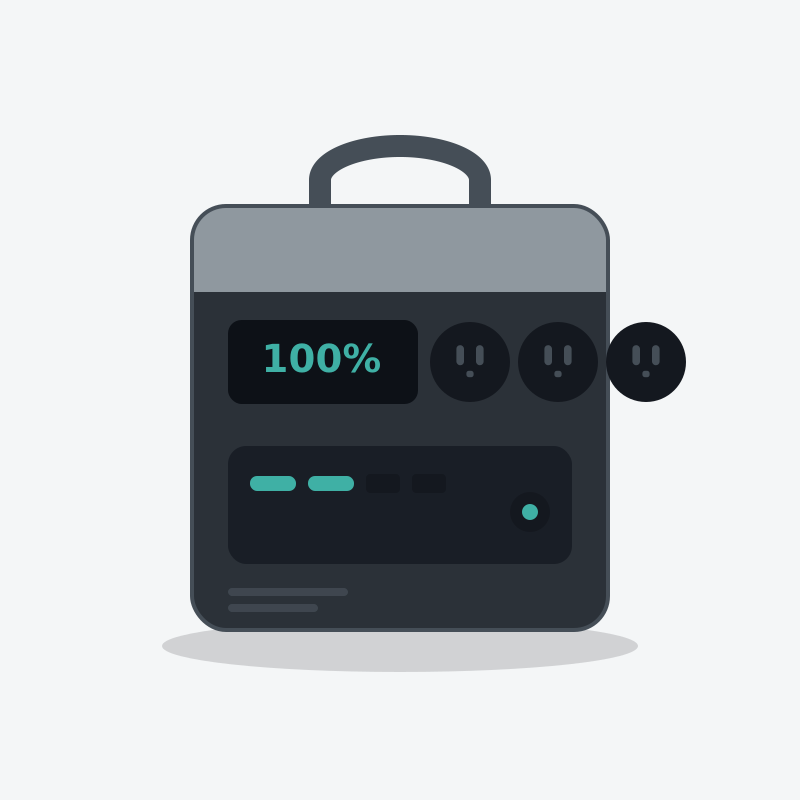
Bluetti
Bluetti AC180
More watts per dollar than the famous brands, if you don't mind a slightly clunkier app.
- Capacity
- 1,152 Wh
- AC output
- 1,800W
- Weight
- 35.3 lb
What's good
- 2,700W of surge headroom, which is what actually starts a fridge compressor
- More capacity than the Jackery 1000 for often less money
- Takes expansion batteries, so it can grow to a serious bank later
- Quiet charging mode keeps it civilised in a bedroom
What's annoying
- 35 lb is heavy for 1.1kWh
- The app has historically been the weakest of the four big brands
- Full wall recharge is slower than the headline number suggests - the fast figure everyone quotes is to 80%, not full
- Only one USB-C port
Who this is wrong for
Anyone who wants hand-holding. Bluetti's documentation assumes you'll figure it out.
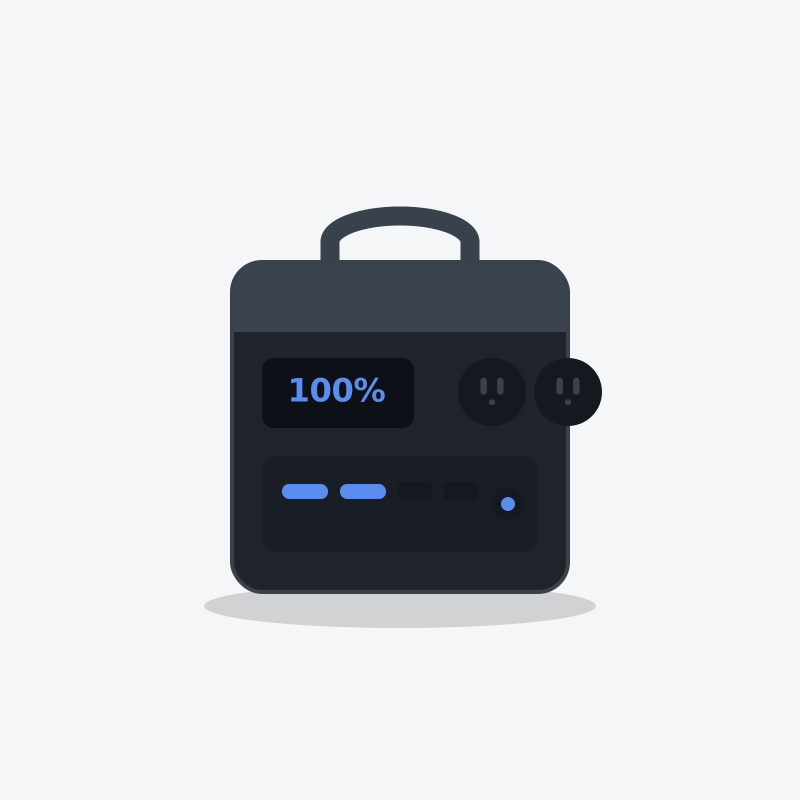
Anker
Anker SOLIX C300
The one you actually carry. Small, quiet, and built better than anything else this size.
- Capacity
- 288 Wh
- AC output
- 300W
- Weight
- 9.1 lb
What's good
- Built-in light that is actually useful, not a gimmick
- Three USB-C ports, one of them high wattage for laptops
- Charges from empty in about an hour
What's annoying
- 300W ceiling — this powers electronics, not appliances
- Small capacity disappears fast if you plug in anything with a motor
- Priced close to units with three times the capacity on sale
Who this is wrong for
Home backup. If your outage plan is a 288Wh box, you don't have an outage plan.
Questions people actually ask
What size solar generator do I need for a refrigerator?
How long will a 1000Wh battery run a fridge?
Will a small 300Wh unit run my fridge?
Do I need to run the fridge continuously?
What about a chest freezer?
Who wrote this
Dhruvil Domadiya
Founder and editor, GreenCommuteGuide
I started GreenCommuteGuide because backup power is sold with numbers that sound impressive and mean very little — watt-hours on the box, surge ratings that turn out to be a boost mode, charge times quoted to 80% and printed as though they were full. I set the rules this site runs on: every spec is checked against the manufacturer's own documentation, anything we have not verified is marked as unverified on the page rather than quietly published, prices are never shown because they go stale, and every review names at least one product not to buy and who it is wrong for. Where I have not tested something myself, the page says so.
- · Sets and enforces the editorial standards on this site — unverified claims are flagged on the page, and the build fails if they are not
- · Specs are taken from manufacturers' own published documentation, never from retailer listings, and the source and date are recorded for each product
- · No payment is accepted for a rating, a ranking, or a positive verdict
Read this next
- Home Outage & BackupHow to Keep Food Cold During a Power OutageYour fridge holds cold for four hours. Your freezer holds it for two days. Here is how to stretch both, and exactly when to throw things out.
- Sizing & CalculatorsSurge Watts vs Running Watts: What Actually Trips Your UnitYour battery is big enough and it still shut off. This is why, and it is the spec almost nobody checks before buying.
- Sizing & CalculatorsWhat Size Solar Generator Do I Need? (Free Calculator)Skip the guesswork. Tick the things you need to keep running, get a real watt-hour number, and see which units can actually do it.
- Home Outage & BackupBest Solar Generators for Power Outages in 2026Which battery actually gets your family through the night, which one is a waste of money, and how to tell the difference before you spend.