Your State's Grid
NYC Blackout Prep for Apartments: What You Can Actually Do on the 14th Floor
No generator, no balcony, no basement — and the building's water pump and elevator die with the grid. Here is what a New York apartment can genuinely prepare for, and what it cannot.
We earn a commission on purchases made through links on this page, at no extra cost to you. How this works.
What's in this article
Sandy put lower Manhattan in the dark for days in October 2012. verify People on high floors learned two things fast: the elevator was gone, and so was the water — the rooftop tank that supplies pressure above the low floors is filled by an electric pump.
That is the New York problem. It is not the lights. It is the building.
Why an apartment is its own problem
You cannot use a generator. Not on the fire escape, not on the balcony, not in the hall. Fuel generators produce carbon monoxide and every one of those places kills. Building code, the fire department and your lease all say the same thing. A battery is the only backup power an apartment can have, because it produces nothing but heat.
The building's systems die with the grid. Elevators, the water pump, the intercom, the electric door release, hallway lighting after the emergency batteries run down. On a high floor, "no power" means "no water and eleven flights of stairs."
You have no outdoor space. No panel, no car in the driveway, no way to recharge except the wall — which is exactly what is not working.
Outages are usually short. Con Ed's dense grid means most events are hours. But the big ones — 2003, Sandy, the summer network failures in Queens and Brooklyn — run for days, and those are what you plan for.
What to actually prepare for
Be specific about the failure.
Phones, a lamp, the router. These are tiny loads, and a 250–300Wh unit covers them for a night or more. For most New York apartments, this is the whole realistic ask.
The fridge. A full-size fridge needs a 1,000Wh unit with an 1,800W inverter. That is a real purchase and a heavy box. Honest question first: how often does your power go out for long enough to spoil food? For most of the city, a cooler and ice covers it.
Water. No battery fixes the building's pump. Fill the bathtub and every bottle the moment the power drops — you may be above the pressure line.
Getting out. Eleven flights in the dark with a bag. A headlamp, not a phone flashlight.
| Appliance | Anker SOLIX C300288 Wh | EcoFlow DELTA 21,024 Wh |
|---|---|---|
| Phones and a laptop~65W running, cycles ~50% of the time | 7.5 hr | 27 hr |
| LED lights (whole room)~40W running | 6.1 hr | 22 hr |
| Wi-Fi router + modem~20W running | 12 hr | 44 hr |
| CPAP (no humidifier)~40W running | 6.1 hr | 22 hr |
| Full-size refrigerator~150W running, cycles ~35% of the time | Won't start it | 17 hr |
Summer blackouts and heat
New York's worst outages cluster in summer, when demand peaks and networks fail under load. A July blackout in a top-floor apartment is dangerous — heat rises and the building holds it.
Air conditioning on a battery is not a plan. A window unit empties even a 1,000Wh unit in a couple of hours.
Fans are. A box fan draws under 100W and a small unit runs one all night. Wet a towel, block the sun, and stay on the lowest floor you can.
If it runs past a night in a heat wave, the answer is a cooling centre or a friend's building with power, not a bigger battery.
What we'd buy, by situation
Most apartments: phones, laptop, lights, router
A 288Wh unit. The Anker SOLIX C300. Light enough to carry, enough to cover a night, and it charges phones directly over USB-C without an adapter.
Working from home, or a CPAP
500Wh–1,000Wh. The EcoFlow DELTA 2 if a full day of laptop plus router matters, or if a fridge is genuinely part of the plan. Know that it is a 27 lb box.
Medical equipment
The battery is one layer. Register with Con Ed's life-sustaining equipment program — it is free and it changes your priority — and have a plan for where you go if the outage runs long.
What not to buy in New York
A generator. Any generator. Not "a small one," not "just for the balcony." Carbon monoxide does not care.
A big battery you cannot carry. If it lives on the 14th floor and you might evacuate, weight is the spec that matters.
Solar panels. Unless you have a south-facing terrace, there is nowhere to put them and a window costs most of the output.
The free things, which matter most
Fill the tub the moment the lights go. You may lose water pressure within minutes.
Know your stairwell. Walk it once in daylight. Count the floors.
A headlamp, not a phone. Phones are your communication; do not spend the battery on light.
Know your neighbours on the floor. In a long outage the building is the unit of survival, not the apartment.
The picks, in detail
Specs come from data/products.json, so they're the same everywhere on this site.
Anker
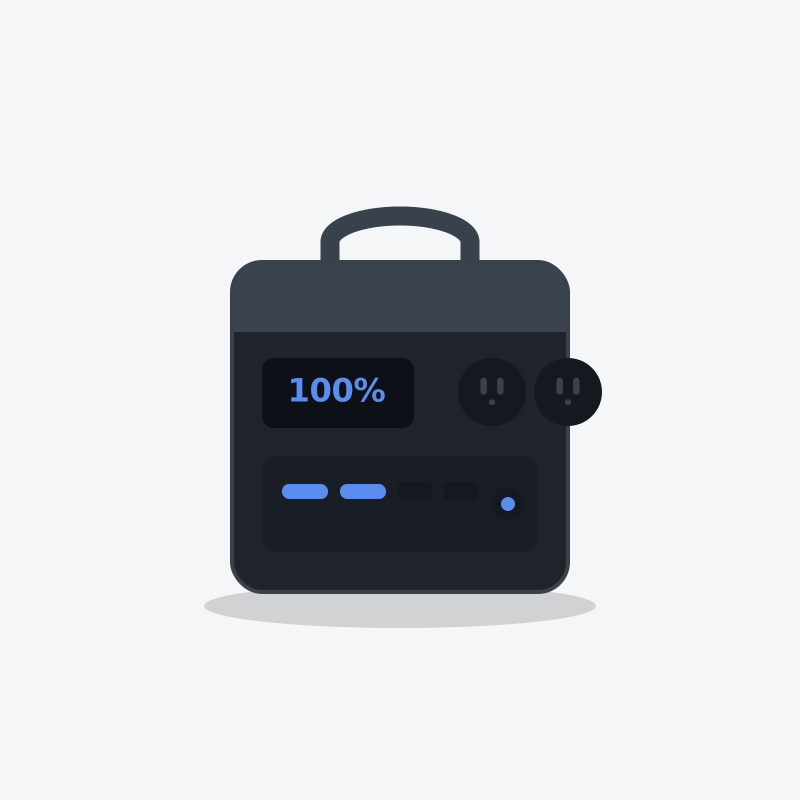
Anker SOLIX C300
The one you actually carry. Small, quiet, and built better than anything else this size.
- Capacity
- 288 Wh
- AC output
- 300W
- Weight
- 9.1 lb
What's good
- Built-in light that is actually useful, not a gimmick
- Three USB-C ports, one of them high wattage for laptops
- Charges from empty in about an hour
What's annoying
- 300W ceiling — this powers electronics, not appliances
- Small capacity disappears fast if you plug in anything with a motor
- Priced close to units with three times the capacity on sale
Who this is wrong for
Home backup. If your outage plan is a 288Wh box, you don't have an outage plan.
EcoFlow
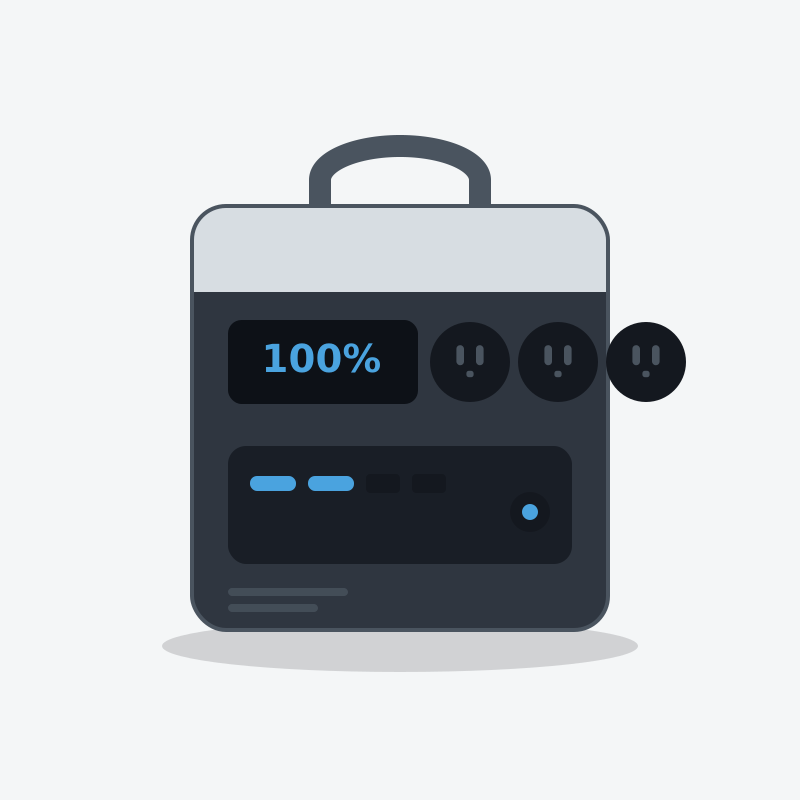
EcoFlow DELTA 2
The one most people should buy. It refills fast enough that a short sunny break between storm bands actually matters.
- Capacity
- 1,024 Wh
- AC output
- 1,800W
- Weight
- 27 lb
What's good
- Wall recharge is genuinely quick — useful when power flickers back for an hour
- LiFePO4 cells, so it tolerates being left plugged in for years
- Six AC outlets means no daisy-chained power strips on the kitchen counter
- Add an extra battery later instead of buying a whole second unit
What's annoying
- The fan is audible in a quiet bedroom at night
- 1800W ceiling rules out most space heaters and hair dryers
- Expansion batteries cost nearly as much as the unit itself
Who this is wrong for
Anyone who needs to power a well pump, an electric water heater or a central AC. It will not start them, and it is not a whole-home unit.
Questions people actually ask
Can I use a generator in a New York apartment?
What happens to a high-rise building in a blackout?
What size battery for an NYC apartment?
How long do Con Edison outages usually last?
Is it safe to charge a power station in a small apartment?
Who wrote this
Dhruvil Domadiya
Founder and editor, GreenCommuteGuide
I started GreenCommuteGuide because backup power is sold with numbers that sound impressive and mean very little — watt-hours on the box, surge ratings that turn out to be a boost mode, charge times quoted to 80% and printed as though they were full. I set the rules this site runs on: every spec is checked against the manufacturer's own documentation, anything we have not verified is marked as unverified on the page rather than quietly published, prices are never shown because they go stale, and every review names at least one product not to buy and who it is wrong for. Where I have not tested something myself, the page says so.
- · Sets and enforces the editorial standards on this site — unverified claims are flagged on the page, and the build fails if they are not
- · Specs are taken from manufacturers' own published documentation, never from retailer listings, and the source and date are recorded for each product
- · No payment is accepted for a rating, a ranking, or a positive verdict
Read this next
- Battery & Tech BasicsCan You Use a Power Station in an Apartment?Yes — and it is one of the few backup options renters actually have. What size makes sense without a balcony, and the three things that change the answer.
- Run This ApplianceBattery Backup for a WiFi Router and Modem: How Long Do You Stay Online?A router and modem draw about 20 watts, so even a small battery runs your wifi for a day or more. The catch is whether your ISP still has power at their end — and how to test that before you spend.
- Home Outage & BackupHow to Keep Food Cold During a Power OutageYour fridge holds cold for four hours. Your freezer holds it for two days. Here is how to stretch both, and exactly when to throw things out.
- Battery & Tech BasicsIs It Safe to Use a Power Station Indoors?Yes, and that is the entire reason they beat gas generators. Here are the four real risks, and the one that actually kills people.