Battery & Tech Basics
Can You Use a Power Station in an Apartment?
Yes — and it is one of the few backup options renters actually have. What size makes sense without a balcony, and the three things that change the answer.
We earn a commission on purchases made through links on this page, at no extra cost to you. How this works.
What's in this article
Why this is the renter's option
Every other form of backup assumes you own the building.
A standby generator needs a gas line and a concrete pad. A transfer switch needs an electrician inside your breaker panel. A home battery needs permanent mounting and usually a permit. A renter can do none of these, and asking a landlord generally goes nowhere.
A power station is an appliance. Nothing is mounted, wired or drilled. You take it with you when you move. That is the whole argument, and it is a strong one.
What size, honestly
Apartment outages tend to be shorter than rural ones — urban grids are repaired faster and you are rarely at the end of a long rural line. That changes the sizing logic.
| Your situation | Sensible size |
|---|---|
| Phones, laptop, lights, router | 250–300Wh |
| Above, plus a CPAP overnight | 400–600Wh |
| Above, plus a mini fridge | 600–1,000Wh |
| Full-size fridge | 1,000Wh+ with an 1,800W inverter |
| Building on a well pump or electric heat | Out of reach — plan around a warm room instead |
Most renters land in the first two rows, and that is a much cheaper purchase than the outage-prep content aimed at homeowners suggests.
On fridges. A full-size fridge needs both real capacity and enough surge to start the compressor — roughly 900W for under a second. verify If your building's outages are the four-hour kind, the fridge holds temperature on its own for about that long with the door shut, and you do not need to power it at all.
The three things that change the answer
1. Do you work from home? Then the router and a laptop are the actual priority, and they are cheap to run. A 300Wh unit keeps a laptop and a router alive for most of a working day. This is the most common apartment use case and it needs the least battery. See will the internet work during an outage — the honest answer is that your router being powered is only half of it.
2. Does anyone use a CPAP? This moves you up a tier, and the humidifier setting matters more than the machine. With the humidifier on, draw can roughly triple. Most people can run without it for a night.
3. How long do your outages actually last? Not the worst you can imagine — what has actually happened in your building. If the answer is "twice, for three hours," you are shopping for a smaller unit than the internet will suggest.
Living with one in a small space
Where it goes. It wants a few inches of clear air on all sides so the fan can work. A shelf, a cupboard with the door open, under a desk. Not in a sealed box, not under a bed with a duvet over it, not in a wardrobe with the door shut.
Leave it plugged in. With LiFePO4 this is correct and it is the whole point — a unit at 100% takes over the instant the power drops. A unit in a cupboard at 40% does not.
Noise. Under apartment-sized loads — phones, lights, a router — most units never spin the fan up at all. You will hear it if you run a kettle through it.
Weight. Matters more than homeowners realise, because you will carry it up stairs when you move. Under 10 lb goes anywhere; a 25 lb unit is a two-hands job on a stairwell.
Skip the solar panels
This is the main place apartment advice goes wrong, because most of it is written for houses.
Panels need somewhere to sit in direct sun, aimed, for hours, repositioned through the day. A north-facing balcony gives you almost nothing. No balcony gives you nothing at all, and a panel against a window loses a large share of its output to the glass.
Charge from the wall instead. For a one-night outage that is the whole plan, and it always works.
If your outages genuinely run past a day and you have a sunny balcony, panels become worth discussing — pick them for your station's input window rather than by wattage. For everyone else, put the panel money into more battery.
What to buy
For a typical apartment, a 250–300Wh LiFePO4 unit from a brand you have heard of, left plugged in.
That covers phones, a laptop, a lamp, the router and a CPAP with the humidifier off — which is essentially everything an apartment outage takes from you. Our under-$500 picks cover this bracket and are blunt about where the money stops working.
Move up to 1,000Wh only if a full-size fridge is genuinely part of the plan. At that point the outage guide is the right page.
Swipe the table sideways to see every column.
| Price | |||||||
|---|---|---|---|---|---|---|---|
| EcoFlowEcoFlow DELTA 2LiFePO4 · expandable | 1,024 Wh | 1,800W | 2,700W | 27 lb | 1h 20m | 5 yr | Check price for EcoFlow DELTA 2 (opens in a new tab, affiliate link) |
| AnkerAnker SOLIX C300LiFePO4 | 288 Wh | 300W | 600W | 9.1 lb | — | 5 yr | Check price for Anker SOLIX C300 (opens in a new tab, affiliate link) |
Specs come from data/products.json. Capacity is the figure on the box — real usable output is roughly 85% of it once you account for inverter losses.
The short version
Yes, safely, and it is the only backup a renter can actually install — because there is nothing to install.
Buy smaller than the internet tells you, leave it plugged in, and skip the solar panels unless you have a sunny balcony and outages that run past a day.
The picks, in detail
Specs come from data/products.json, so they're the same everywhere on this site.
Anker
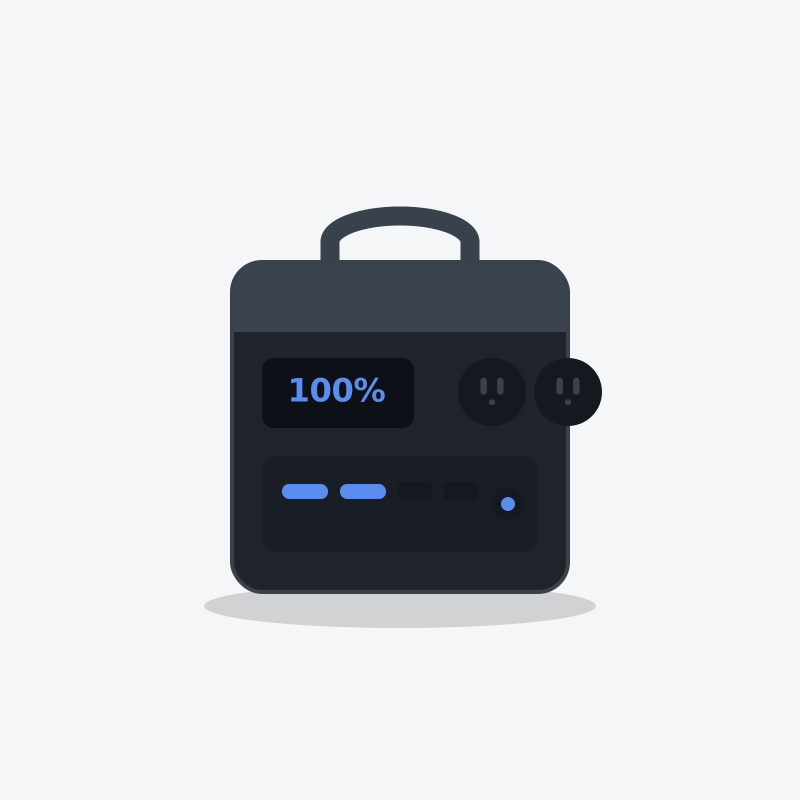
Anker SOLIX C300
The one you actually carry. Small, quiet, and built better than anything else this size.
- Capacity
- 288 Wh
- AC output
- 300W
- Weight
- 9.1 lb
What's good
- Built-in light that is actually useful, not a gimmick
- Three USB-C ports, one of them high wattage for laptops
- Charges from empty in about an hour
What's annoying
- 300W ceiling — this powers electronics, not appliances
- Small capacity disappears fast if you plug in anything with a motor
- Priced close to units with three times the capacity on sale
Who this is wrong for
Home backup. If your outage plan is a 288Wh box, you don't have an outage plan.
EcoFlow
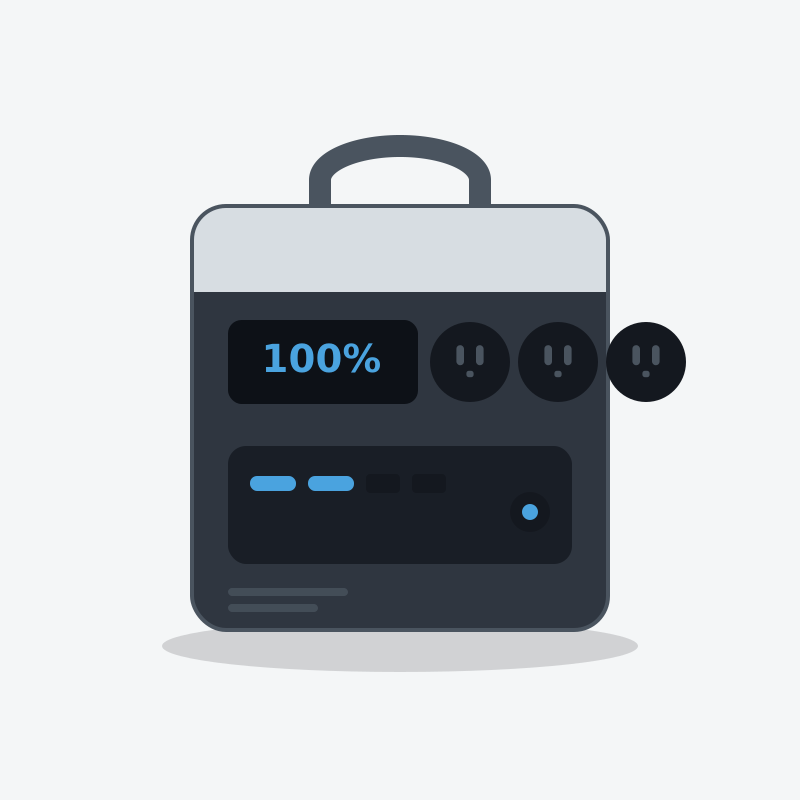
EcoFlow DELTA 2
The one most people should buy. It refills fast enough that a short sunny break between storm bands actually matters.
- Capacity
- 1,024 Wh
- AC output
- 1,800W
- Weight
- 27 lb
What's good
- Wall recharge is genuinely quick — useful when power flickers back for an hour
- LiFePO4 cells, so it tolerates being left plugged in for years
- Six AC outlets means no daisy-chained power strips on the kitchen counter
- Add an extra battery later instead of buying a whole second unit
What's annoying
- The fan is audible in a quiet bedroom at night
- 1800W ceiling rules out most space heaters and hair dryers
- Expansion batteries cost nearly as much as the unit itself
Who this is wrong for
Anyone who needs to power a well pump, an electric water heater or a central AC. It will not start them, and it is not a whole-home unit.
Questions people actually ask
Can you use a power station in an apartment?
Do I need a balcony or solar panels for a power station in an apartment?
What size power station makes sense for an apartment?
Will my landlord have a problem with a power station?
Is it safe to leave a power station charging in an apartment?
Who wrote this
Dhruvil Domadiya
Founder and editor, GreenCommuteGuide
I started GreenCommuteGuide because backup power is sold with numbers that sound impressive and mean very little — watt-hours on the box, surge ratings that turn out to be a boost mode, charge times quoted to 80% and printed as though they were full. I set the rules this site runs on: every spec is checked against the manufacturer's own documentation, anything we have not verified is marked as unverified on the page rather than quietly published, prices are never shown because they go stale, and every review names at least one product not to buy and who it is wrong for. Where I have not tested something myself, the page says so.
- · Sets and enforces the editorial standards on this site — unverified claims are flagged on the page, and the build fails if they are not
- · Specs are taken from manufacturers' own published documentation, never from retailer listings, and the source and date are recorded for each product
- · No payment is accepted for a rating, a ranking, or a positive verdict
Read this next
- Battery & Tech BasicsIs It Safe to Use a Power Station Indoors?Yes, and that is the entire reason they beat gas generators. Here are the four real risks, and the one that actually kills people.
- Home Outage & BackupBest Budget Power Stations Under $500At this money you are buying a convenience, not a backup plan. Here is what that actually covers, and who should save up instead.
- Run This ApplianceBattery Backup for a WiFi Router and Modem: How Long Do You Stay Online?A router and modem draw about 20 watts, so even a small battery runs your wifi for a day or more. The catch is whether your ISP still has power at their end — and how to test that before you spend.
- Run This ApplianceModem Battery Packs: Are the Dedicated Ones Worth It?The purpose-built ones look like the obvious answer and usually aren't. What they hold, what a small power station holds for the same money, and when the dedicated box actually wins.