Home Outage & Backup
Payback Math: How Many Outages Before Backup Power Pays For Itself?
Four numbers, five minutes, and an answer specific to your house. For a lot of people the honest result is 'buy the ice instead' — and we would rather tell you that.
We earn a commission on purchases made through links on this page, at no extra cost to you. How this works.
What's in this article
Number 1: How often does your power actually go out?
Not how often you worry about it. How often it happened.
Count the outages over four hours long since 2020. Six years. If you cannot remember, that itself is data — it means the answer is close to zero.
Divide by six. That is your outages per year. For most American suburbs it lands between 0.3 and 2. In parts of Texas, Louisiana, Michigan and rural New England it is meaningfully higher.
Your utility publishes reliability statistics, and many outage maps keep a history. If you want a real number rather than a memory, that is where to find it.
Number 2: What does one outage cost you?
Add up what you actually lose in a typical event:
| Item | Typical cost |
|---|---|
| Fridge + freezer contents (family of four) | $300–$800 |
| One night in a hotel | $120–$250 |
| Eating out for two days | $80–$200 |
| Lost work day (if you work from home) | your day rate |
| Refilling prescriptions spoiled | varies |
| Bag of ice, twice | $10 |
For a short outage where you keep the doors shut, the honest answer is often under $50. For a two-day outage in summer with a full freezer, it is $400–$900.
Insurance usually does not rescue you here, because the common exclusion is off-premises power failure and the deductible eats what is left. Details here.
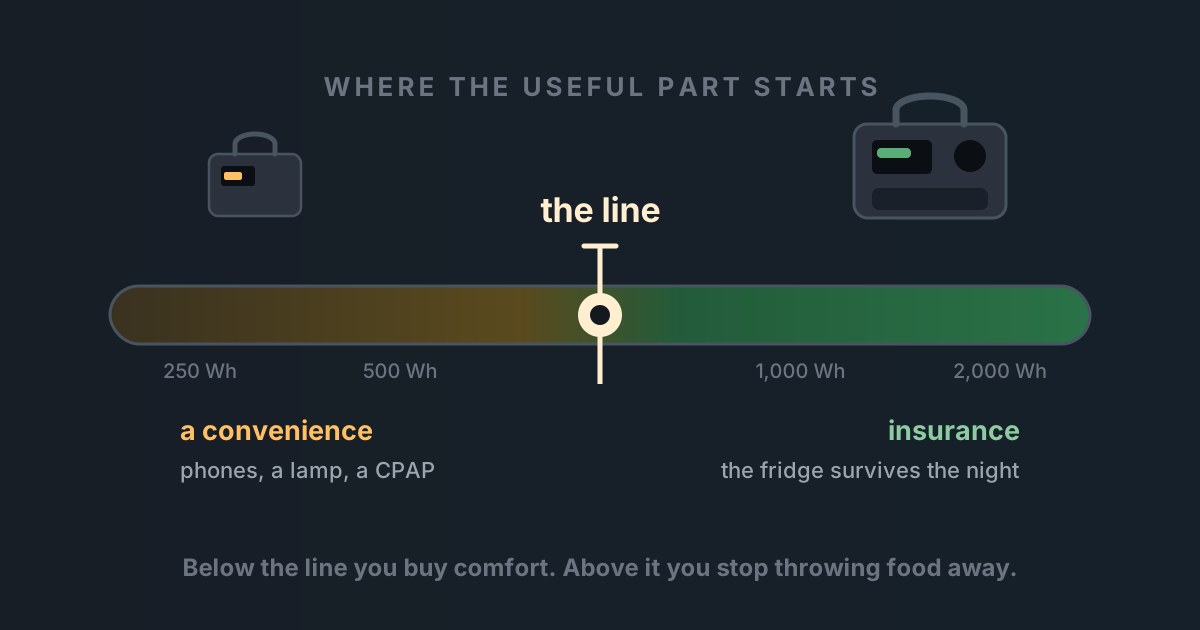
Number 3: What does the equipment cost?
Round numbers for the tiers on this site:
| Tier | Cost | What it does |
|---|---|---|
| Small (300–500Wh) | $200–$400 | Phones, router, CPAP, fans |
| Mid (1,000Wh + 1,500W) | $600–$900 | Fridge, furnace blower, all of the above |
| Large (2,000–4,000Wh) | $1,500–$3,500 | Add well pump, longer runtime, 240V |
| Whole home installed | $10,000+ | The house, professionally wired |
Add a panel ($200–$500) if you want multi-day capability.
Number 4: How long does it last?
A LiFePO4 unit rated for 3,000+ cycles, used a handful of times a year and stored properly, will last well past ten years. Something else usually fails first — see How Long Do Solar Generators Actually Last?
Use 10 years as a planning figure. It is conservative for the cells and realistic for the electronics.
Now do the sum
(Outages per year) × (cost per outage) × 10 years vs. equipment cost
Three worked examples:
The suburban house that rarely loses power. 0.4 outages/year × $150 × 10 = $600 avoided against a $700 unit. Roughly break-even after a decade. The math says this is a comfort purchase, not an investment. That is a fine reason to buy — just know which one you are making.
The Texas or Michigan household. 2 outages/year × $450 × 10 = $9,000 avoided against a $900 unit. Ten times over. This is not close, and if you are in this group and have not bought anything, you are choosing to lose money.
The rural well-water household. 1.5 outages/year × $700 (food, plus no water at all, plus a hotel) × 10 = $10,500 against a $2,500 large unit and pump setup. Clearly worth it — and the water is why, not the food. See Can You Run a Well Pump on a Solar Generator?
The things the sum leaves out
Money is not the only axis, and pretending otherwise would be dishonest in both directions.
Buy regardless of the math if: someone in the house depends on powered medical equipment, or refrigerated medication, or you have an infant, or you are on a well, or you are elderly and cannot easily leave in a heat event. Those are safety purchases and the payback calculation does not apply. It never did.
Do not buy if: the answer above came out negative and none of those apply. Spend the money on a chest freezer full of frozen water jugs, a good cooler, headlamps and a $50 hand-crank radio. That kit costs a fifth as much and covers the four-hour outage that is the only kind you get.
We would rather write that sentence than sell you a battery.
The cheapest version that works
If the math is marginal and you want something:
- $40 — headlamps, a battery radio, a fridge thermometer, frozen water jugs
- $250 — a 300Wh unit for phones, router and a fan
- Stop there until you have had an outage that made you wish for more
That is the honest ladder. Most people should be on the second rung, and the industry would prefer you started on the fourth.
The short version
- Count real outages since 2020 and divide by six. Memory is not data; the number usually surprises people.
- One short outage costs under $50. A two-day summer outage costs $400–$900.
- Multiply, compare to equipment cost over ten years, and read the result honestly.
- Buy regardless of the math for medical needs, infants, well water, or if leaving is hard.
- If the math says no, buy the $40 kit and a cooler instead.
The picks, in detail
Specs come from data/products.json, so they're the same everywhere on this site.
EcoFlow
EcoFlow DELTA 2
The one most people should buy. It refills fast enough that a short sunny break between storm bands actually matters.
- Capacity
- 1,024 Wh
- AC output
- 1,800W
- Weight
- 27 lb
What's good
- Wall recharge is genuinely quick — useful when power flickers back for an hour
- LiFePO4 cells, so it tolerates being left plugged in for years
- Six AC outlets means no daisy-chained power strips on the kitchen counter
- Add an extra battery later instead of buying a whole second unit
What's annoying
- The fan is audible in a quiet bedroom at night
- 1800W ceiling rules out most space heaters and hair dryers
- Expansion batteries cost nearly as much as the unit itself
Who this is wrong for
Anyone who needs to power a well pump, an electric water heater or a central AC. It will not start them, and it is not a whole-home unit.
Anker
Anker SOLIX C300
The one you actually carry. Small, quiet, and built better than anything else this size.
- Capacity
- 288 Wh
- AC output
- 300W
- Weight
- 9.1 lb
What's good
- Built-in light that is actually useful, not a gimmick
- Three USB-C ports, one of them high wattage for laptops
- Charges from empty in about an hour
What's annoying
- 300W ceiling — this powers electronics, not appliances
- Small capacity disappears fast if you plug in anything with a motor
- Priced close to units with three times the capacity on sale
Who this is wrong for
Home backup. If your outage plan is a 288Wh box, you don't have an outage plan.
Questions people actually ask
Is backup power worth it?
How do I work out the payback on a power station?
How much does one power outage cost?
What is the cheapest version that works?
Who wrote this
Dhruvil Domadiya
Founder and editor, GreenCommuteGuide
I started GreenCommuteGuide because backup power is sold with numbers that sound impressive and mean very little — watt-hours on the box, surge ratings that turn out to be a boost mode, charge times quoted to 80% and printed as though they were full. I set the rules this site runs on: every spec is checked against the manufacturer's own documentation, anything we have not verified is marked as unverified on the page rather than quietly published, prices are never shown because they go stale, and every review names at least one product not to buy and who it is wrong for. Where I have not tested something myself, the page says so.
- · Sets and enforces the editorial standards on this site — unverified claims are flagged on the page, and the build fails if they are not
- · Specs are taken from manufacturers' own published documentation, never from retailer listings, and the source and date are recorded for each product
- · No payment is accepted for a rating, a ranking, or a positive verdict
Read this next
- Battery & Tech BasicsIs a Solar Generator Worth It? The Honest MathIt depends on one number: how often your power actually goes out. Here is the arithmetic, including the cases where the answer is no.
- Home Outage & BackupDoes Homeowners Insurance Cover Food Spoiled in an Outage?Sometimes — and the deciding factor is usually where the power failed, not how much food you lost. Here is how to check your own policy in about four minutes.
- Sizing & CalculatorsWhat Size Solar Generator Do I Need? (Free Calculator)Skip the guesswork. Tick the things you need to keep running, get a real watt-hour number, and see which units can actually do it.
- Home Outage & BackupRun a Blackout Drill: Test Your Backup Before You Need ItTwo hours on a Saturday tells you more than any review. Kill the main breaker, start the clock, and find out what you actually own.