Home Outage & Backup
Best Budget Power Stations Under $500
At this money you are buying a convenience, not a backup plan. Here is what that actually covers, and who should save up instead.
We earn a commission on purchases made through links on this page, at no extra cost to you. How this works.
What's in this article
Five hundred dollars is a real amount of money. So let's be straight about what it buys, because a lot of articles in this bracket quietly imply it buys more than it does.
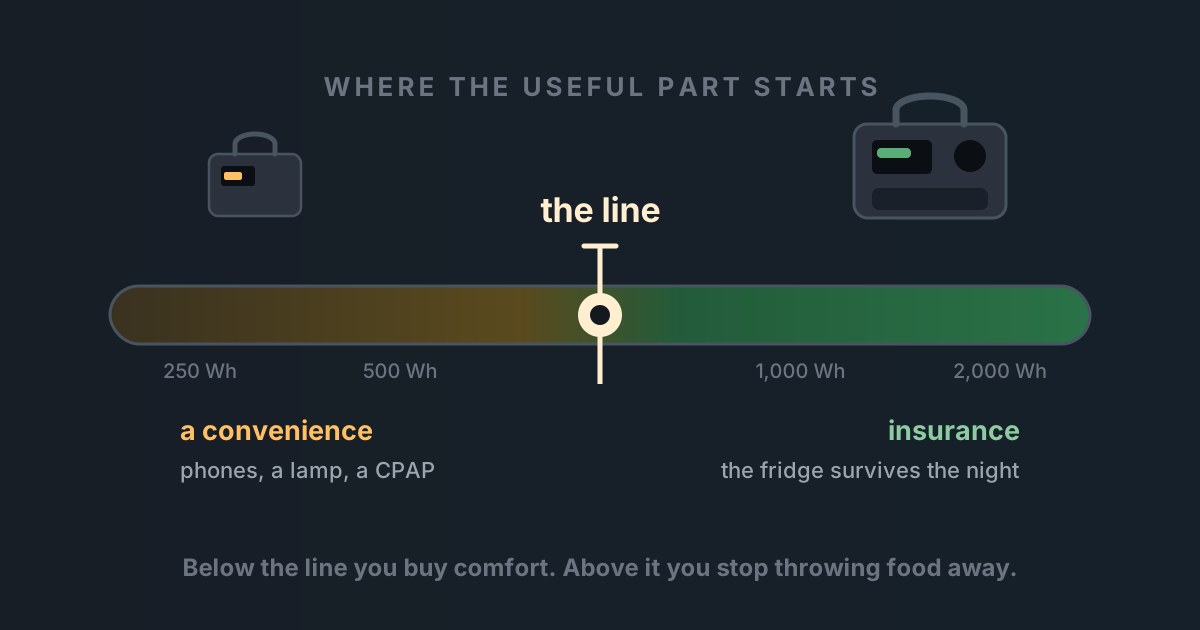
Under $500 you are buying a convenience. Phones charged, lights on, internet up, CPAP running.
You are not buying food insurance. That line sits around a thousand dollars and no amount of clever shopping moves it.
If that's disappointing, better to hear it now than on day two of an outage with a fridge full of spoiled groceries.
The short version
In a hurry? Find your row and go. The details are below if you want them.
Best Overall
Most people, most outages
Anker SOLIX C300
288 Wh · 300W · 9.1 lb
Best Budget
Phones and a CPAP, nothing more
Anker SOLIX C300
288 Wh · 300W · 9.1 lb
Best for RV
Fits the bay, survives the road
Anker SOLIX C1000
1,056 Wh · 1,800W · 28.44 lb
Best Whole-Home
Well pump, furnace, 240V circuits
EcoFlow DELTA Pro 3
4,096 Wh · 4,000W · 113 lb
Specs unverified
What this money genuinely covers
Two phones, a laptop, a room of LED lights, a router and modem, and a CPAP with the humidifier off.
That's not nothing. That's the difference between a dark house where nobody can call anyone and a dark house where everything important still works.
| Appliance | Anker SOLIX C300288 Wh |
|---|---|
| Phones and a laptop~65W running, cycles ~50% of the time | 7.5 hr |
| LED lights (whole room)~40W running | 6.1 hr |
| Wi-Fi router + modem~20W running | 12 hr |
| CPAP (no humidifier)~40W running | 6.1 hr |
| Full-size refrigerator~150W running, cycles ~35% of the time | Won't start it |
Look at the fridge row. That's the honest answer to the question everyone actually wants to ask.
What we'd buy
Best overall here: Anker SOLIX C300
288Wh, about nine pounds, and better assembled than anything else at this size. verify
Three USB-C ports — one high-wattage — covers a modern kit without a bag of adapters. The built-in light is genuinely useful rather than a spec-sheet tick, and it means one less thing to find in the dark.
Refills to 80% in 50 minutes from the wall. Anker doesn't publish a 0–100% time, so we won't invent one.
Who it's wrong for: anyone whose real problem is the fridge. It's a good product being asked to do a job it can't. If food is the worry, save up.
Friendliest: Jackery Explorer 300 Plus
Under nine pounds, no app required, and an interface that explains itself.
If you're buying for a parent or for someone who doesn't enjoy figuring out devices, this is the one that actually gets used instead of sitting in a cupboard at 40 percent.
Who it's wrong for: anyone who needs more than one AC outlet. There is exactly one, and with four people in the house that becomes a negotiation.
If you can stretch: anything around 700–800Wh
Roughly three times the capacity of the two above. That is the size that runs a CPAP with the humidifier on, or goes two nights without it.
Units in this range sometimes drop into this bracket during a sale. If one does, take it — the extra capacity is the most useful money you can spend at this end of the market.
Who it's wrong for: somebody who genuinely only needs phones and a lamp. You'd be paying for capacity you'll never touch.
What we would not buy
Unbranded units at suspiciously low prices. You cannot verify cell quality after the fact, and a bad lithium pack is not the same kind of failure as a bad toaster. Established brands have reputations to lose. A store name made of three random syllables does not.
Anything advertising huge capacity for this money. Check the chemistry and the output wattage. Big capacity paired with a 300W inverter is a big tank with a tiny tap.
Two small units instead of one bigger one. You can't combine their output. Two 300W units still won't start a fridge — you'd have spent $600 to solve nothing.
Lead-acid jump starters. They advertise big numbers, deliver far less usable energy than the label implies, hate deep discharge, and die after a couple of years sitting.
Exactly where the wall is
It is worth being precise about what this budget cannot reach, because the boundary is sharper than most buying guides admit.
| What you want to run | Under $500? | Why |
|---|---|---|
| Phones, tablets, laptop | Yes, for days | Tiny loads. This is what these units are for. |
| Router and modem overnight | Yes, comfortably | Around 10–20W. Almost free. |
| LED lights, all evening | Yes | A few watts each. |
| CPAP, humidifier off | Yes, one night | Roughly 30–60W. verify |
| CPAP with humidifier | Borderline | The heater can triple the draw. Needs the top of this bracket. |
| Full-size fridge | No | Not capacity — surge. Most units here cannot start the compressor. |
| Space heater, kettle, microwave | No | 1,000–1,500W against a 300W inverter. Not close. |
| Well pump, AC, dryer | No | Out of reach for this whole product category, at any budget. |
The line runs between the CPAP row and the fridge row, and it is not a money problem you can shop your way around at this level. It is a surge problem — a fridge compressor spikes to roughly 900W for under a second, verify and a 300W inverter cannot supply that no matter how many watt-hours sit behind it.
What you give up at this price
Not defects — deliberate trade-offs that make the price possible. Worth knowing which ones you will actually notice.
Inverter size. The biggest one, and the one that decides what you can run at all.
Expansion. Nothing in this bracket takes an add-on battery. What you buy is what you have, permanently.
UPS switchover. Higher-end units take over in under 20ms, fast enough that a desktop never reboots. Budget units often have no pass-through at all, so a desktop or a sump pump sees the gap.
Recharge speed. An hour on a mid-range unit; several on some budget ones. This matters more than it sounds during a flickering multi-day outage, where a short window of grid power is your chance to refill.
Ports. One AC outlet instead of four or six. With a family, that becomes a queue.
App and display. Often a few LEDs rather than a real readout. You lose the ability to see actual watts drawn, which is the number that tells you whether you are about to trip it.
What you generally do not give up any more is chemistry. LiFePO4 has reached this price point, and there is little reason to accept older lithium-ion for the sake of a small saving — the difference in lifespan is large.
Who should skip this bracket entirely
If your honest goal is "I don't want to lose $400 of groceries again," then nothing on this page solves your problem, and buying one of these will feel like a waste in about eight months.
Wait, save, and buy a 1,000Wh unit with at least 1,800W output. It's the single most worthwhile upgrade in this whole category, and this category discounts hard several times a year.
Buying the right thing late beats buying the wrong thing now. Our under-$1,000 picks cover that bracket, and the outage guide explains why 1kWh is the size that changes the night.
If food is genuinely the worry and the budget is genuinely fixed, spend nothing here at all: a cooler and a bag of ice bought before the storm outperforms every unit on this page for keeping food safe. We wrote out how to do that properly.
Straight answer
Around 250–300Wh from a brand you've heard of. That's the sensible buy under $500, and for phones, lights, internet and a CPAP it's genuinely enough.
Just don't let anyone — including us — tell you it protects your food.
The picks, in detail
Specs come from data/products.json, so they're the same everywhere on this site.
Anker
Anker SOLIX C300
The one you actually carry. Small, quiet, and built better than anything else this size.
- Capacity
- 288 Wh
- AC output
- 300W
- Weight
- 9.1 lb
What's good
- Built-in light that is actually useful, not a gimmick
- Three USB-C ports, one of them high wattage for laptops
- Charges from empty in about an hour
What's annoying
- 300W ceiling — this powers electronics, not appliances
- Small capacity disappears fast if you plug in anything with a motor
- Priced close to units with three times the capacity on sale
Who this is wrong for
Home backup. If your outage plan is a 288Wh box, you don't have an outage plan.
Jackery
Jackery Explorer 300 Plus
Specs unverifiedA laptop-and-phones box. Honest about what it is, which is refreshing.
- Capacity
- 288 Wh
- AC output
- 300W
- Weight
- 8.27 lb
What's good
- Under 9 lb, so it goes in a backpack without a fight
- LiFePO4 at this size and price is not a given
- Silent under light loads
What's annoying
- One AC outlet
- 300W means no kettle, no toaster, no coffee maker
- Not a backup plan — it's a convenience
Who this is wrong for
Anything with a heating element or a motor. It will trip and you'll be annoyed.
Questions people actually ask
Can a power station under $500 run a refrigerator?
What can a 300Wh power station actually run?
Is a cheap power station worth buying at all?
Should I buy two small ones instead of one big one?
Do budget units use good batteries?
Who wrote this
Dhruvil Domadiya
Founder and editor, GreenCommuteGuide
I started GreenCommuteGuide because backup power is sold with numbers that sound impressive and mean very little — watt-hours on the box, surge ratings that turn out to be a boost mode, charge times quoted to 80% and printed as though they were full. I set the rules this site runs on: every spec is checked against the manufacturer's own documentation, anything we have not verified is marked as unverified on the page rather than quietly published, prices are never shown because they go stale, and every review names at least one product not to buy and who it is wrong for. Where I have not tested something myself, the page says so.
- · Sets and enforces the editorial standards on this site — unverified claims are flagged on the page, and the build fails if they are not
- · Specs are taken from manufacturers' own published documentation, never from retailer listings, and the source and date are recorded for each product
- · No payment is accepted for a rating, a ranking, or a positive verdict
Read this next
- Home Outage & BackupBest Solar Generators Under $1,000This is the bracket where backup power stops being a toy and starts saving your food. Here is what to get, and the trap to avoid.
- Run This ApplianceBest Solar Generator for a CPAP MachineYou need one night, not a whole house. Turn the humidifier off and a small battery does the job for a fraction of what people tell you to spend.
- RV, Camping & Off-GridBest Portable Power Station for CampingThe one you carry beats the one with better specs. Here is what size actually makes sense for a weekend, and what most people over-buy.
- Sizing & CalculatorsWhat Size Solar Generator Do I Need? (Free Calculator)Skip the guesswork. Tick the things you need to keep running, get a real watt-hour number, and see which units can actually do it.