Home Outage & Backup
Best Solar Generators Under $1,000
This is the bracket where backup power stops being a toy and starts saving your food. Here is what to get, and the trap to avoid.
We earn a commission on purchases made through links on this page, at no extra cost to you. How this works.
What's in this article
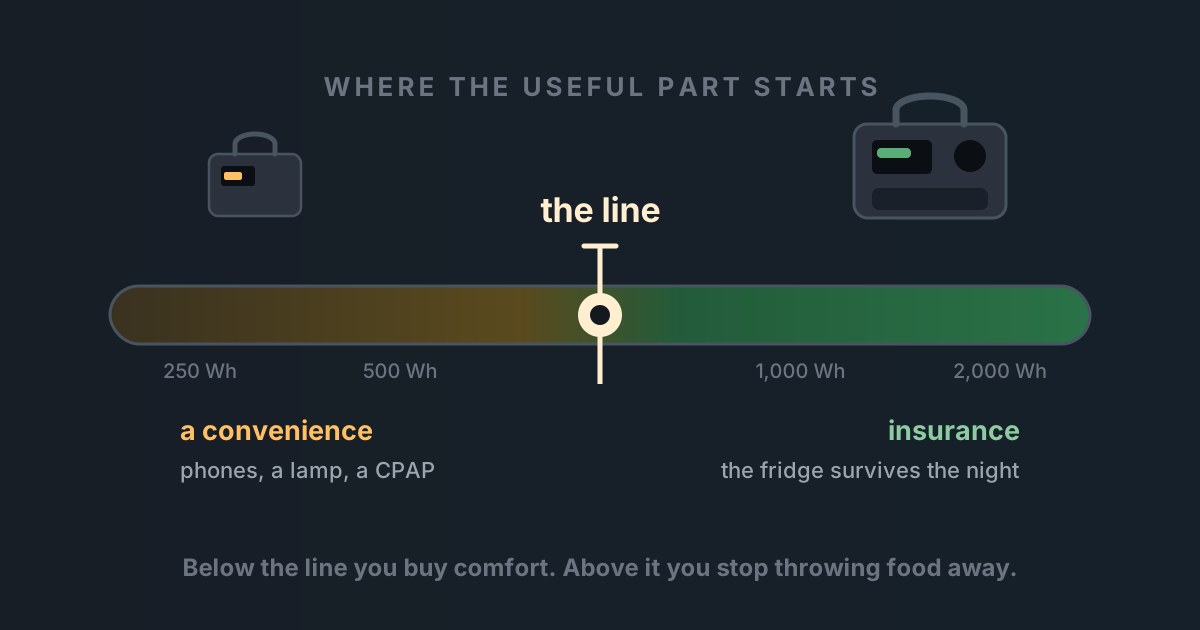
Under five hundred dollars you're buying a convenience. Somewhere around a thousand you're buying a fridge that stays cold.
That's the honest line, and it's the reason this price bracket matters more than any other. This is where a power station stops being a gadget and starts being insurance.
If you want the answer now
In a hurry? Find your row and go. The details are below if you want them.
Best Overall
Most people, most outages
EcoFlow DELTA 2
1,024 Wh · 1,800W · 27 lb
Best Budget
Phones and a CPAP, nothing more
Anker SOLIX C300
288 Wh · 300W · 9.1 lb
Best for RV
Fits the bay, survives the road
Anker SOLIX C1000
1,056 Wh · 1,800W · 28.44 lb
Best Whole-Home
Well pump, furnace, 240V circuits
EcoFlow DELTA Pro 3
4,096 Wh · 4,000W · 113 lb
Specs unverified
What this money buys
Roughly 1,000 watt-hours, 1,800 watts of output, and LiFePO4 cells rated for thousands of cycles.
In practice: your fridge through the night, your internet, everyone's phones, a couple of lamps, and a fan in summer. verify
That is most of what an outage actually costs you.
What it does not buy: heating, air conditioning, a well pump, an electric range. Those live in a different price bracket entirely, and anyone selling you a 1kWh unit as a whole-home solution is overselling.
The pick for most people: EcoFlow DELTA 2
The recharge speed is what earns it the top slot.
About eighty minutes from a wall outlet. verify That sounds like a spec-sheet detail until the grid comes back for an hour mid-outage and this thing nearly refills while slower units barely move.
Six AC outlets means no daisy-chained power strips on the counter when you're running a fridge, a modem, a lamp and two chargers.
And it takes an expansion battery later, so a bad winter doesn't mean starting over.
Who should skip it: anyone whose actual worry is a well pump. It cannot start one. Also anyone who won't install the app — a lot of the value lives there.
Best built: Anker SOLIX C1000
The most compact 1kWh unit here, and the best assembled. verify
The size matters more than it sounds. If this lives in a closet, an RV bay or under a stair, the C1000 fits where the others make you rearrange things.
Anker's warranty service is also the least painful of the big four, and on a product you might not really need for three years, that's not a soft factor.
Who should skip it: anyone planning to expand. It tops out around 2kWh and the expansion battery costs enough that you'd have been better buying bigger up front.
Most capacity for the money: Bluetti AC180
More watt-hours and a stronger surge rating than the famous brands, usually for less. verify
The surge part matters — that's what actually starts a fridge compressor without tripping.
The trade is polish. Bluetti's app has historically been the weakest of the big four and the documentation assumes you'll work things out.
Who should skip it: first-time buyers who want the device to explain itself. That's a real need and Bluetti doesn't serve it well.
Easiest to live with: Jackery Explorer 1000 v2
Lighter than most rivals, with a handle built for a hand and a screen that talks in plain language.
If you're buying this for a parent, or for anyone who doesn't enjoy figuring out devices, this is the one that gets used instead of sitting in a closet at 40 percent.
Who should skip it: spec shoppers. Three AC outlets, no expansion path, and you pay a premium for the friendliness. That's a fair trade only if you want the friendliness.
Swipe the table sideways to see every column.
| Price | |||||||
|---|---|---|---|---|---|---|---|
| BluettiBluetti AC180LiFePO4 · expandable | 1,152 Wh | 1,800W | 2,700W | 35.3 lb | 1h 48m | 5 yr | Check price for Bluetti AC180 (opens in a new tab, affiliate link) |
| JackeryJackery Explorer 1000 v2LiFePO4 | 1,070 Wh | 1,500W | 3,000W | 23.8 lb | 1 hr | 5 yr | Check price for Jackery Explorer 1000 v2 (opens in a new tab, affiliate link) |
| AnkerAnker SOLIX C1000LiFePO4 · expandable | 1,056 Wh | 1,800W | 2,400W | 28.44 lb | 58 min | 5 yr | Check price for Anker SOLIX C1000 (opens in a new tab, affiliate link) |
| EcoFlowEcoFlow DELTA 2LiFePO4 · expandable | 1,024 Wh | 1,800W | 2,700W | 27 lb | 1h 20m | 5 yr | Check price for EcoFlow DELTA 2 (opens in a new tab, affiliate link) |
Specs come from data/products.json. Capacity is the figure on the box — real usable output is roughly 85% of it once you account for inverter losses.
What we would not buy at this price
Any NMC lithium-ion unit, whatever the badge on it.
This bracket still contains older-chemistry units — often from long-established names — offering more watt-hours for the same money. The capacity is real. The trade is not worth it.
NMC packs are commonly rated around 500 cycles against 3,000-plus for LiFePO4. verify They also dislike sitting at 100% for years, which is precisely the job of a backup unit — it lives plugged in, full, waiting. That is the worst possible duty cycle for the chemistry.
The tell is usually on the spec sheet rather than the marketing: a cycle rating in the hundreds rather than the thousands, a wall recharge measured in many hours rather than one, and a two-year warranty where the LiFePO4 competition offers five.
When is an older unit still defensible? Two cases, genuinely. If you already own that brand's panels and accessories and want them to keep working. And if a long-established company with real US service matters more to you than the spec sheet. Both are real reasons. Neither applies to most people reading this.
At this budget you have a genuine choice, and there is no good reason to accept 500-cycle chemistry. The full comparison is here.
The 1,500Wh trap
You'll see units in this bracket advertising much higher capacity for the same money.
Check two things before you get excited.
Chemistry. Cheap capacity is usually NMC. You're buying a battery that ages faster and doesn't like sitting at full charge — which is the entire job of a backup unit.
Output wattage. Some big-capacity budget units pair a large battery with a small inverter. Big tank, small tap. A 2,000Wh unit with 1,000W output is worse for outage backup than a 1,000Wh unit with 1,800W output.
What each price step actually gets you
The bracket is not one price. It is roughly three, and the jumps are not evenly useful.
Around $400–500. 250–500Wh. Phones, lights, router, a CPAP with the humidifier off. Not a fridge — the inverter is usually too small to start a compressor at all. Covered properly in what you can get under $500.
Around $600–700. This is where 1,000Wh and an 1,800W inverter appear, and it is the single most valuable step in the whole category. Crossing it changes what the unit can do, not just how long it does it — a fridge becomes possible. Below this line you are buying a phone charger; above it you are buying outage backup.
Around $800–1,000. Roughly the same capability, better executed. Faster wall recharge, more outlets, better app, longer warranty, sometimes an expansion port. Real improvements to living with the thing, but they do not change what it runs.
Runner-ups worth knowing about
The four above are what we would buy. Three others come up constantly and deserve a straight answer.
A 2kWh unit on sale. More capacity is a genuine step up and normally sits above this bracket. If one falls into it during a sale it is a good buy — with the caveat that around 50 lb it stops being something you move casually.
Bluetti AC200L. Double the capacity of the AC180 and more outlets. Normally above this budget. Worth watching if two-day outages are your actual worry rather than overnight ones.
Anything around 700-800Wh. Sometimes drops into the low end of this bracket, and if what you need is a CPAP and a router rather than a fridge, it is enough and it is much lighter to live with.
What changes the answer
The four picks assume a fairly typical household. Four things override them.
You have a well pump. Nothing in this bracket starts one. That is a 4,000Wh, 240V decision and a much larger budget — we set out why.
Someone depends on medical equipment. Runtime becomes a safety margin rather than a convenience, and the sizing logic changes. See backup for medical equipment.
Your outages routinely run past two days. Capacity stops being the constraint and recharging becomes it. Spend part of the budget on solar panels rather than all of it on the battery.
It is mostly going camping. Buy for weight instead — a 25 lb unit is a very different object at a campsite. The camping picks are a different shortlist.
What we'd do with a thousand dollars
Buy a 1,000Wh LiFePO4 unit with at least 1,800W output, and leave it plugged in permanently.
Then, if there's money left, buy a 200W folding solar panel rather than a bigger battery. Past a day, recharging matters more than capacity — a big battery you can't refill just runs out later.
And wait for a sale if you're not in an emergency. This category discounts hard and often.
One last thing worth saying plainly: the unit that is always charged beats the bigger unit in the garage at 40 percent. Whichever you buy, leave it plugged in. That single habit does more for your actual outage outcome than any spec on this page.
The picks, in detail
Specs come from data/products.json, so they're the same everywhere on this site.
EcoFlow
EcoFlow DELTA 2
The one most people should buy. It refills fast enough that a short sunny break between storm bands actually matters.
- Capacity
- 1,024 Wh
- AC output
- 1,800W
- Weight
- 27 lb
What's good
- Wall recharge is genuinely quick — useful when power flickers back for an hour
- LiFePO4 cells, so it tolerates being left plugged in for years
- Six AC outlets means no daisy-chained power strips on the kitchen counter
- Add an extra battery later instead of buying a whole second unit
What's annoying
- The fan is audible in a quiet bedroom at night
- 1800W ceiling rules out most space heaters and hair dryers
- Expansion batteries cost nearly as much as the unit itself
Who this is wrong for
Anyone who needs to power a well pump, an electric water heater or a central AC. It will not start them, and it is not a whole-home unit.
Anker
Anker SOLIX C1000
The best-built 1kWh unit on the market, and the one that fits an RV bay without a shoehorn.
- Capacity
- 1,056 Wh
- AC output
- 1,800W
- Weight
- 28.44 lb
What's good
- The most compact 1kWh box here — it genuinely fits where others don't
- Anker's warranty service is the least painful in this category
- Full wall recharge in under an hour
- Quiet fan behaviour under moderate load
What's annoying
- Expansion battery caps you at about 2,112Wh and is expensive
- Fewer solar input options than EcoFlow
- Anker discounts less often, so you rarely catch a deep sale
Who this is wrong for
People who need to run more than 1800W. And it won't grow with you — expansion is limited.
Bluetti
Bluetti AC180
More watts per dollar than the famous brands, if you don't mind a slightly clunkier app.
- Capacity
- 1,152 Wh
- AC output
- 1,800W
- Weight
- 35.3 lb
What's good
- 2,700W of surge headroom, which is what actually starts a fridge compressor
- More capacity than the Jackery 1000 for often less money
- Takes expansion batteries, so it can grow to a serious bank later
- Quiet charging mode keeps it civilised in a bedroom
What's annoying
- 35 lb is heavy for 1.1kWh
- The app has historically been the weakest of the four big brands
- Full wall recharge is slower than the headline number suggests - the fast figure everyone quotes is to 80%, not full
- Only one USB-C port
Who this is wrong for
Anyone who wants hand-holding. Bluetti's documentation assumes you'll figure it out.
Jackery
Jackery Explorer 1000 v2
The friendliest unit here for someone who has never owned a battery. Buttons make sense, the screen makes sense.
- Capacity
- 1,070 Wh
- AC output
- 1,500W
- Weight
- 23.8 lb
What's good
- Lighter than most 1kWh rivals, and the handle is genuinely comfortable
- The interface explains itself — no manual needed
- US support is easy to reach compared with smaller brands
What's annoying
- Only three AC outlets
- No expansion battery option at all
- You pay a premium for the brand name and the friendly design
Who this is wrong for
Spec chasers. You can get more watts per dollar elsewhere, and Jackery knows it.
Questions people actually ask
What can a $1,000 solar generator actually run?
Is 1000Wh enough for a house?
Should I spend less and get 500Wh?
Do prices drop enough to wait for a sale?
LiFePO4 or not at this price?
Who wrote this
Dhruvil Domadiya
Founder and editor, GreenCommuteGuide
I started GreenCommuteGuide because backup power is sold with numbers that sound impressive and mean very little — watt-hours on the box, surge ratings that turn out to be a boost mode, charge times quoted to 80% and printed as though they were full. I set the rules this site runs on: every spec is checked against the manufacturer's own documentation, anything we have not verified is marked as unverified on the page rather than quietly published, prices are never shown because they go stale, and every review names at least one product not to buy and who it is wrong for. Where I have not tested something myself, the page says so.
- · Sets and enforces the editorial standards on this site — unverified claims are flagged on the page, and the build fails if they are not
- · Specs are taken from manufacturers' own published documentation, never from retailer listings, and the source and date are recorded for each product
- · No payment is accepted for a rating, a ranking, or a positive verdict
Read this next
- Home Outage & BackupBest Solar Generators for Power Outages in 2026Which battery actually gets your family through the night, which one is a waste of money, and how to tell the difference before you spend.
- Home Outage & BackupBest Budget Power Stations Under $500At this money you are buying a convenience, not a backup plan. Here is what that actually covers, and who should save up instead.
- Brand vs BrandJackery Explorer 1000 v2 vs EcoFlow Delta 2: Which One Wins?Two 1kWh batteries, nearly the same money. One is friendlier, one refills three times faster. Here is which one belongs in your house.
- Sizing & CalculatorsWhat Size Solar Generator Do I Need? (Free Calculator)Skip the guesswork. Tick the things you need to keep running, get a real watt-hour number, and see which units can actually do it.